Eostre Myth Meaning & Symbolism
A myth of the dawn goddess whose return from the underworld brings light, life, and the promise of cyclical renewal to a frozen world.
The Tale of Eostre
Listen. The world is held in the iron grip of the Cailleach, the bone-white Crone of Winter. Her breath is the north wind that silences the birds. Her cloak is the deep snow that smothers the hills. All is silent, all is still, and the sun is a pale, weak coin lost in a grey vault of sky. Life sleeps a death-like sleep, and memory of green things fades to a dream.
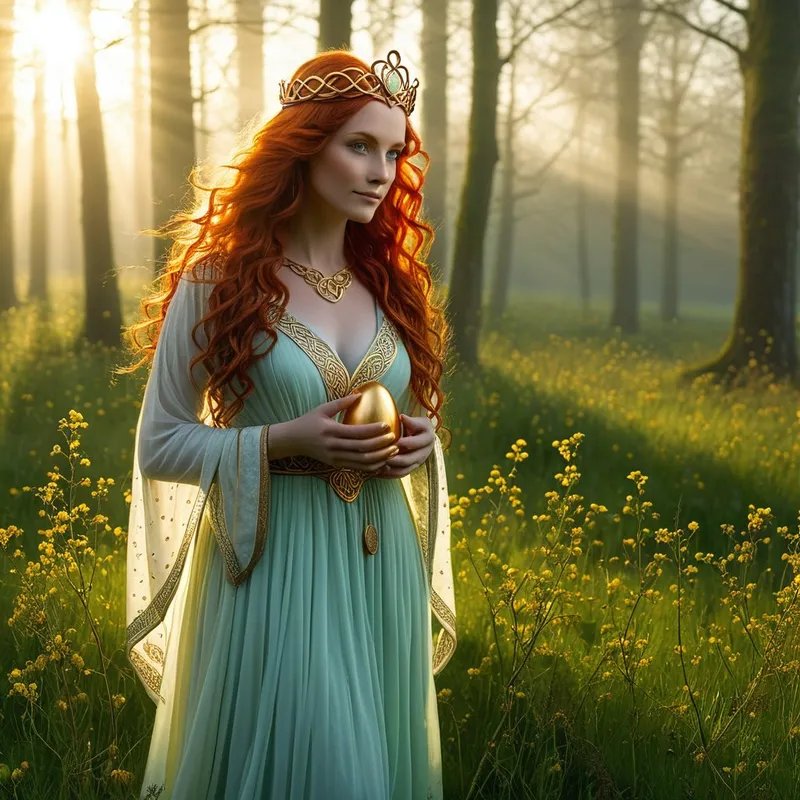
But beneath the roots of the great oak, in the dark, warm belly of the earth, another power stirs. She is Eostre. They say her hair is the first light that gilds the edge of night, and her eyes hold the forgotten blue of the summer sky. She is the promise, the turning of the wheel. Yet she is bound, not by chains, but by the deep, necessary rhythm of things. Her time in the underworld is a gestation, a gathering of potency.
The crisis comes not with a bang, but with a profound, collective sigh from the land itself. The cold has lasted too long. The Cailleach has grown weary in her sovereignty, her magic thinning like old ice. A stillness, deeper than mere quiet, falls. It is the pause before the return.
And Eostre feels the call. It is not a sound, but a pull in the blood, a quickening in the dark soil. She begins her ascent. Not as a warrior, but as a sleeper awakening. She moves through the labyrinth of roots and stone, and where her fingers brush the earth, a faint, vital warmth spreads. She finds a narrow passage, a crack in the world’s foundation, slick with meltwater and the scent of damp clay.
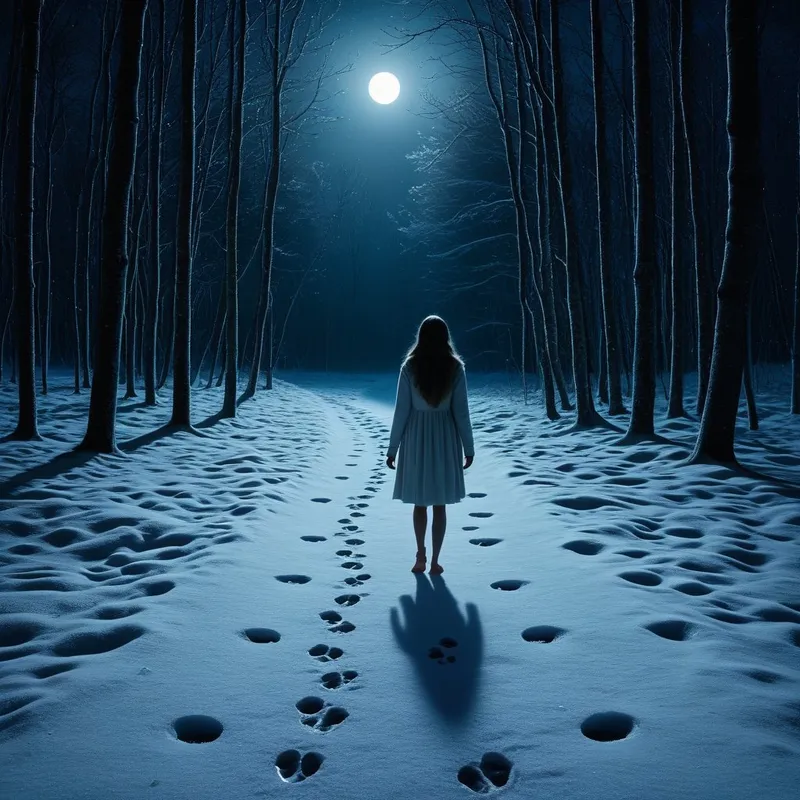
The journey upward is a rebirth. The pressure of the earth gives way to the biting kiss of the surface air. She emerges not onto a field, but into the heart of the frozen forest in the deepest hour of the night. The world is monochrome, etched in silver and black. Her breath plumes in the air, the first living steam in months. She is weak, newborn into the cold, her light dim.
She walks. With each step, a tiny miracle. The frozen moss beneath her bare feet yields, becoming soft and green. Where a tear of exhaustion and joy falls from her cheek, a single, brave snowdrop pushes through the iron-hard ground. She has no weapon but her presence. She comes to a clearing where an ancient, lightning-blasted hawthorn stands, its branches like claws against the stars.
Here, she rests. She gathers the last of her strength, the accumulated potential of her dark season. She cups her hands, and from her own essence—from the memory of sun and the hope of life—she forms an egg. It is not of a bird, but of the world itself. It rests in her palms, glowing with a soft, internal gold, a miniature sun. She holds it aloft, offering it to the fading stars.
And as the first sliver of true dawn etches the eastern hills, the egg pulses. A hairline crack of brilliant light appears on its shell. The light does not shatter it, but pours forth, gentle and inexorable. It flows down her arms, across the frozen ground, up the gnarled bark of the hawthorn. Where it touches, buds swell. Where it pools, the ice sighs and becomes water. The light spreads, a wave of color and sound returning to the world. The Cailleach, seeing the inevitable turn, wraps her white cloak tighter and retreats to the high mountains, her rule ended for a season.
Eostre does not conquer. She simply arrives. And in her arrival, the world remembers how to live.
Cultural Origins & Context
The figure of Eostre presents a fascinating challenge to the mythologist. The primary historical source is the 8th-century English monk Bede, who mentions a pagan Anglo-Saxon goddess Eostre, whose name was given to the month of April and whose festivities were subsumed into the Christian Paschal celebration. She is not directly attested in insular Celtic literature. However, by employing a comparative and reconstructive lens—a practice grounded in both anthropology and depth psychology—we can respectfully situate a "Celtic Eostre" within a plausible cosmological framework.
This involves looking to the deep Indo-European archetype of the Dawn Goddess, such as the Vedic Ushas or the Greek Eos, and observing how these themes manifest in Celtic lore. We see her essence in the pervasive Celtic reverence for the liminal: dawn, the spring equinox (Imbolc), and the potent symbolism of eggs and hares as creatures of fertility and cyclical return. Her story would not have been a single, canonical text, but a seasonal truth performed and felt. It was likely woven into the rituals that marked the end of winter, told by firelight as the community felt the first genuine thaw, enacted in the simple acts of cleaning the hearth, blessing seeds, or watching for the first returning birds. Her myth served the vital societal function of aligning human hope with the natural world's rhythm, transforming anxiety over survival into a participatory ceremony of renewal.
Symbolic Architecture
At its core, the myth of Eostre is a masterful depiction of the psyche's inherent movement toward wholeness and renewal after a period of stagnation, depression, or "winter."
The dawn does not fight the night; it patiently awaits its turn, and in its arrival, the night is simply rendered obsolete.
Eostre herself is the archetypal principle of enantiodromia—the emergence of an opposite condition from within the depths of an existing state. Winter contains the seed of spring; the darkness holds the latent image of light. Her descent and gestation in the underworld are not a punishment, but a necessary incubation. The Yggdrasil-like hawthorn tree she revitalizes represents the axis of the world, the connection between the underworld, middle earth, and the heavens. By restoring it, she restores the flow of life through all realms.
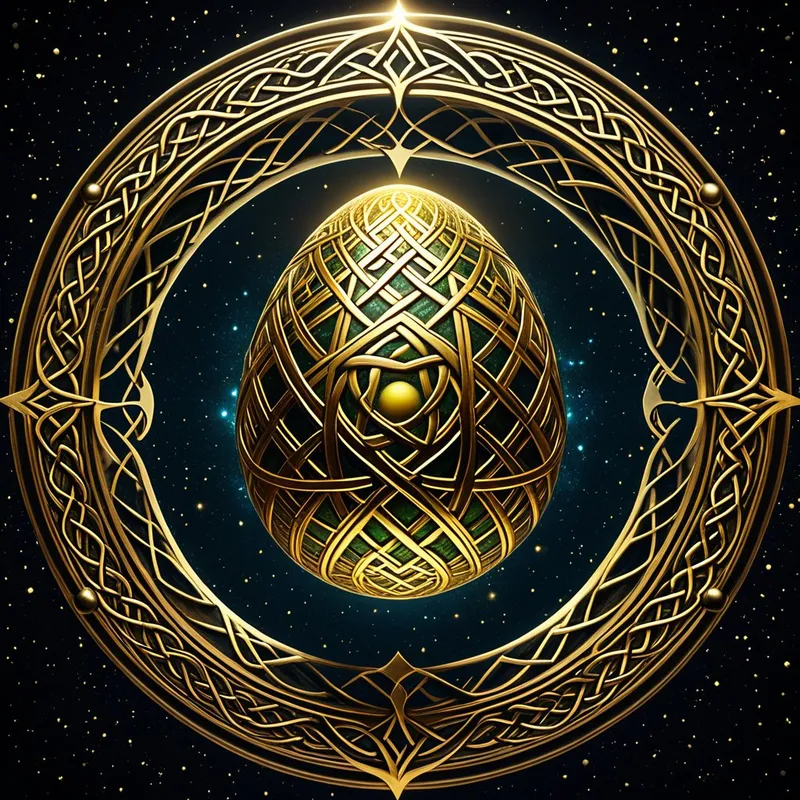
The luminous egg is the ultimate symbol of this contained potential. It is the prima materia of the soul, the unbroken, perfect totality of the Self before it is born into the complexities and divisions of conscious life. Its cracking is not destruction, but revelation. It represents the moment of insight, the "aha" that releases new energy and perspective into a frozen psychic landscape.
The Dreamer's Resonance
When this myth stirs in the modern unconscious, it often manifests in dreams of profound, quiet transformation. One does not dream of slaying dragons, but of finding a single green shoot in a concrete landscape, of discovering a hidden, warm room in a cold house, or of holding a precious, fragile object that glows with its own light.
Somatically, this can correlate to a release of long-held tension, a feeling of "thawing" after a period of emotional numbness. Psychologically, the dreamer is likely moving from a state of introverted stagnation—a psychic winter where ideas and feelings felt frozen—into a nascent phase of renewal. There is often a sense of vulnerability (the newborn Eostre in the cold); the new psychic attitude is tender and requires protection. The dream may present guides in the form of animals associated with dawn and spring—hares, robins, or lambs—signaling the instinctual body's alignment with this new cycle. The conflict in such dreams is rarely violent; it is the tension between the comfort of known barrenness and the risky, vulnerable act of hoping again.
Alchemical Translation
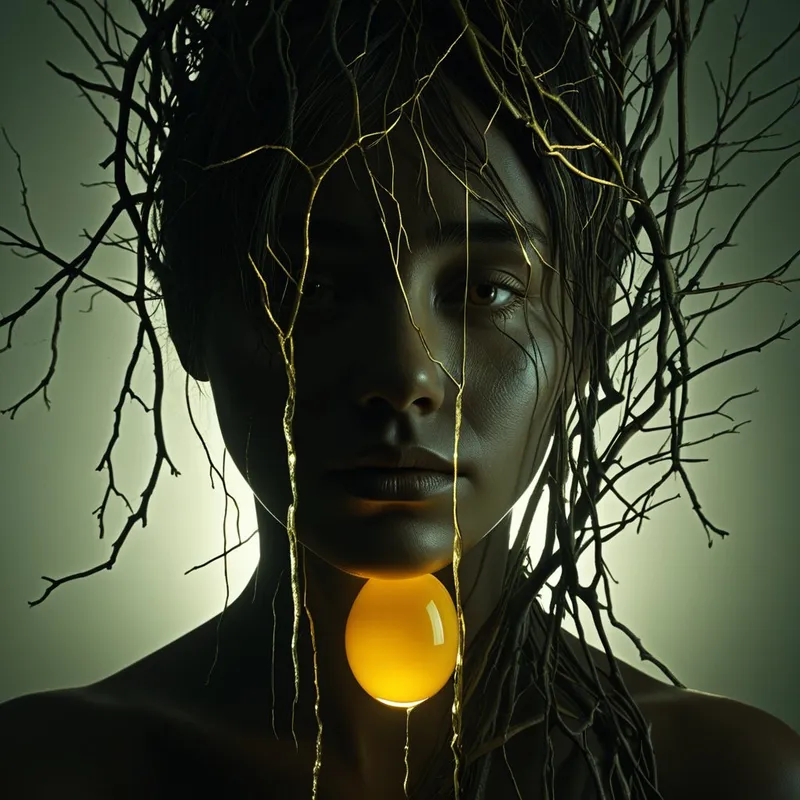
The alchemical journey mirrored in Eostre's myth is the solutio—the dissolving of rigid, fixed forms (ice) followed by the coagulatio—the formation of a new, more vibrant substance (living water, sprouting life). For the individual, this is the process of softening a calcified personality structure.
Individuation is not about adding more to the self, but about returning to the essential, luminous egg of potential we have always carried and allowing it to hatch in its own time.
The modern seeker's "underworld" is any period of fallowness, depression, or forced introspection. Eostre's journey teaches that this is not wasted time, but the nigredo, the essential blackening where material is broken down. The ascent is the conscious integration of this material. The act of "forming the egg" is the crucial, creative step where we take the insights gleaned from our darkness and consciously formulate them into a new intention, a new project, a new way of being. We must cup our hands and give form to our latent light.
Finally, her offering of the egg is the act of surrendering this new, fragile self-formation to a reality greater than the ego. It is the trust that the dawn will come, that the cycle will turn, and that our small, conscious work is part of a vast, natural process of renewal. We do not force the spring. We align with its inevitability, and in doing so, we become agents of the thaw, the light-bringers in our own once-frozen worlds.
Associated Symbols
Explore related symbols from the CaleaDream lexicon: