Enmerkar and the Lord of Aratta Myth Meaning & Symbolism
A Sumerian epic of rivalry between two kings, a divine challenge, and the invention of writing to carry a message the messenger could not remember.
The Tale of Enmerkar and the Lord of Aratta
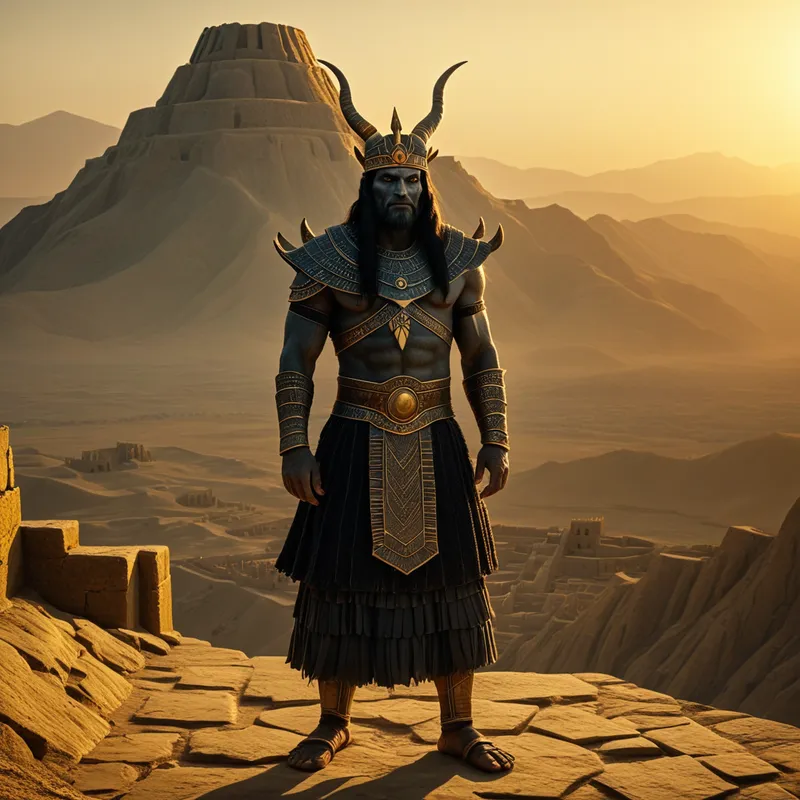
Hear now the tale from the time when the world was younger, when the Anunnaki walked closer to the earth. In the blessed city of Uruk, where the Euphrates ran like liquid silver, there ruled a king chosen by the gods. His name was Enmerkar, son of the sun, and his heart was set on a great work. He desired to build a magnificent temple for Inanna, the Queen of Heaven, to make her dwelling-place the wonder of the world.
But the materials he needed were not of the river plain. He required the precious stones of the earth’s bones: lapis lazuli as deep as the night sky, gold that held the sun’s fire, and silver that captured the moon’s tears. These treasures lay in a distant, fortified land beyond seven mountain ranges, a place shrouded in mystery and pride: Aratta.
Enmerkar, his will as firm as the brick of his city, turned his gaze eastward. He did not raise an army of bronze and spear. Instead, he raised a messenger. He sent this man on the perilous journey, bearing not threats, but a speech—a long, intricate, and divinely inspired challenge to the unnamed Lord of Aratta. The speech was a woven net of words, praising Inanna, declaring her favor for Uruk, and demanding the treasures as tribute to her glory. It was a test of wills, cloaked in piety.
The messenger crossed deserts where the wind whispered secrets and climbed mountains where eagles knew the language of storms. He arrived, dusty and awe-struck, before the high throne of Aratta. He delivered Enmerkar’s speech, every potent syllable. The Lord of Aratta listened, surrounded by his own wealth and pride. He was not cowed. He issued a challenge in return: let Enmerkar send grain to feed Aratta, and he would consider the request. A king’s duel fought with words and wheat.
Thus began a sacred contest, a tense dialogue across the vast distance. The messenger became a living cord stretched between two mighty poles, running back and forth with increasingly complex rhetorical demands and divine proofs. Enmerkar, through his messenger, proved Inanna’s favor by causing drought to wither Aratta’s fields. The Lord of Aratta, cunning and resilient, sought a champion to wrestle for his cause. The conflict escalated, a psychic storm between two rulers, with the land itself and the favor of the capricious Inanna as the battleground.
Then came the moment of crisis, the flaw in the human instrument. The messenger, burdened by the weight of the journey and the crushing complexity of his king’s latest, most elaborate message, faltered. His mind, the vessel, cracked. The words—the sacred, binding, magical words—slipped away like water through fingers. He stood before Enmerkar, empty and trembling, unable to repeat the speech he was to carry.
In that silence, on the brink of failure, the spark of genius was struck. Enmerkar, the problem-solver, the civilizer, did not rage at the man. He looked at the wet clay of the riverbank, at the stylus used for accounting. And he pressed. He inscribed the words. He fixed the fleeting breath of speech into the enduring flesh of the earth. For the first time, language was made visible, permanent, and independent of the failing human memory. The tablet was born. The messenger now carried not a burden in his mind, but an object in his hands. The message arrived in Aratta, perfect and unchanging. Faced with this immutable divine will made physical, the Lord of Aratta finally submitted. The treasures flowed to Uruk, and the temple of Inanna rose toward the heavens.
Cultural Origins & Context
This epic, one of the earliest known pieces of literature, dates to the Third Dynasty of Ur (c. 2100-2000 BCE) or earlier. It belongs to a cycle of four poems concerning the early kings of Uruk, bridging the mythical past of direct divine rule with the historical reality of city-state rivalry. It was not mere entertainment; it was a foundational text, recited by scribes and likely performed in ritual or courtly contexts. Its function was multifaceted: to glorify Uruk’s supremacy and its special relationship with Inanna, to legitimize kingship as a divinely-ordained institution of order (me), and most profoundly, to mythologize the very technology that allowed such stories to be told—writing. It is a myth about the origin of myth-making itself, a self-reflective loop born from the clay of the Mesopotamian plain.
Symbolic Architecture
At its heart, this is a myth of the King confronting his own Shadow, projected onto the distant, mountainous "other" of Aratta. Enmerkar of the cultivated, ordered plain and the Lord of the wild, mineral-rich mountains are two halves of a whole psyche. Their conflict is not for destruction, but for integration—the raw resources of the unconscious must be brought into the service of the conscious, cultural project (the temple).
The first enemy of the soul is forgetting; the first hero is the one who finds a way to remember.
The messenger represents the fragile ego-consciousness, the "function" that attempts to mediate between the ruling principle (Enmerkar) and the hidden complex (Aratta). His failure is inevitable, for the unconscious does not communicate in neat, memorizable speeches. It speaks in symbols, images, and demands that overwhelm the conscious mind. The invention of writing is the mythic moment of creating a tertium quid—a third thing. It is the birth of the symbolic container, the Temple of language itself, which can hold the otherwise unbearable tension between opposites.
The Dreamer's Resonance
When this myth stirs in the modern dreamer, it often manifests as a pattern of intense, unresolved negotiation. You may dream of a crucial message you cannot deliver, a speech you forget as you step onto a stage, or a long journey to confront a powerful but elusive figure in a remote place. Somatically, this can feel like a constriction in the throat (the unsaid message) or a profound heaviness in the limbs (the burden of the journey).
Psychologically, this signals a critical impasse in the psyche. The conscious attitude has issued a demand to the unconscious—for creativity (resources), for love (Inanna’s favor), for power—but the means of communication have broken down. The ego-messenger is exhausted. The dream is highlighting the insufficiency of mere willpower and linear thinking. It points to the need for a new technology of the self, a way to "write down" and objectify the internal dialogue, to give form to the formless pressures from within.
Alchemical Translation
The alchemical process modeled here is the solutio followed by the coagulatio—dissolution and coagulation. The long, fluid speeches are the solutio, the dissolving of a simple demand into a complex, watery realm of divine rhetoric and challenge. The messenger’s failure is the maximum dissolution, the complete loss of form.
The crisis of forgetting is the prerequisite for the miracle of inscription.
From this fertile void emerges the coagulatio: the fixing of the volatile spirit into a solid body. The wet clay (prima materia) receives the impression of the stylus (intentional consciousness) and is fired into permanence. This is individuation in action: the creation of a durable symbolic artifact—a piece of art, a committed decision, a structured ritual, a written confession—that can stand between the warring factions of the psyche. The hero’s task is not to conquer the Lord of Aratta by force, but to invent the Bridge (the written tablet) that makes relationship and tribute possible. One integrates the shadow not by defeating it, but by developing a language it can understand and to which it can respond.
Associated Symbols
Explore related symbols from the CaleaDream lexicon:
- Messenger — The fragile ego-consciousness tasked with an impossible mediation, representing the perilous journey of communication between the conscious self and the unconscious other.
- Temple — The ultimate cultural project of the conscious mind, the ordered structure (a coherent psyche, a life's work) that can only be built with resources integrated from the unconscious realm.
- Mountain — The distant, fortified land of Aratta, symbolizing the unconscious itself—a place of great wealth (potential) and resistance, separate from the cultivated plain of consciousness.
- Clay Tablet — The born symbol, the third thing that transcends conflict; the act of giving permanent, objective form to fleeting psychic content, enabling true integration.
- Grain — The sustenance of consciousness, the practical, nourishing energy that must be offered to the unconscious to engage it in dialogue, representing an initial sacrifice.
- Lapis Lazuli — The deep blue treasure of the unconscious, symbolizing wisdom, the night sky, and the sacred value hidden within the psychic depths.
- Journey — The long, arduous process of engaging with the unconscious, requiring repeated effort and traversal of internal landscapes (the seven mountains).
- Forgetting — The critical failure of the ego's standard operating procedure, the necessary breakdown that forces the invention of a new, more resilient psychic technology.
- Inanna — The archetypal force of desire, sovereignty, and dynamic power whose favor swings between the rivals, representing the libido or psychic energy that fuels the entire conflict.
- Speech — The magical, binding power of the Logos, the attempt of consciousness to rule through sheer will and articulation, which ultimately proves insufficient without a physical anchor.
- Shadow — The Lord of Aratta himself, the personified rival and holder of resources, representing all that the conscious king (Enmerkar) denies in himself but desperately needs.