
Enlil's Plow Myth Meaning & Symbolism
The god Enlil creates the plow, a divine tool stolen by humanity, forging civilization and a new, complex relationship with the divine order.
The Tale of Enlil's Plow
Hear now, in the time before time, when the world was young and raw. The air was thick with the scent of damp clay from the Apsu, and the great An looked down upon a land untamed. It was a world of marsh and thicket, where reeds grew tall as towers and the earth slept, heavy and silent, beneath a blanket of wild growth.
In the heart of this green chaos dwelt Enlil, the Storm Lord, Separator of Heaven and Earth. His breath was the wind, his voice the thunder. He surveyed the unbroken plain and saw not disorder, but potential—a sleeping power waiting to be awakened. A deep restlessness stirred within him, a creative urge as potent as the gale. He went to the forge of the gods, where the fires of the earth met the skill of the divine. There, with the help of the artisan god, he did not fashion a weapon, but a tool. From the bones of the mountains and the breath of the furnace, he brought forth the First Plow.
It was a thing of terrible beauty. Its share was bronze, sharp enough to part the fabric of the world itself. Its handles were of tamarisk, strong and supple. Enlil took it to the virgin field. He set his divine strength to the yoke, and as he pushed, the share bit deep into the dark, resistant flesh of the earth. The sound was a groan, a sigh of release. A straight, clean furrow opened behind him, a line of order drawn through chaos. From this sacred wound, life erupted—not wild, but chosen. Barley and wheat sprang forth in obedient rows, a golden testament to the covenant between will and world. The plow was not merely a tool; it was Enlil’s word made manifest, the grammar of civilization written into the soil.
The gods marveled. They feasted on the bread of this new order. But in the reed huts by the riverbanks, the people—the Sag-gig-ga—watched. They saw the straight furrow and the heavy grain. A hunger awoke in them, deeper than belly-hunger. It was the hunger to do, to imprint their own will upon the world, to become partners in this act of creation. The plow, this divine key to the earth’s bounty, rested in the temple storehouse, a sacred object guarded by ritual.
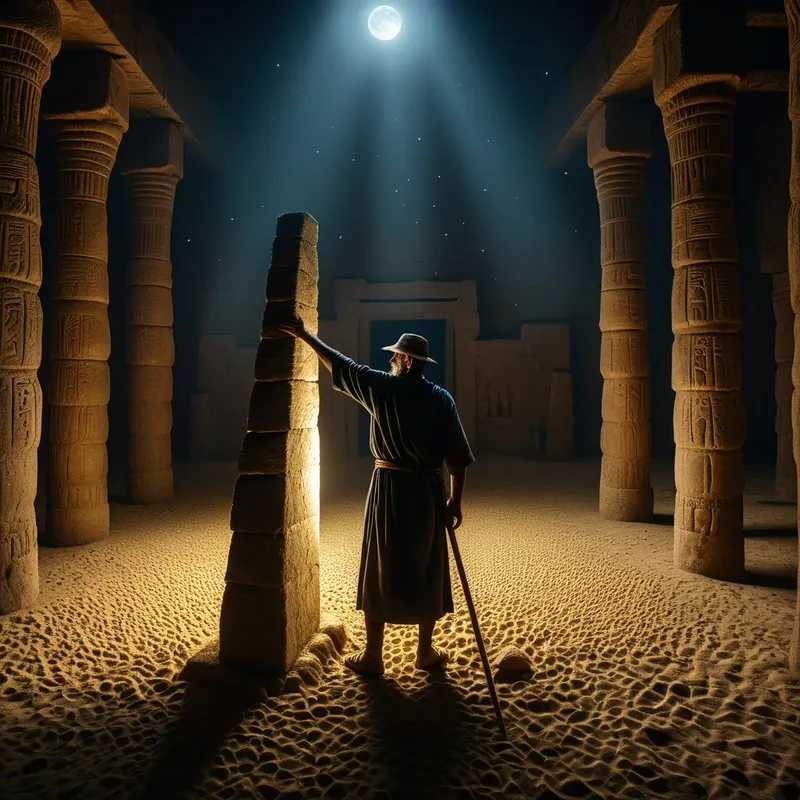
One night, when the moon was a sliver and the watch of the gods was turned elsewhere, a man of daring heart crept into that holy place. The air was thick with the smell of sacred oil and ripe grain. His hands, calloused from digging with sticks, trembled as they closed around the smooth tamarisk wood of the plow’s handle. The bronze felt cold, then warm, as if recognizing a new master. He did not run. With a solemnity that matched the act of theft, he dragged the heavy instrument out into the starlit field.
At dawn, he set the share to the soil. It resisted him, a mortal. He strained, his muscles cracking, his breath a prayer and a curse. Then, with a shudder, the earth yielded. The furrow he cut was crooked, shallow compared to Enlil’s, but it was his. And from it, life came. The people gathered. They saw, and they understood. The secret was out. The divine technology had passed into human hands.
When Enlil discovered the theft, his rage shook the foundations of the world. Storms gathered over the plain. He had not intended this. The order was to be his to bestow, not theirs to seize. Yet, as he looked down from his mountain, Ekur, he saw not blasphemy alone, but its fruit. The people were no longer merely tending wild patches; they were weaving the land into a tapestry of fields and canals. They had taken his word and were learning to speak the language themselves. His anger cooled, tempered by a grudging, awe-filled recognition. A new pact was forged, not of gift, but of consequence. Humanity now held the power to feed itself and to build cities, but with it came the burden of labor, the weight of responsibility, and forever after, the uneasy gaze of a god who knew his children had grown clever enough to steal fire from heaven.
Cultural Origins & Context
This myth, echoing from the clay tablets of the third millennium BCE, was not mere entertainment. It was a foundational narrative for the world’s first urban civilization. The story of Enlil’s Plow was likely recited during crucial agricultural festivals, particularly at the start of the planting season. It served as the sacred charter for the very essence of Sumerian life: organized, irrigation-based agriculture. The myth explained why their society was structured as it was—why they labored in the fields under the sun, why they built granaries and temples, and why their relationship with the gods was one of complex reciprocity involving offerings, prayer, and fear.
Passed down by priestly scribes in the temple schools, the tale functioned on multiple levels. Societally, it justified the social order and the back-breaking work of farming as a divine, if stolen, mandate. Theologically, it explained humanity’s intermediate state—neither wild animal nor carefree god, but a conscious creator burdened with knowledge. The plow’s theft marked the moment humanity stepped out of passive existence and into history, accepting toil as the price for self-determination and cultural creation.
Symbolic Architecture
At its core, the plow is the ultimate symbol of the cosmos imposing itself upon the chaos. It is a tool of differentiation, carving the "one" into the "two," separating the fertile line from the fallow ground. This is the primary act of consciousness: to make distinctions, to create categories, to bring form from formlessness.
The plowshare is the sharp edge of consciousness itself, cutting the first furrow in the undifferentiated field of the unconscious.
Enlil represents the archetypal ordering principle, the sovereign will that initiates creation. The theft by humanity symbolizes the inevitable, painful, and necessary process of ego-development. The conscious mind (humanity) must "steal" the tools of order from the unconscious (the gods) to build its own world. This is never a peaceful transfer. It is an act of rebellion, met with divine rage (the storm of psychic upheaval), followed by a new, more mature relationship. The myth captures the profound ambivalence of this step: the joy of creation is forever twinned with the burden of responsibility and the loss of innocent, unthinking unity with the source.
The Dreamer's Resonance
When this myth stirs in the modern psyche, it may manifest in dreams of discovering or stealing a powerful, ancient tool or technology. One might dream of finding a mysterious key in a grandfather’s attic, operating a complex, archaic machine they shouldn’t understand, or secretly learning a forbidden skill. The somatic feeling is often one of exhilarating tension—a racing heart, a mix of terror and thrilling potency.
Psychologically, this signals a moment where the dreamer is appropriating a latent inner power. It is the ego claiming a creative or ordering capacity that has previously been projected onto an external authority (a parent, a tradition, a god, a boss). The "storm of Enlil" that often follows in the dream narrative represents the inner backlash—guilt, anxiety, or a fear of punishment for daring to become one’s own authority. The dream marks the critical, often uncomfortable, transition from being a passive recipient of one’s life structure to becoming the active plowman of one’s own soul.

Alchemical Translation
The alchemical journey modeled here is the opus of building a conscious life. The prima materia is the raw, undirected potential of the individual—the swampy, fertile unconscious. Enlil’s act of creation is the first inspiration, the divine spark of an idea or calling that comes from beyond the ego.
The theft is the essential act of individuation: taking the inspired idea and daring to implement it with one’s own hands, thus transforming inspiration into genuine creation.
The modern seeker must first recognize their own "divine plow"—the unique talent, insight, or calling that feels both sacred and daunting. The "temple granary" is the inner sanctum where this power is kept, often guarded by internalized voices of tradition or prohibition. The act of "theft" is the courageous, perhaps guilt-inducing, decision to claim this power for oneself, to stop waiting for permission, and to apply it to the field of one’s own life.
The ensuing "storm" is the necessary nigredo, the dark night of doubt and psychic disorder that follows any bold act of self-assertion. Surviving this storm leads to the new pact: a mature consciousness that no longer sees itself as a passive child of the gods (or the unconscious), but as a responsible co-creator. One accepts the burden of labor—the daily, disciplined work of tilling the soul—in exchange for the authority to shape one’s own destiny. The fruit is no longer just divine bounty, but the authentic yield of a self-cultivated life.
Associated Symbols
Explore related symbols from the CaleaDream lexicon: