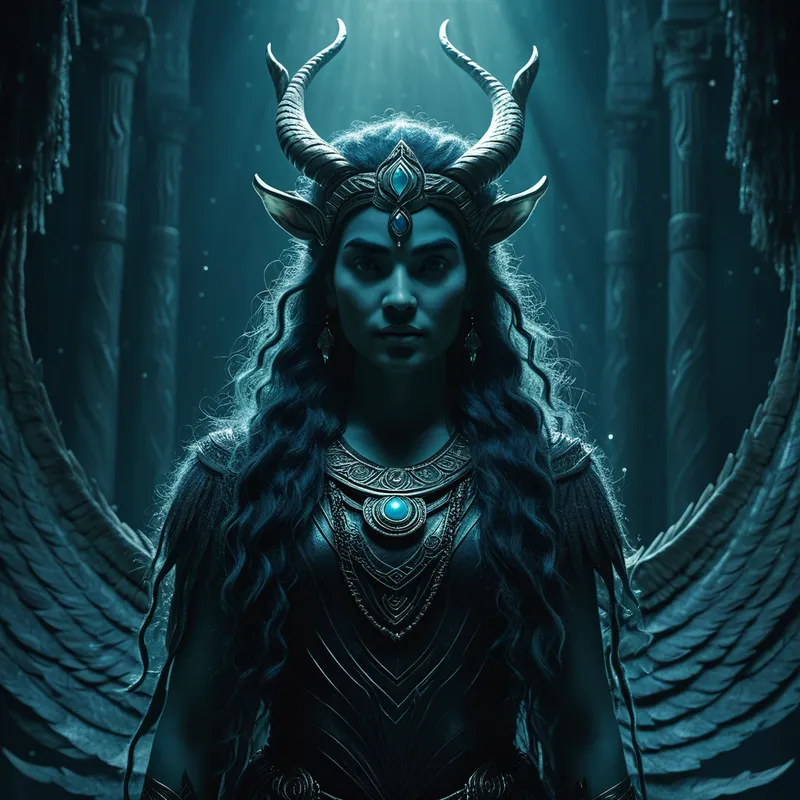
Enlil
The powerful Sumerian god of wind, air, earth, and storms, Enlil was a central deity who shaped the world and humanity, often through both creation and destructive force.
The Tale of Enlil
In the beginning, when the world was young and the gods were newly born from the mingling of the primeval waters, An claimed the heavens and Ki the earth. From their union came a son of terrible and necessary force: Enlil, whose name means "Lord Wind." He was the breath between them, the storm that cleaved sky from earth, for in those days, they lay pressed together in a dark, fertile embrace, and no thing could grow.
It was Enlil, the restless and powerful, who saw the potential for separation, for space, for life. With a roar that was the first thunder, he inserted himself between his parents, lifting An high into the luminous vault and pressing Ki down to form the solid ground. In that act of cosmic violence, the world was given its form. For this, he was hailed as King of the Gods, the one who brought order from the formless unity. He was given the city of Nippur, the spiritual center of Sumer, and there he held the sacred Duranki.
His power was absolute, symbolized by the Tablets of Destiny, which he wore upon his breast. With them, he ordained the fates of all things, from the path of the stars to the rise and fall of kings. Yet, this god of order and kingship was also the bringer of the terrifying melam, the awe-inspiring radiance that could shatter mountains and lay cities low. He was the benevolent provider of the sharur, the divine wind that filled the sails and brought the rains, and the author of the devastating flood that wiped humanity clean when their clamor disturbed his rest.
His narrative is etched with a profound tension between his role as sovereign and the raw, untamed forces he embodied. This is most starkly revealed in the myth of his exile. Enlil, walking by the riverbank, encountered the beautiful goddess Ninlil, bathing in its waters. Overcome with desire, he seized her, and she conceived the moon-god Nanna. For this transgression against the emerging cosmic order—a rape within the newly separated realms—the assembly of gods judged him. They banished him to the Kur, the land of no return. Yet, Ninlil, in a complex journey of loyalty and sovereignty, followed him, and through a series of encounters in the underworld, she bore three more deities of the netherworld, securing Enlil's return and re-establishing his rule, now tempered by a consort and by the experience of exile.
Thus, Enlil rules, but his reign is forever shadowed by the knowledge of the chaos that precedes order, the violence inherent in creation, and the exile that even the king of gods must endure to understand the full scope of his dominion.
Cultural Origins & Context
Enlil’s worship was centered in Nippur, a city that never served as a political capital but remained the undisputed religious heart of Sumer for millennia. Kings from rival city-states like Ur, Lagash, and later Akkad would make pilgrimage to Nippur to seek Enlil’s blessing, for legitimacy flowed from his decree. He was not a patron of a single city in the way Enki was of Eridu or Inanna was of Uruk; he was the sovereign above them all, the guarantor of the cosmic and social hierarchy.
His rise to supremacy reflects a crucial shift in early Mesopotamian theology. He represents a movement away from the passive, distant sky-father An, toward a god who is actively, sometimes violently, engaged in the governance of the universe. Enlil is the divine correlate to the institution of kingship—the power that enforces boundaries, allocates destinies, and commands both reverence and fear. He is the psychological embodiment of the principle that structure—be it of society, agriculture, or the cosmos itself—is not a gentle emergence but often a forceful imposition, a necessary separation that carries a cost.
Symbolic Architecture
Enlil’s mythology constructs a profound architecture of paradox. He is the separator who creates the space for life, yet his method is one of divine violence. He is the author of fate, yet he is subject to the judgment of the divine assembly. He is the king exiled to the underworld, who returns to rule all the more firmly.
He represents the fundamental psychic truth that the ego, the organizing principle of consciousness (the "Lord of the Wind" of the mind), must differentiate itself from the unconscious unity. This act of separation is both creative and traumatic, founding the known world while casting a long shadow of guilt and the potential for exile.
His possession of the Tablets of Destiny is not merely a symbol of power, but of responsible power. To hold the fates is to bear the weight of consequence, to be the source of both bounty and calamity. The storm is not mindless chaos; it is the disciplined, terrifying aspect of a sovereign will, cleansing, renewing, and reminding humanity of its precarious, gifted place within a structured cosmos.
The Dreamer's Resonance
To encounter Enlil in the inner landscape is to confront the archetypal force of the Sovereign within oneself—the part that seeks to establish order, make decisive choices, and claim authority over one’s life. He is the inner voice that says, "Enough. A boundary must be drawn here." This can manifest as the courage to leave a stifling situation, to assert one’s will in a project, or to impose a necessary discipline.
Yet, the Enlil energy carries its perils. His shadow is the tyrannical ruler, the one who separates with cruelty, who uses authority to dominate rather than to steward. His exile myth speaks directly to the psychological consequence of abusing this sovereign power: a fall into the underworld of guilt, isolation, and disorientation. The dreamer feeling cast out, judged, or stripped of status may be experiencing the "exile of Enlil," a necessary correction from the deeper self for an overreach of egoic will. The return, like his, requires an integration of what was rejected or violated (represented by Ninlil’s journey), a reconciliation with the feminine, the depths, and the consequences of one’s actions.
Alchemical Translation
The alchemy of Enlil is the separatio followed by a sacred coniunctio. His primary act is the separation of heaven and earth, the quintessential division that makes the work of consciousness possible. In the soul’s laboratory, this is the difficult process of discrimination—distinguishing spirit from matter, thought from instinct, self from other. It is a violent, necessary rupture.
His exile and return narrate the alchemical stage of mortificatio and sublimatio. The king must die, must descend to the underworld (be humbled, confronted with his shadow), so that his power can be purified and raised to a higher level. His reunion with Ninlil in the depths signifies that true, enduring order is not born of sheer force alone, but is consecrated through a union with the very principle of life and sovereignty he once violated.
Thus, the raw, untamed power of the storm (prima materia) is subjected to the law of the Tablets (structure and fate) and the ordeal of exile (purification), to ultimately return as legitimate, life-sustaining kingship—the lapis philosophorum of divine and human governance.
Associated Symbols
Explore related symbols from the CaleaDream lexicon:
- Tablet — The inscribed stone of divine law and pre-ordained fate, representing the immutable structure of cosmos and self.
- Order — The fundamental principle of arrangement and hierarchy, violently imposed yet necessary for existence and identity.
- Storm — The terrifying, cleansing manifestation of sovereign power, containing both creative breath and destructive fury.
- Mountain — The axis mundi, the meeting point of heaven and earth, and the solid, enduring seat of divine authority.
- Thunder — The audible voice of the sovereign god, a sound that commands awe, announces judgment, and breaks stagnant silence.
- Exile — The necessary fall from grace and power, a descent into the underworld that precedes purification and legitimate return.
- Crown — The visible emblem of sanctioned rulership, earned through trial and conveying the right and burden to command destiny.
- Border — The line created by separation, defining self from other, sacred from profane, and order from chaos.
- Father — The archetypal principle of authority, law, and structural foundation, both protective and demanding.
- Destiny — The pre-written path of all things, held and administered by a power greater than individual will.
- Temple — The earthly dwelling of the god, the organized, sacred space where cosmic order is reflected and maintained.
- Wind — The invisible, pervasive force that fills space, carries seed and storm, and is the very breath of divine command.