
Engkanto Myth Meaning & Symbolism
A myth of luminous nature spirits who dwell in ancient places, offering profound beauty and terrible danger to those who cross their liminal threshold.
The Tale of Engkanto
Listen, and let the old stories breathe. There is a world that exists in the corner of your eye, a shimmer just beyond the last rice paddy, a whisper in the leaves of the oldest tree. This is the realm of the Engkanto.
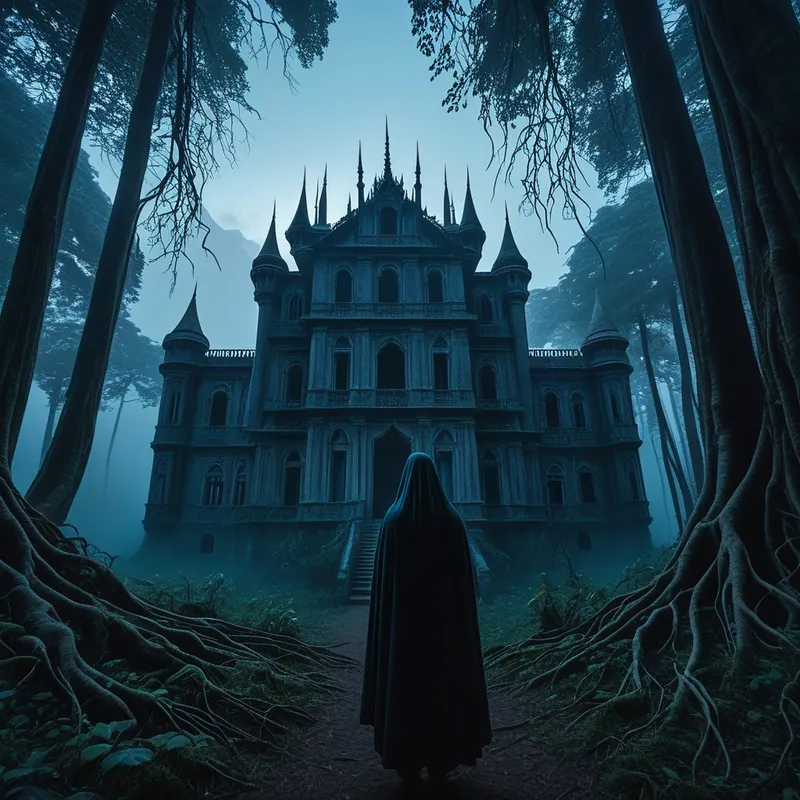
They are not gods, nor are they demons. They are the soul of place itself, given form. Some dwell in the heart of the balete, its great, twisted roots forming arches into shadowed halls. Others rule crystalline rivers where the water sings, or command the dizzying heights of mist-wrapped mountains. Their beauty is not of this earth—it is a beauty that aches, that pulls at the very fabric of your longing. Skin like moonlight on dark water, eyes holding the depth of untouched forest pools, voices that are the sound of wind through bamboo and the first drop of rain on a broad leaf.
Into this realm once wandered a young woodcutter, let us call him Kaibigan. He was a practical soul, his world defined by the weight of his axe and the solidity of the trees he felled. One evening, chasing a stray goat, he pushed through a curtain of hanging vines into a clearing he had never seen. The air was cooler, sweeter. In the center stood a balete of impossible size, and from within its roots spilled a light of gold and pearl.
A figure emerged. She was the most devastating vision he had ever beheld. She offered no name, only a smile that promised the end of all weariness. She spoke of her palace within the tree, of feasts without end, of music that would soothe his calloused hands. "Stay," her voice echoed in his bones. "Forget the sun that burns and the soil that demands. Here, beauty is eternal."
Kaibigan was enchanted. For days that felt like moments, he reveled in her world. He drank from cups of dewdrop, ate fruits that tasted of memory, and danced to melodies that had no beginning. But soon, a deep unease began to root in him. The food, though delicious, left him emptier. The laughter of the other engkantos had a hollow, echoing quality. He longed for the coarse texture of his mother's blanket, the sour tang of unripe mango, the weight of true fatigue after honest work.
He looked at his enchanting host and, in a fleeting moment when her guard dropped, saw not immortal beauty, but an ancient, terrible loneliness—a hunger that fed on his mortal warmth. He remembered an old warning: to eat the food of the spirits is to be bound to them forever. He had eaten. Panic, cold and clear, cut through the enchantment.
His flight was not one of strength, but of desperate, homesick longing. He tore through the shimmering veil of the clearing, ignoring the beautiful, pleading calls that turned to sharp, whistling commands. He did not look back. When he stumbled into his village, he was gaunt, his eyes wild. He found his hut, his hearth cold. To his horror, the villagers told him he had been missing for seven years. The goat he had chased was long dead. In the world of men, time had flowed like a river, while in the arms of the Engkanto, it had been a still, beautiful pond. He was home, but he was forever a stranger, with the echo of unearthly music haunting his dreams and the taste of spirit-fruit ash on his tongue.
Cultural Origins & Context
The myth of the Engkanto is not a single story but a living stratum of belief woven into the animist tapestry of pre-colonial Philippine cultures. These narratives were the province of the community elders and the babaylan, who served as intermediaries between the human world and the spirit world. The stories were not mere entertainment; they were ecological and social law. They explained the unknown sounds in the forest, the sudden illness after visiting a certain spring, or the mysterious beauty of a particular landscape.
By attributing consciousness and power to specific, beautiful locales—ancient trees, unusual rock formations, deep pools—the myth enforced a code of respect and restraint. It taught that nature is not a passive resource but a sovereign realm with its own inhabitants, laws, and consequences. To trespass, to pollute, or to exploit without offering proper respect was to invite the "engkanto's" wrath, which could manifest as illness (usog), madness, or disappearance. Thus, the myth functioned as a profound environmental ethic and a psychological map of the boundaries between the known world of the village (bayan) and the wild, unknown, and alluring outer world.
Symbolic Architecture
The Engkanto represents the archetypal force of the Anima/Animus in its most natural, untamed, and ambivalent form. It is the soul of the world, the psychic energy of the non-human, which is both incredibly attractive and inherently dangerous to the conscious ego.
The enchantment is not a lie, but a different kind of truth—one that the conscious self cannot inhabit without losing itself.
The balete tree is the ultimate symbol of the threshold, the limen. Its aerial roots create a natural doorway, representing the permeable boundary between the conscious ego (the village, the familiar) and the unconscious (the spirit world, the wild). The Engkanto's realm is the unconscious itself: beautiful, timeless, filled with potential, but lacking the structure, conflict, and linear progression that define conscious life.
The central conflict—the offer of eternal beauty at the cost of one's place in time and community—mirrors the psyche's temptation to retreat into inner fantasy, to be captivated by a compelling complex or a numinous inner image, at the expense of engagement with outer reality. The "food" of the spirits is the symbol of this psychic incorporation; to fully identify with the enchanting content is to be consumed by it, to lose one's differentiating consciousness.

The Dreamer's Resonance
When the pattern of the Engkanto myth arises in modern dreams, it signals a profound encounter with the autonomous, enchanting contents of the personal or collective unconscious. The dreamer may find themselves in an impossibly beautiful landscape, meet a figure of devastating allure, or discover a hidden, luxurious room in their house.
This is not merely a pleasant fantasy. The somatic resonance is key: there is often a feeling of awe mixed with dread, of being "spellbound" or paralyzed by beauty. Psychologically, this indicates that a powerful complex—often related to the ideal Lover, the escape from responsibility, or the pull of regressive nostalgia—has been activated. The dream is presenting the temptation in its full, radiant force. The danger, as in the myth, is psychic stagnation. The dream-ego may be tempted to stay, to stop its development, lulled by the perfect, conflict-free atmosphere of the complex. The dreamer waking with a sense of unease or haunting longing is experiencing the same pull Kaibigan felt—the call back to the imperfect, temporal, but real world of the ego's responsibilities and relationships.

Alchemical Translation
The myth of the Engkanto models the critical phase of the individuation process known as the confrontation with the anima/animus. The goal is not to defeat the spirit, nor to flee from it forever in terror, but to achieve a relationship with it.
The first step, embodied by Kaibigan's initial enchantment, is recognition. The conscious ego must acknowledge the power and beauty of this inner other. The second step, his moment of panic and realization, is differentiation. The ego must assert its own nature, its need for time, struggle, and individual substance, realizing that total union with this numinous image is a kind of death. The flight is a necessary rejection of complete identification.
The true alchemy occurs after the return. The treasure is not the spirit's gold, but the transformed perspective of the one who has seen it.
The final, ongoing alchemical work is integration. Kaibigan returns changed, "haunted." He carries the memory of the beauty within him, but it now exists in tension with his human life. This is the translation: the enchanting energy of the Engkanto, once an external force that threatened to consume, becomes an internal source of inspiration, depth, and connection to the natural world. The individual no longer projects soulful beauty solely onto external people or places (a dangerous enchantment), but recognizes it as a quality of the inner world that can enrich, rather than erase, their outer life. They learn to visit the threshold, to respect the power of the unconscious, but to always return, bearing its gifts into the realm of time and community.
Associated Symbols
Explore related symbols from the CaleaDream lexicon:
- Forest — The archetypal realm of the unknown unconscious, a place of both nourishment and danger where the ordinary rules of the ego are suspended.
- Tree — Specifically the balete, representing the axis mundi, a living bridge between worlds and the rooted, ancient power of the psyche's foundational structures.
- Door — The liminal threshold of the balete's roots, symbolizing the moment of choice between consciousness and the unconscious, safety and discovery.
- Mirror — The Engkanto itself acts as a mirror, reflecting the dreamer's deepest longing for beauty, perfection, and escape from temporal burdens.
- Spirit — The essential nature of the Engkanto, representing autonomous psychic energy that exists beyond personal control, both alluring and formidable.
- Dream — The entire realm of the Engkanto is akin to a collective dreamscape, a state where time distorts and the soul's imagery takes tangible form.
- Time — The central conflict of the myth; the spirit world exists in eternal, cyclical time, while human life and individuation require linear time and mortality.
- Beauty — The bait and the trap, representing the numinous, captivating quality of unconscious contents that can enchant the ego away from its developmental path.
- River — The flow of time and consciousness in the human world, which stands in stark contrast to the still, pond-like time of the enchanted realm.
- Heart — The seat of longing that draws Kaibigan in, and the core of his authentic feeling that ultimately pulls him back to his own life and community.