Engawa Myth Meaning & Symbolism
A myth of the spirit dwelling in the transitional space between home and world, teaching the sacred art of being neither inside nor outside.
The Tale of Engawa
Listen, and let the tale settle in the space between your breath and the silence that follows.
In the time when the world was still whispering its first secrets to the kami, there existed a spirit unlike any other. It was not born of the deep forests, nor the rushing rivers, nor the high mountains. It was born of a pause. A held breath. A place that was neither one thing nor the other.
This was the spirit of the Engawa.
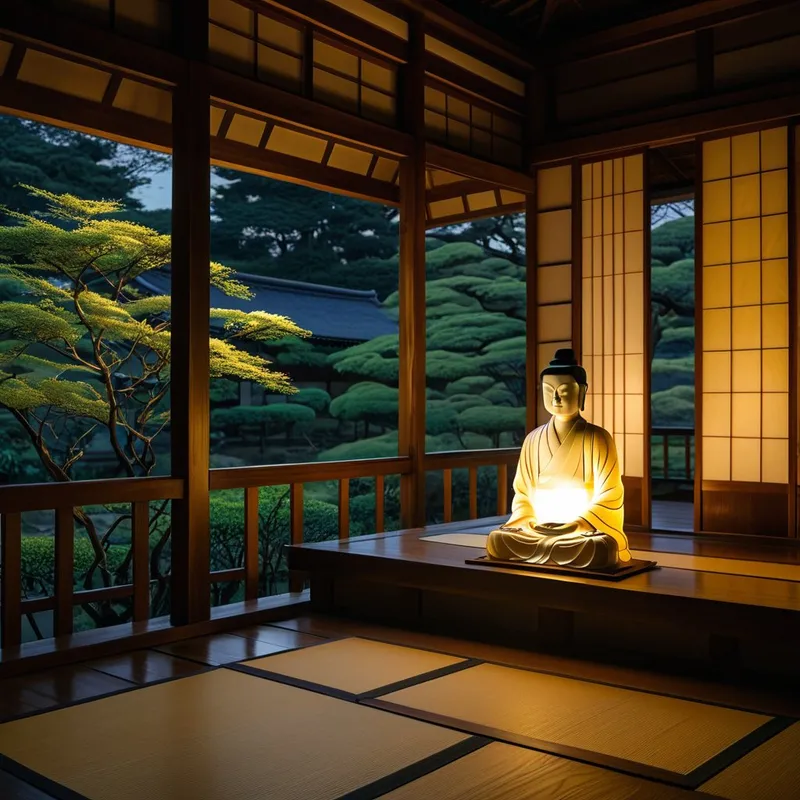
It did not dwell fully within the warm, ordered world of the house, with its tatami mats and softly sliding shoji. Nor did it belong to the wild, untamed garden, where stones held the memory of mountains and moss drank deep of shadow. Its domain was the slender wooden plank that bridged them—a ribbon of polished cypress that knew the touch of the socked foot from within and the bare, dew-kissed foot from without.
For generations, the people of a certain village built their homes with great care, but they built this space without thought. It was merely a walkway, a practical edge. They rushed across it, from safety to work, from community to solitude, never lingering. And so, the spirit slept, a faint potentiality.
Then came a season of great storms. Winds howled, and the boundaries of the world seemed to blur. Rivers invaded fields, and forest creatures crept to the very walls of the homes. In one house, an old scholar, his eyes dim but his perception sharp, could not sleep. He felt a profound unease, not of fear, but of a threshold quivering. He did not retreat to his inner room. Instead, he moved to the Engawa.
He sat there, in the deep night, as the storm raged. He placed his left hand on the tatami behind him, feeling the steady, woven order of the indoors. He stretched his right hand into the lashing rain, feeling the chaotic, vital power of the outdoors. And he simply sat, holding the tension of both.
In that moment of conscious stillness, the spirit awoke. It did not appear in a flash of light, but as a deepening of the very space he occupied. The wood beneath him seemed to hum with a gentle warmth. The air itself on the Engawa became distinct—neither the still air of the house nor the wild air of the storm, but a third thing, a mingling. The scholar felt a presence, vast and patient, that saw the house and the garden not as separate realms at war, but as two breaths of a single being.
From that night, the spirit of the Engawa was known. It taught, without words, that to sit on the threshold was to perform a sacred act. It was to become the shimenawa of one’s own life, marking a space where transformation could occur. Those who learned to linger there—to watch the twilight deepen without rushing to light the lamp, to feel the first autumn chill without closing the screen—found a strange peace. They carried the calm of the inside into the world, and brought the vitality of the world into their home, without ever confusing the two. The Engawa was no longer just a place. It was a witness, a teacher, and a sanctuary for the in-between soul.
Cultural Origins & Context
The Engawa, as an architectural element, is a definitive feature of traditional Japanese design, particularly in machiya and temple structures. While there is no single, canonical "myth of Engawa" recorded in ancient texts like the Kojiki or Nihon Shoki, the concept it embodies is deeply woven into the spiritual and aesthetic fabric of Japanese culture, particularly within Shinto and Zen Buddhism.
This "myth" is what anthropologists might call an implicit myth or a myth of place. It was not passed down by a single bard but was communally authored through lived experience and philosophical reflection. Its storytellers were the architects who designed the space, the carpenters who crafted it, and the generations of people who used it. Its societal function was pedagogical and psychological. It taught the art of ma (間)—the pregnant pause, the intentional interval. In a culture that highly values harmony (wa) and the subtle awareness of one's environment, the Engawa served as a physical training ground for navigating life's fundamental transitions: public and private, cultivated and wild, self and other.
It functioned as a spiritual airlock, allowing one to decompress from the social obligations of the world before entering the intimate space of the home, and vice-versa. This ritual of transition, performed daily, embedded a deep respect for boundaries and the process of crossing them consciously.
Symbolic Architecture
The Engawa is a master symbol of liminality—the quality of ambiguity and disorientation that occurs in the middle stage of a rite of passage, when participants no longer hold their pre-ritual status but have not yet begun the transition to the status they will hold when the rite is complete.
The Engawa is the embodied paradox: to be fully in neither place is to be present in the truth of both.
Psychologically, it represents the ego's necessary and sacred function as a threshold entity. The ego, in its healthiest form, is not a fortified castle keep but an Engawa. It is not meant to be an impermeable wall separating the inner world of the unconscious (the wild, untamed garden) from the outer world of collective reality (the structured home). Its purpose is to facilitate conscious relationship and exchange between these two vast realms.
The house symbolizes the constructed self—the persona, identity, and conscious order we have built. The garden symbolizes the untamed Self—the unconscious, instinctual, and archetypal forces. The Engawa is where they meet in awareness. To fear this space is to remain rigidly in one realm or the other, leading to either sterile isolation or chaotic inundation. To inhabit it willingly is to engage in the core act of consciousness.

The Dreamer's Resonance
When the pattern of the Engawa appears in modern dreams, it signals a psyche working deeply with a state of transition or an internal boundary. The dreamer is likely in a literal or psychological "in-between" state: between jobs, relationships, life stages, or between a old way of being and a new one that has not yet solidified.
Somatically, one might dream of sitting on such a threshold, feeling the different textures (smooth wood, rough stone, cool air, warm light) on different parts of the body. This is the psyche attempting to feel its way through the transition, to ground the disorienting process in bodily sensation. A dream of being stuck on the Engawa, unable to decide whether to go in or out, points to resistance or fear of committing to the change that the transition implies. Conversely, a dream of joyfully lingering on the Engawa, watching rain fall or seasons change from that vantage point, indicates a hard-won comfort with ambiguity and a trust in the process of becoming.
The Engawa in a dream asks the fundamental question: Can you tolerate the not-knowing? Can you be present in the passageway without demanding the false security of a closed door?

Alchemical Translation
The alchemical process mirrored in the Engawa myth is not the dramatic solve et coagula (dissolve and coagulate) of total destruction and rebirth, but the subtler, essential process of separatio and coniunctio happening simultaneously. It is the art of distinguishing elements without severing their relationship—holding the tension of opposites until a third, transcendent position emerges.
For the modern individual pursuing individuation, the Engawa models the practice of the transcendent function. This is the psyche's capacity to hold conscious and unconscious material in dialogue until a new, reconciling attitude emerges.
The goal is not to live on the Engawa forever, but to learn its wisdom so you can move between worlds with integrity, carrying the essence of each into the other.
The "alchemical translation" is a daily practice. It is the conscious pause before reacting to a provocation (holding the inner feeling and the outer stimulus on your mental Engawa). It is the act of journaling, where private thought is brought to the threshold of language. It is the moment of meditation where you observe the flow of thoughts (the garden) without being swept into them, from the stable vantage point of awareness (the house). By consciously creating and honoring these psychological Engawa moments, we build a resilient self that is not brittlely solid nor fluidly formless, but adaptable and deeply connected—a self that knows it is both the house and the garden, and, most importantly, the sacred space in between where the mystery of being unfolds.
Associated Symbols
Explore related symbols from the CaleaDream lexicon: