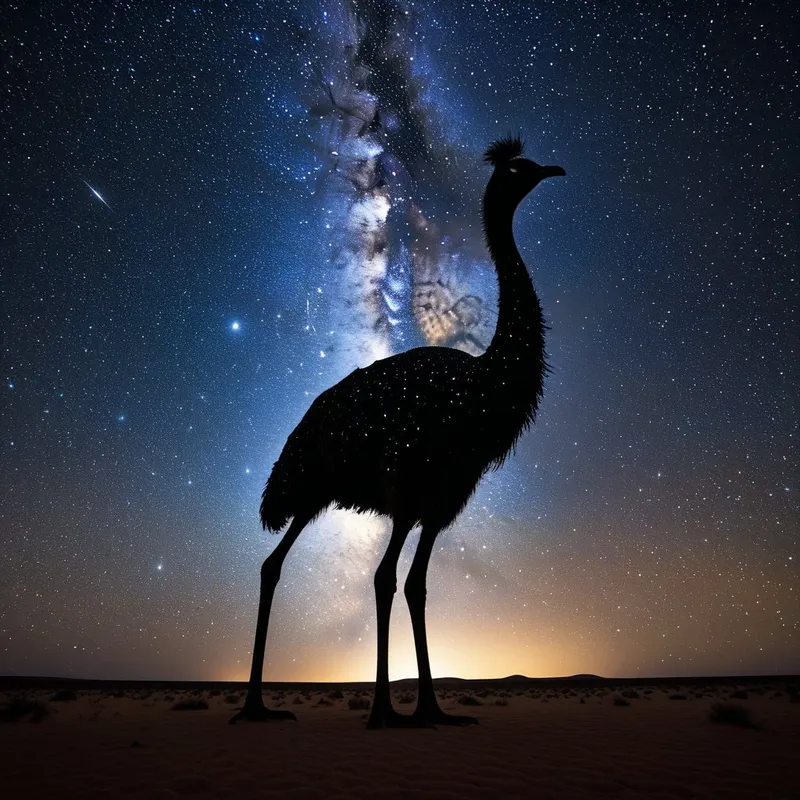
Emu in the Sky Myth Meaning & Symbolism
A celestial emu, formed from the dust between stars, teaches the first people the sacred law of the land and the cycle of life.
The Tale of Emu in the Sky
In the time before time, when the world was soft and the sky was close enough to touch, there was only the great, silent dark and the first stirrings of the Dreaming. Then, from the breath of the ancestors, the stars began to burn. But they were scattered, lonely fires in the immense black. Between them, in the great river of light we call the Milky Way, lay vast banks of cool, dark dust.
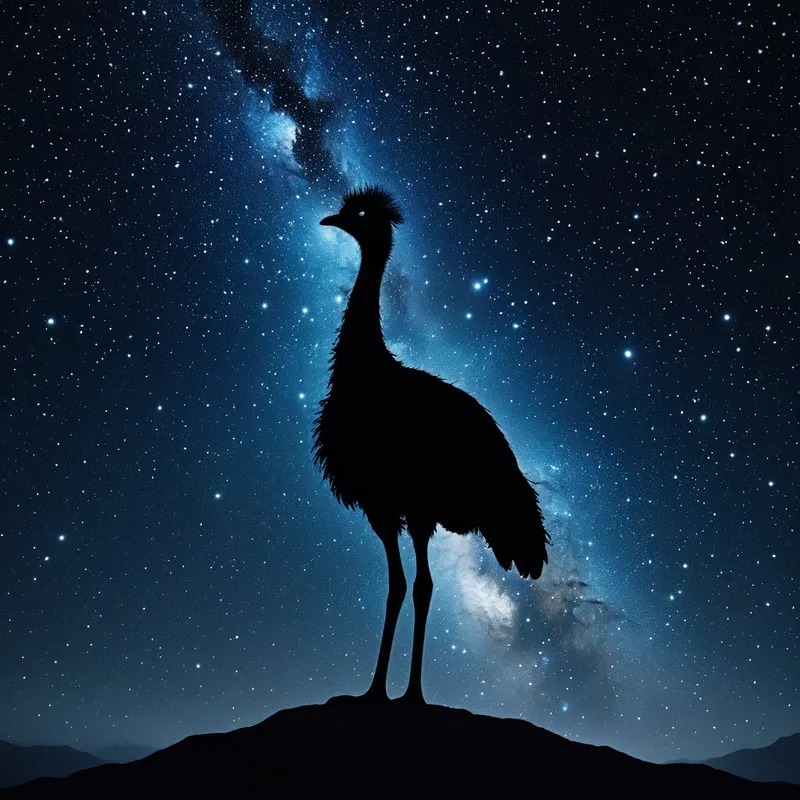
And in that dust, a shape began to form. It was not made by hand, but by intention. It was the shape of Gugurmin, the Emu. From the cosmic silt, her long neck arched, her powerful body settled, and her legs, forever in motion, were etched into the void. She became the Emu in the Sky, a great black shadow against the shimmering river of ancestors.
She looked down upon the newly formed land, red and raw. She saw the first people, emerging from the earth, confused and without law. They did not know when to hunt, when to gather, when to sing the land into being. The Emu in the Sky did not speak with a voice of thunder. Her teaching was in her being, in her silent dance with the seasons.
As the cold season of Burrugin approached on the land below, the celestial Emu would shift. Her form, clear and high in the night, would begin to sink towards the horizon. This was her sign. On the earth, the female emus would begin to lay their large, dark green eggs in nests scratched into the red soil. The people, watching the sky, knew: now is the time. The eggs were plentiful, a rich gift of protein, but they were not to be taken greedily. Only so many, and only with thanks, following the law written in the stars.
And as the celestial Emu vanished below the horizon, swallowed by the earth, her lesson was complete. The eggs on the ground had hatched. The chicks were scurrying, and the season of plenty was over. The people turned to other foods, other laws. The great shadow in the sky was gone, but her promise remained. She would return, rising again from the dust, her cycle eternal—a lawgiver not of stone tablets, but of starlight and shadow, of presence and absence, teaching the rhythm of reciprocity between the heavens and all who walk the earth.

Cultural Origins & Context
This is not a story confined to a single tribe, but a foundational narrative shared across many of the hundreds of Aboriginal Australian language groups. The Emu in the Sky is one of the most widespread and recognizable constellations in Aboriginal astronomy, a dark nebula within our galaxy's bright band. Its transmission was not through written texts, but through the living, breathing practice of oral tradition and direct, experiential education.
Knowledge-holders, often Elders, would point out the celestial emu during night-time ceremonies or during the long, quiet hours of a desert night. The story was told not as mere entertainment, but as integrated, practical cosmology. It functioned as a complex ecological calendar, a moral guide for sustainable hunting, and a theological assertion of the sacred order. The emu in the sky and the emu on the ground were not separate entities; they were manifestations of the same ancestral essence, connected by the Songlines that weave through the land and up into the stars. To know the story was to know your place in a living, intelligent cosmos, to participate correctly in its cycles, and to remember the law laid down in the Dreaming.
Symbolic Architecture
At its core, the Emu in the Sky is an archetype of immanent law and enlightened perception. It represents a cosmology where divinity and natural law are not abstract concepts handed down from a distant heaven, but are embodied, observable, and participatory.
The greatest truths are not shouted from the mountaintop, but whispered in the spaces between the stars. Wisdom is often found not in the light itself, but in the shape of the darkness that gives the light its meaning.
The Emu is formed from darkness—the cosmic dust. This is profoundly symbolic. It teaches that knowledge, structure, and law (Lore) often emerge from the void, the unknown, the unformed potential. It is a corrective to a consciousness that only values the bright, the obvious, and the illuminated. The myth valorizes the ability to see the pattern in the negative space, to derive guidance from absence as much as presence.
Psychologically, the Emu represents the Self in the Jungian sense—the organizing, guiding principle of the total psyche. It does not command; it orients. Its cyclical disappearance and return model the process of connecting with inner guidance (the emu high in the sky, clearly visible), losing connection during life's trials (the emu setting), and the faithful return to that core orientation. It is the internal compass calibrated to the cosmos itself.

The Dreamer's Resonance
When this mythic pattern stirs in the modern dreamer, it often manifests not as a literal emu, but as a profound encounter with a guiding absence or a structured void. One might dream of a vast, starry sky where a crucial constellation is missing, yet its shape is felt more powerfully than if it were lit. Or one might dream of following animal tracks that fade into bare rock, yet a deep, somatic knowing continues to guide the way.
Such dreams signal a psychological process of navigating by a law that is felt, not seen—an internal Lore. The dreamer is being invited to trust a wisdom that does not come from the bright, conscious ego (the shining stars), but from the darker, unconscious substance of the psyche (the cosmic dust). It is the somatic intelligence of the body, the intuitive knowing of the heart, the ancestral memory that whispers below the threshold of thought. The anxiety in the dream comes from the ego's fear of the dark, of losing its familiar, illuminated landmarks. The resolution comes in surrendering to a deeper, cyclical rhythm, trusting that guidance will re-emerge in its proper season.
Alchemical Translation
The alchemical journey modeled by the Emu in the Sky is the transmutation of chaos into kosmos—of unordered experience into a personal, sacred order. This is the heart of individuation.
The prima materia, the raw stuff of the soul, is the scattered starlight and formless dust of our unlived life, our potential, our confusion. The first stage of the work (nigredo) is the recognition and acceptance of this dark, nebulous material within us—our shadows, our unknowns. The Emu myth teaches us to gaze into this inner "Milky Way" and not despair at its apparent chaos, but to look for the dark shape slowly coalescing within it.
Individuation is not about becoming brighter, but about becoming more distinct. It is the courage to let the dark dust of your experience settle into the unique, enduring shape of your own law.
The cohesive force is the ancestral, archetypal pattern—the innate image of the Emu, the Self. As we align our actions with this inner pattern (hunting only when the celestial sign permits, i.e., acting with ethical timing and respect), we perform the sacred operation. We incarnate the cosmic law into our earthly behavior. The cyclical disappearance of the guide is the necessary solutio—a dissolution of certainty where we must live the law from memory and faith, internalizing it fully. Its return is the coagulatio, the confirmation that the law is now solid within us, a part of our psychic bone structure.
For the modern individual, this translates to the difficult work of deriving one's own ethical code not from external dogma (the brightly lit, obvious stars of societal expectation), but from the silent, often dark contemplation of one's own deepest nature and its fit within the great cycle of life. It is the process of becoming a sage not by acquiring more light, but by learning to see perfectly in the dark.
Associated Symbols
Explore related symbols from the CaleaDream lexicon: