Empty Tomb Myth Meaning & Symbolism
A story of a sealed tomb found empty, signifying a rupture in cosmic order and the triumph of life over the finality of death.
The Tale of Empty Tomb
Let the world hold its breath. The sun, a bloodied eye, refused to rise over Golgotha. For three days, the earth had groaned under the weight of a silence so complete it felt like a wound. The air was thick with the scent of crushed myrrh and unresolved grief.
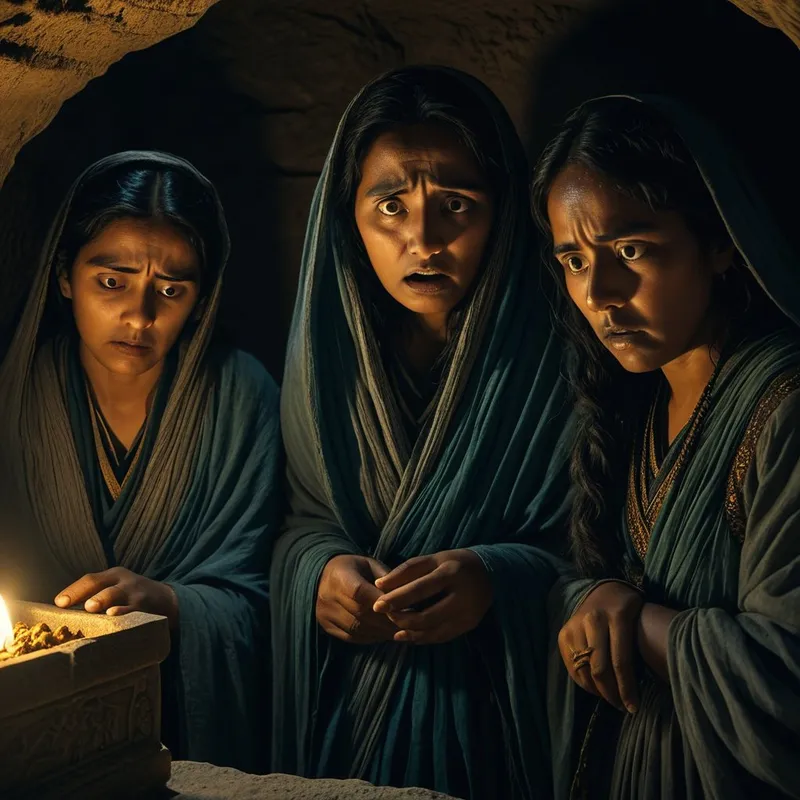
In that pre-dawn grey, when shadows are longest and hope is a forgotten language, three women moved through the olive groves. Mary of Magdala, her soul scoured raw by witnessing the unthinkable, led the way. With her were Mary, the mother of James, and Salome. Their hands clutched linen bundles of aloes and spices—a final, tender rebellion against decay, a ritual to anoint what the world had declared finished. Their whispered question hung in the chill air: “Who will roll away the stone for us?”
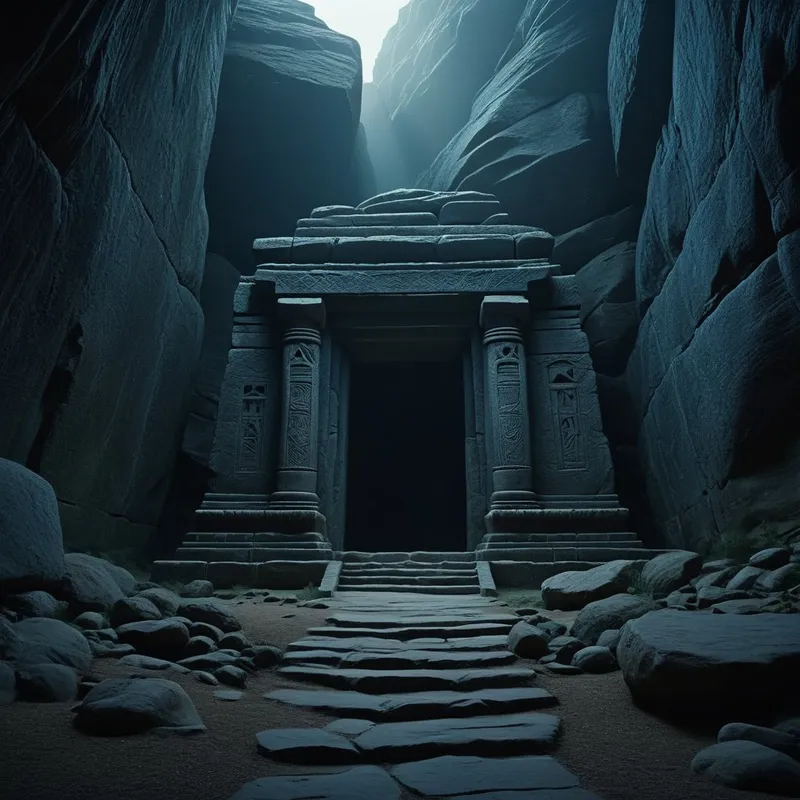
They arrived at the tomb hewn into the rock, a place of finality. But the stone—a massive disk meant to seal fate itself—was not in its place. It was rolled aside, a gaping maw in the hillside. The seal of Rome was broken. The order of the world was fractured.
Trembling, Mary Magdalene peered into the darkness. The stone slab where the body had been laid was there, but the linen wrappings lay collapsed, empty, like the shed skin of a serpent. A young man clothed in a radiant white robe sat where the head had been. “Do not be alarmed,” he said, his voice echoing strangely in the small space. “You seek Jesus of Nazareth, who was crucified. He is not here. He has been raised. See the place where they laid him.”
The words did not compute. They were a language of impossible physics. The women fled, terror and ecstasy warring in their hearts, their message of resurrection seeming to them, and to the disciples who heard it, like the ravings of the grief-mad.
But Mary Magdalene returned. She stood alone in the garden, weeping at the emptiness. She saw two figures in white where the body had been. “Woman, why are you weeping?” they asked. “They have taken my Lord,” she sobbed, “and I do not know where they have laid him.”
Turning, she saw a man she took for the gardener. “Sir, if you have carried him away, tell me where you have laid him.” Then he spoke her name. “Mary.” And in that single word, spoken with a familiar, impossible tenderness, the universe reconfigured. The tomb was not a monument to absence, but a portal. The gardener was the Christ. Death had been outmaneuvered. The stone was not a barrier removed, but a threshold crossed.
Cultural Origins & Context
This narrative emerges from the heart of 1st-century Judea, a culture steeped in Hebrew scripture and living under the brutal Pax Romana. The empty tomb story is the foundational kernel of the Christian movement, appearing in all four canonical Gospels with variations in detail, but a unified core: the women discover the empty tomb and are the first witnesses to the resurrection.
Its transmission was oral before it was textual, told in secret gatherings and public squares as a kerygma—a proclamation of shocking, good news. The tellers were not dispassionate historians but evangelists, witnesses claiming this event changed everything. Societally, it functioned as the ultimate vindication for a marginalized sect. Their executed leader was not a failed rebel, but the victor over humanity’s oldest, deepest tyrant: death itself. It inverted the world’s power structure, declaring that the way of love and sacrifice, not the way of the sword and the throne, held ultimate authority.
Symbolic Architecture
The empty tomb is not a symbol of vacancy, but of potent, pregnant absence. It represents the moment the container can no longer hold the contents. Psychologically, it maps the crisis point where an old identity, a worn-out complex, or a foundational belief system dies and is discovered to be gone.
The tomb is the hardened psyche, the calcified self-concept. The emptiness within is not an end, but the space where transformation becomes possible.
The rolled-away stone symbolizes the removal of a final, seemingly insurmountable obstacle—often our own despair, cynicism, or rigid worldview. The linen wrappings left behind are the shed trappings of the former self, the empty husk of a life outgrown. The figure mistaken for the gardener is profound: new life emerges not in celestial fireworks, but in the humble, grounded reality of our everyday world, often in a form we do not initially recognize.
The Dreamer's Resonance
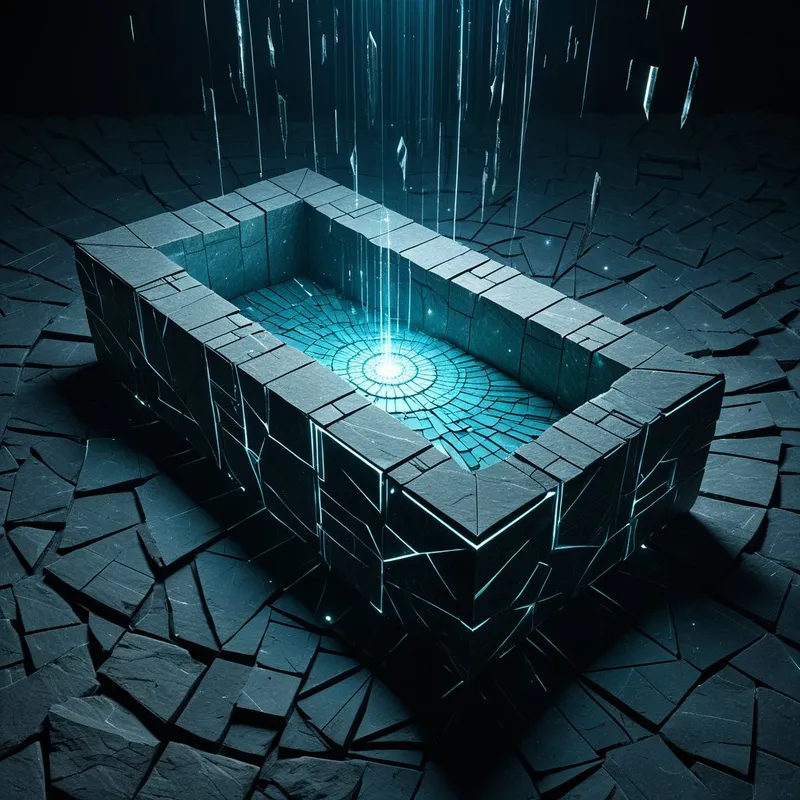
When this mythic pattern stirs in the modern dreamer, it signals a profound somatic and psychological process. To dream of finding an empty coffin, a vacant room that once held a feared presence, or a shattered vault is to experience the psyche’s report on a deep-level death-and-rebirth sequence.
The somatic feeling is often one of disorienting shock followed by eerie stillness—a cold sweat, a racing heart that suddenly goes quiet. Psychologically, the dreamer is navigating the discovery that a core wound, a long-held grievance, or a defining trauma has lost its psychic charge. The “body” of that old pain is gone. The conflict is not with the pain itself anymore, but with the terrifying freedom of its absence. The dream asks: Can you bear the responsibility of this emptiness? Can you stop weeping for what was and recognize the new life already addressing you by name in the garden of your own soul?
Alchemical Translation
The alchemical process mirrored here is the nigredo giving way to the albedo—the blackening of despair transformed into the whitening of illumination. The myth models the complete cycle of individuation: the conscious acceptance of death (the crucifixion), the necessary descent into the tomb of the unconscious (the three days), and the ultimate, integrative return that changes the very fabric of the personality.
The triumph is not in avoiding the tomb, but in passing through it and finding it cannot hold you. The old self must be rendered utterly to ash and void before the phoenix of the true self can rise.
For the modern individual, the “empty tomb” moment occurs when we realize our cherished suffering, our victim identity, or our ego’s fortress has become a hollow shell. The work is to stop anointing the corpse of the past with the spices of nostalgia or resentment. It is to turn away from the dark cavity and, bewildered, step into the garden. There, the transformed consciousness—the Self—often appears in the humble guise of a gardener, inviting us to tend the new, fragile life now growing in the plot where we once buried our hopes. The empty tomb is the ultimate argument for the psyche’s indestructibility, a mythic compass pointing always from crucifixion to resurrection, from containment to liberation.
Associated Symbols
Explore related symbols from the CaleaDream lexicon: