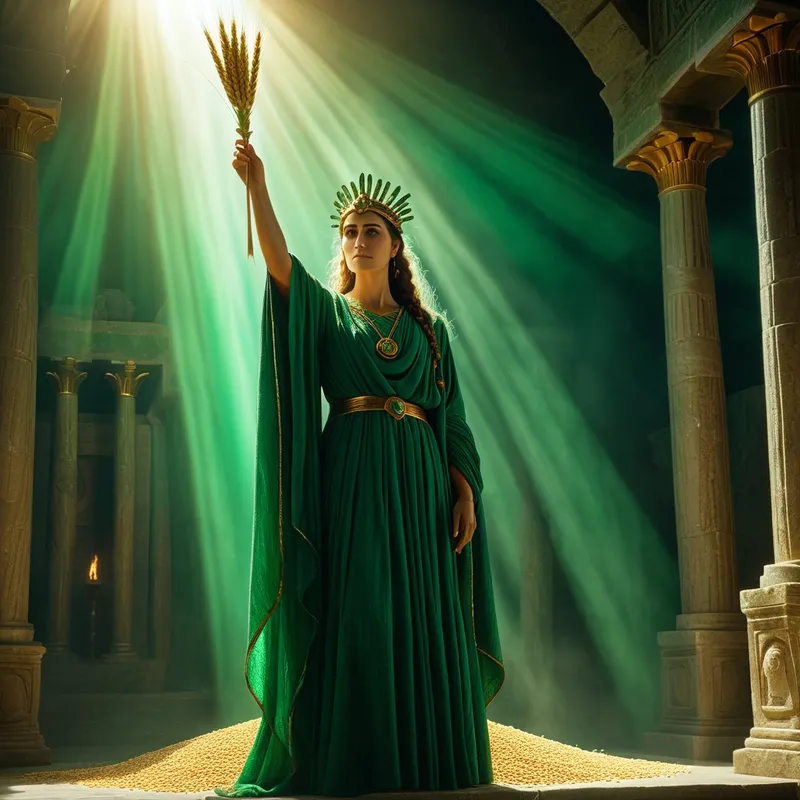
Eleusinian Mysteries Myth Meaning & Symbolism
The sacred rites of Eleusis, born from Demeter's grief and Persephone's descent, promised initiates a blessed afterlife through the mystery of the grain.
The Tale of Eleusinian Mysteries
Hear now the story that was never spoken aloud in the marketplace, the tale whispered only in the dark of the sacred hall. It begins not with a shout, but with a silence—the terrible silence of a mother’s stolen joy.
The world was golden. Demeter, her hair the color of ripe barley, walked the fields, and the earth laughed with fruitfulness. Her daughter, Kore, whom we call Persephone, was that laughter made flesh. She danced in a Nysian meadow, a circle of bright flowers at her feet. The scent of violet and rose was thick in the air. She reached for a narcissus, a bloom of hypnotic beauty, and as her fingers closed around the stem, the earth beneath her feet cracked open with a sound like a mountain sighing.
From the chasm came a chariot of black adamant, drawn by immortal steeds whose breath was mist. Hades, Lord of the Many Guests, seized her. His grip was as final as the grave. Kore’s cry was swallowed by the closing earth. All that remained was the trampled circle of flowers and the echo of her girdle tearing loose.
Demeter felt the void in her soul before she saw the empty meadow. For nine days and nine nights, she roamed the earth, a torch in each hand, her divine form cloaked in mortal grief. She drank no nectar, ate no ambrosia. The sun burned, the rain fell, but she was insensible to all but loss. She learned the truth from the all-seeing Helios, and her sorrow turned to a cold, cosmic rage.
She withdrew her grace. The fertile soil turned to dust. Seeds shriveled in the ground. Mankind faced extinction, and the gods of Olympus trembled before the famine. In her wanderings, disguised as an old woman, Demeter came to Eleusis. There, in the palace of King Celeus, she nursed the prince Demophoön, anointing him with ambrosia and holding him in the hearth’s fire to burn away his mortality. When the queen Metaneira screamed in terror, the goddess revealed her true, awesome form. In her anger and grief, she commanded a temple be built for her at Eleusis.
There, in her new temple, she sat. The world grew barren. Finally, Hermes, at the command of a concerned Zeus, descended to the sunless land. He found Persephone, now Queen of the Underworld, seated beside a stern Hades. She had eaten. A single seed—some say three, or four—of a pomegranate, the fruit of binding. That taste was a covenant. Because of it, she could not be wholly free.
A compromise was struck in the silent halls of fate. For two-thirds of the year, Persephone would walk in the light with her mother, and the earth would bloom. For one-third, she would reign in the dark beside her husband, and the earth would mourn. Demeter accepted this law. She restored life to the fields. But before leaving Eleusis, she took the kings aside—Celeus, Triptolemus, and others—and she showed them. She revealed her sacred rites, her dromena. She gave them the gift of the grain and, with it, a hope that pierced the final darkness. This was the Mystery.

Cultural Origins & Context
The myth was not merely a story for the Eleusinian Mysteries; it was their divine charter and beating heart. Centered at the sanctuary of Eleusis, just west of Athens, these rites were the most famous and revered of all ancient Greek secret religious ceremonies. For nearly two millennia, from the Mycenaean era well into the Roman period, initiates—mystai—from all walks of life, enslaved and free, Greek and later Roman, made the sacred procession from Athens to Eleusis.
The myth was enacted, not just recited. The public aspects involved the procession along the Sacred Way, ritual bathing in the sea, and fasting. The core secrets, the aporrheta (unrepeatable things), occurred inside the great hall, the Telesterion. Here, in a powerful multi-sensory experience involving darkness, sudden light, sacred objects (hiera), and likely a dramatic re-presentation of the myth of Demeter and Persephone, the initiate underwent a profound psychological shift. The function was clear: to conquer the fear of death. As the Aristophanes has a chorus say of the initiated, "For them alone is there life; all others suffer evil."
Symbolic Architecture
At its core, the myth is an archetypal map of the soul’s necessary journey through loss, disintegration, and reconstitution on a higher plane. Demeter represents the conscious, nurturing, life-giving principle—the ego that seeks to maintain order, growth, and connection. Persephone is the soul, the nascent psyche, or the vital connection to life that is suddenly and traumatically severed by an encounter with the unconscious (Hades).
The descent is not a punishment, but a fate—the inevitable encounter with the aspects of reality (death, loss, the unconscious) that the conscious mind cannot control or keep in the light.
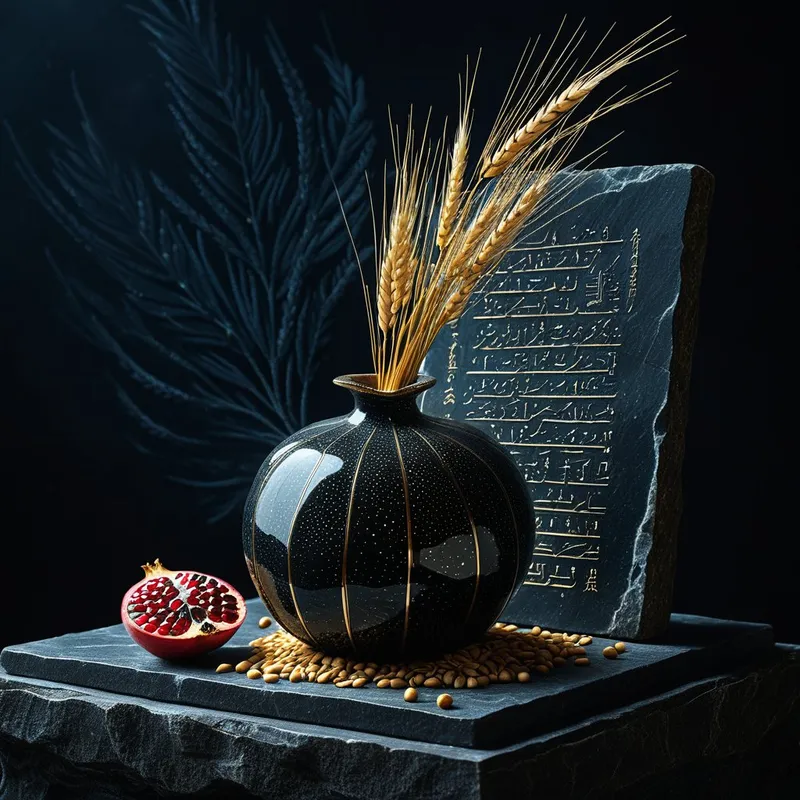
The pomegranate seed is the critical symbol of integration. To eat the food of the underworld is to internalize the experience of the dark. It means one can never again be the innocent maiden (Kore); the experience changes you fundamentally, granting a new, sovereign identity (Persephone, Queen). The cyclic resolution—the annual return—symbolizes the understanding that life and death, joy and grief, consciousness and the unconscious, are not opposites in eternal conflict, but partners in a sacred, eternal dance. The grain, which must be buried (die) to sprout (live), is the perfect emblem of this mystery.
The Dreamer's Resonance
When this myth stirs in the modern dreamer, it often manifests as dreams of sudden, unexplained loss or abduction: a cherished object vanishes, a loved one disappears without a trace, or the dreamer finds themselves in a descending elevator, a tunnel, or a suddenly unfamiliar basement. The somatic feeling is one of hollow dread, a chilling vacuum.
Psychologically, this signals an involuntary initiation—a "numinous rape" by the unconscious. The ego is being compelled to release its tight identification with the "sunlit world" of persona, achievement, and known identity. The dreamer is not necessarily facing literal death, but the death of a stage of life, a cherished self-image, or a controlling narrative. The recurring motif of searching, often fruitlessly, mirrors Demeter’s frantic journey. The process, though painful, aims at the creation of a more complex and resilient self, one capable of holding the tension between the upper and lower worlds.
Alchemical Translation
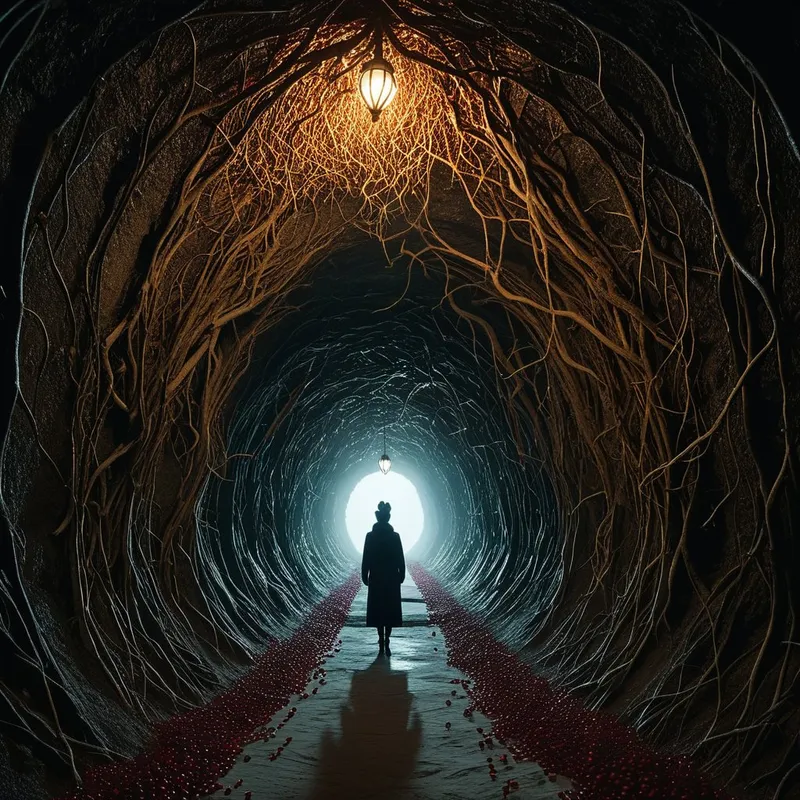
The alchemical journey of individuation follows the Eleusinian path precisely. The initial state is the viriditas, the green flourishing of the conscious personality (Kore in the meadow). The nigredo, the blackening and descent, is initiated by a shock from the unconscious (Hades’ abduction)—a depression, a crisis, a failure that "steals" one’s light.
The work in the darkness is the mortificatio: the seeming death of the old self. Demeter’s temple at Eleusis, where she sits withdrawn, is the vessel for this dissolution. One must learn to sit in the barren field of one’s grief and rage without premature consolation.
The pomegranate seed is the moment of coniunctio, the sacred marriage. It represents the conscious acceptance and integration of the shadow—the parts of oneself that feel "underworldly," dark, or rejected. One must "taste" this reality and claim it. This is what transforms the Maiden into the Queen, granting authority over the realm of the deep psyche.
The final return is the albedo and rubedo—the whitening and reddening. It is not a return to the old innocence, but a cyclical renewal with gained wisdom. The initiate, like the grain, emerges with a "firm and blessed hope" for the entirety of the journey, not just the spring. They carry the knowledge that the soul is amphibious, meant to live in both worlds, and that true wholeness includes the fertile dark from which all light is eventually reborn.
Associated Symbols
Explore related symbols from the CaleaDream lexicon: