Ekkekko God of Abundance Myth Meaning & Symbolism
A myth of the hidden household god of prosperity, awakened not by grand deeds but by humble, consistent offerings, revealing that abundance flows from sacred reciprocity.
The Tale of Ekkekko God of Abundance
Listen, and hear the whisper from the smoke-blackened rafters of a humble home high in the Andes. This is not a tale of the thunderous Inti or the earth-shaking Pachacamac. This is the story of the god who dwells in the shadows, in the forgotten corner, in the quiet breath between heartbeats.
In a time when the mountain winds sang of scarcity, there lived a woman whose name is not remembered, for her story belongs to all who have ever felt want gnawing at their bones. Her hearth was cold, her pirwa empty, her spirit worn thin as old cloth. The grand temples on the horizon offered prayers to the sky, but their echoes did not fill her bowl.
One evening, as the violet dusk settled into the stone of her dwelling, she heard not a sound, but a presence. A feeling of patient watching from a niche in the wall, where shadows pooled deepest. There was no majestic form, only a suggestion—a small, rounded stone that seemed to hold the warmth of a sleeping creature. Despair had made her humble, and humility opened her senses. She did not demand. She had nothing to demand with.
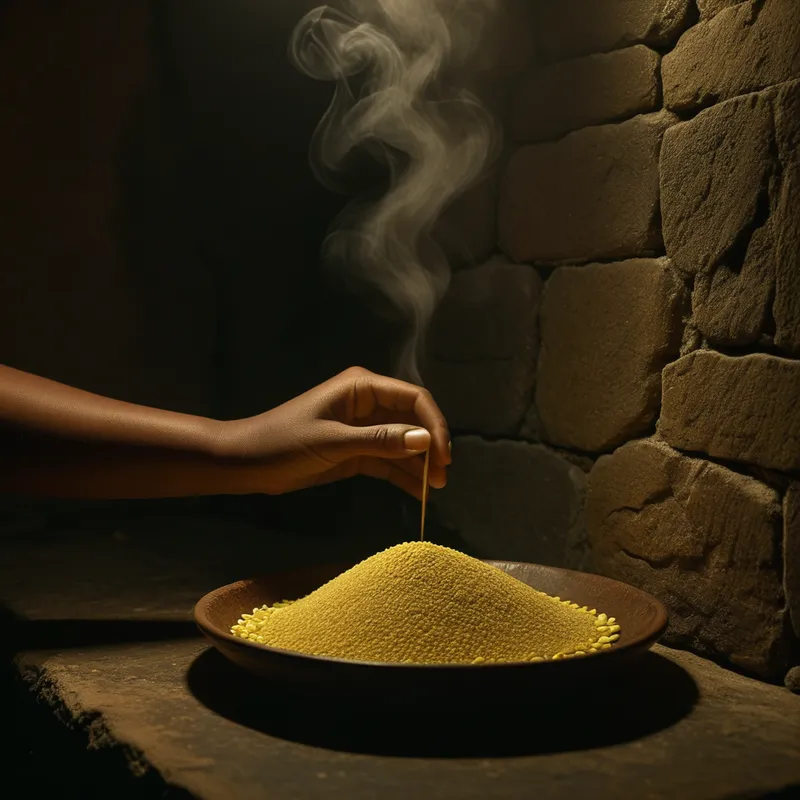
Instead, she took the last pinch of sara meal from her pouch. It was dust, barely enough to taste. With a breath softer than a sigh, she offered it to the shadow in the wall. The next day, she found a single, perfect coca leaf, spared from the wind. This too, she placed in the niche. Day after day, with a consistency born not of hope, but of a newfound sacred duty, she gave. A drop of chicha, a thread from her frayed mantle, a whispered word of gratitude for the cold sunrise.
And the shadow began to stir.
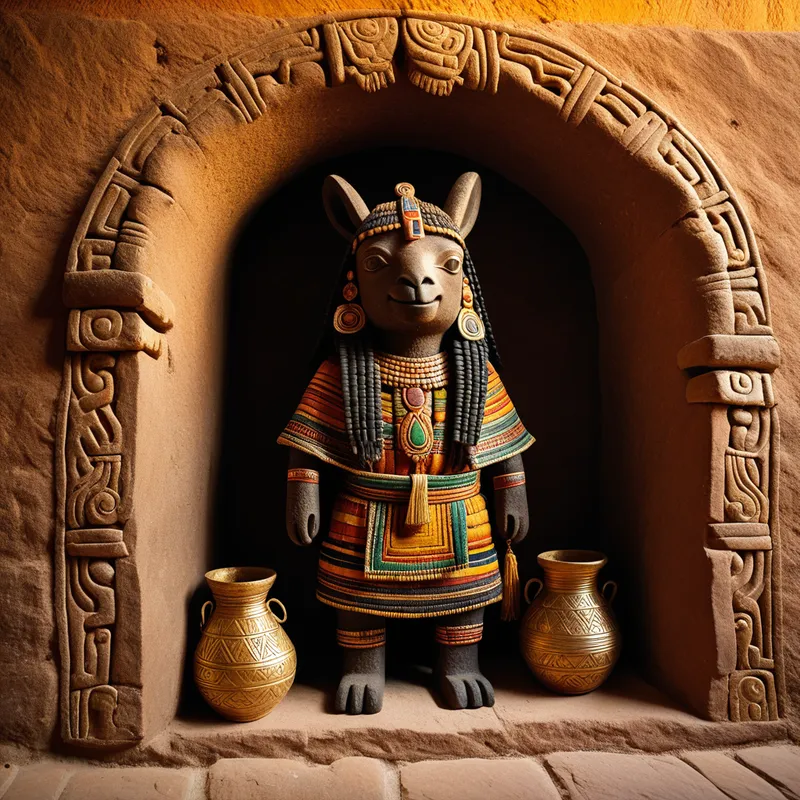
It did not roar or blaze. It swelled, quietly, like a seed absorbing moisture in the dark earth. The stone in the niche seemed to grow fuller, rounder, taking on the form of a small, smiling man, his back burdened with a multitude of tiny sacks and figurines. This was Ekkekko. He had been there all along, dormant, waiting not for a heroic summoning, but for the gentle, relentless rain of small acknowledgments. Where the woman offered a crumb, he returned a grain. Where she offered a thread, he returned a strand of wool. Slowly, steadily, the cold hearth warmed. The empty pirwa began to whisper with the rustle of stored tubers. Prosperity did not fall from the sky; it grew from that shadowed corner, spilling into her life like a slow, sure river.
Cultural Origins & Context
The myth of Ekkekko is a folk tradition, a thread in the vast tapestry of yanantin and ayni that structured the Andean world. Unlike the state-sponsored cults of the Sapa Inca, Ekkekko belonged to the domestic sphere, to the ayllu and the hearth. His stories were passed down not by official amautas, but by grandmothers and mothers, in the intimate space of the home.
His primary function was profoundly practical: to ensure the material well-being of the household. He was the spiritual embodiment of the desire for fertility in flocks, abundance in harvest, and general good fortune. Rituals involved “feeding” and clothing small figurines representing him, often loading them with miniature replicas of desired goods. This practice cemented his role as an accessible intermediary. In a cosmology where reciprocity with the earth (Pachamama) was paramount, Ekkekko translated that vast cosmic exchange into a personal, manageable dialogue within one’s own walls. He made the sacred immediate.
Symbolic Architecture
At its core, the myth of Ekkekko is a parable of the hidden potential within the mundane and the psychology of nurturing. Ekkekko himself symbolizes the dormant potential for growth and prosperity that exists in every situation, every relationship, every psyche. He is not absent; he is unattended.
The god does not reside in the spectacular, but in the consistently tended. Abundance is not a distant treasure to be seized, but a proximate force to be cultivated.
The woman represents the part of the self that operates from a perceived deficit. Her initial state is one of psychic poverty. Her transformative act is not one of grand conquest, but of subtle, repetitive offering. The coca leaf, the maize dust—these are symbols of attention, intention, and the sacrifice of the little one actually has. The myth teaches that the channel for abundance opens not through forceful taking, but through faithful giving, even when the giving seems insignificant. The resolution—the gradual filling of the home—is a powerful symbol of inner fulfillment manifesting as outer circumstance, built not on luck, but on the sacred ritual of daily care.
The Dreamer's Resonance
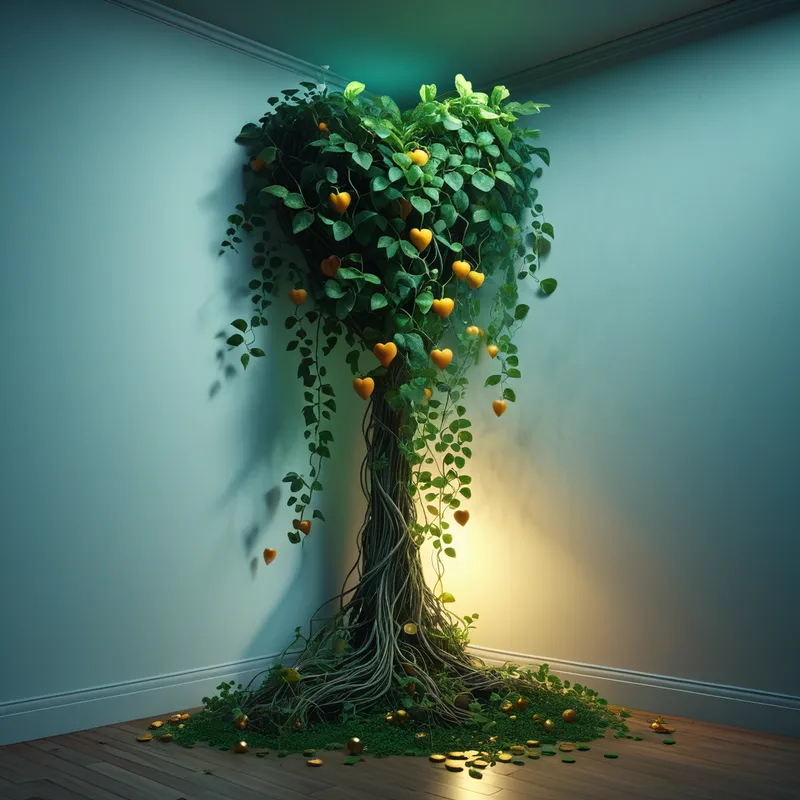
When this myth pattern stirs in the modern dreamer, it often manifests as dreams of neglected spaces: a forgotten room in one’s house brimming with possibility, a withered plant that suddenly blooms with unexpected vitality, or discovering a hidden, valuable heirloom in a cluttered drawer. Somatically, one might feel a constriction in the chest or gut—the feeling of scarcity—giving way to a sensation of warmth or gentle expansion.
Psychologically, this signals a process of recognizing and investing in one’s own latent resources. The dreamer may be ignoring a talent, a relationship, or an aspect of self-care that, while small, holds the seed of nourishment. The “Ekkekko dream” is a call from the unconscious to stop seeking salvation from external, grandiose sources (the distant sun god) and to turn attention inward and downward, to the humble, daily rituals that truly sustain the soul. It is an invitation to feed what is already there, however small it may seem.
Alchemical Translation
The alchemical process modeled here is the transmutation of scarcity consciousness into fecundity consciousness. In Jungian terms, it is the integration of the Caregiver archetype, not as a force that gives to others from an empty vessel, but as one that first establishes a circuit of nurture within the self.
The initial nigredo (blackening) is the woman’s despair and empty hearth—the felt reality of lack. The albedo (whitening) begins with her first, almost hopeless offering: the act of acknowledging the shadow in the wall. This is the crucial moment of granting consciousness to the neglected inner object. The daily rituals are the citrinitas (yellowing), the slow, patient work of repeated application—the psychological equivalent of tending a garden. One does not command a seed to grow; one provides soil, water, and light, consistently.
Individuation is often the accumulation of minor, faithful attentions to the soul’s hidden niches.
The final rubedo (reddening), the manifestation of Ekkekko’s gifts, is the achieved state where the psyche experiences itself as a source of its own abundance. The outer world reflects this inner fullness. The modern individual learns that their “gold” is not found in a single heroic quest, but forged in the daily, humble fires of attentive practice, respectful reciprocity with their own depths, and the courage to believe that the smallest offering matters.
Associated Symbols
Explore related symbols from the CaleaDream lexicon:
- Bowl of Abundance — The central vessel of the myth, representing the receptive state of the household and the psyche that is gradually filled through consistent, humble offerings.
- Hearth — The domestic center of warmth and nourishment, whose rekindling symbolizes the revival of inner vitality and the generative power of the cared-for self.
- Seed — The core symbol of dormant potential within scarcity; the tiny, overlooked offering that contains the blueprint for future growth and prosperity.
- Ritual — The disciplined, daily practice of attention and offering that awakens the dormant god, representing the transformative power of small, consistent actions.
- Shadow — The unacknowledged, neglected aspect of the self or one’s environment where potential abundance lies hidden, waiting for recognition.
- Reciprocity — The foundational principle of ayni enacted in the myth, the sacred exchange where giving, however small, activates a cycle of receiving.
- Nurturance — The core action of the Caregiver archetype, directed inward to awaken inner resources, transforming psychic poverty into self-sustenance.
- Stone — The humble, enduring form of Ekkekko, symbolizing the solid, foundational potential within the ordinary and the overlooked.
- Grain — The substance of the initial offering, representing the essential, life-giving nourishment that is both sacrificed and multiplied through the ritual of care.
- Home — The bounded, personal universe where this alchemy occurs, emphasizing that the journey toward abundance begins in one’s immediate, intimate space.