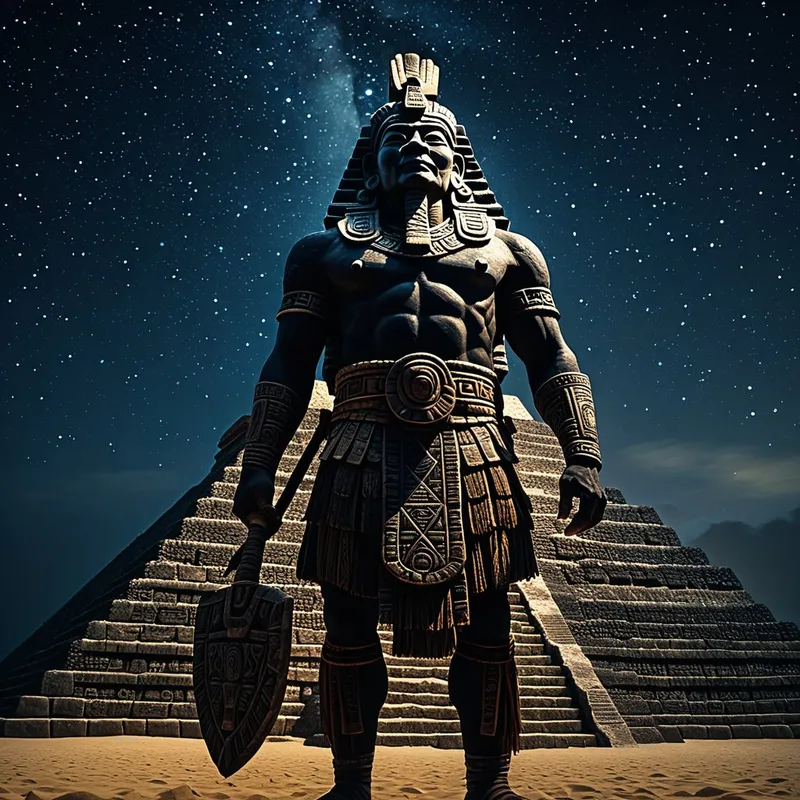
Ek Chuah Myth Meaning & Symbolism
A myth of the black scorpion god, patron of merchants and cacao, embodying the sacred tension between commerce, sustenance, and the underworld's shadow.
The Tale of Ek Chuah
Hear now the tale that travels not on the wind, but on the feet of weary men, along the white stone roads that stitch the world together. In the deep green belly of the world, where the ceiba tree’s roots drink from the dark waters of Xibalba, there walks a figure both feared and beseeched.
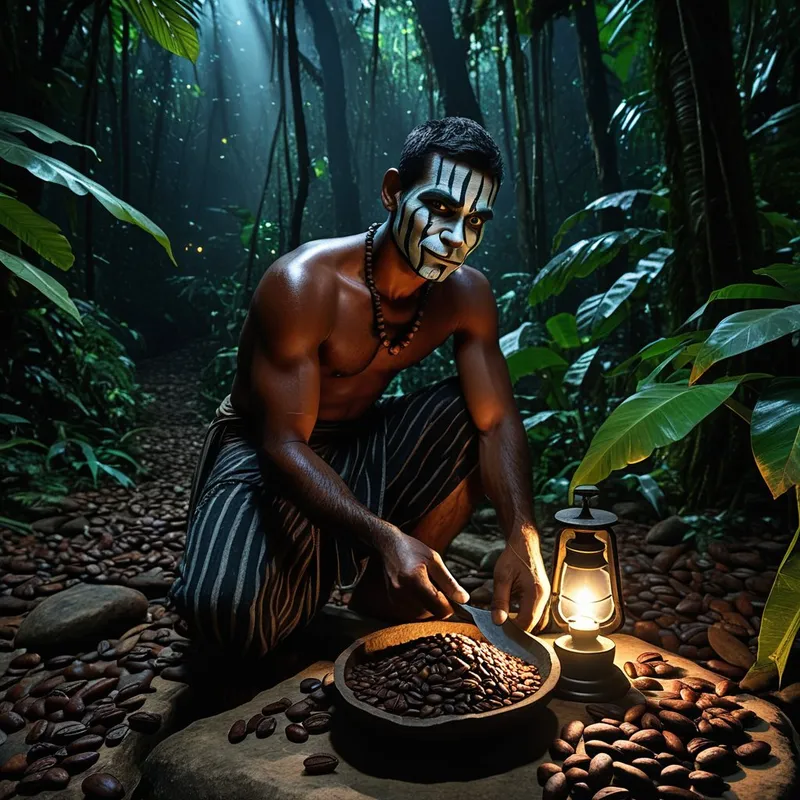
He is the Black One, Ek Chuah. His skin is the color of a starless midnight, painted with the soot of sacred fires. His mouth is a grim slash, his lower lip hanging long and heavy, as if weighted down by all the silent bargains ever struck. On his back, he carries a universe of possibility: a merchant’s pack, bulging with strange spices, gleaming obsidian, brilliant quetzal feathers, and most precious of all, the wrinkled, bitter beans of the cacao.
He walks the sacbeob, the white roads, but his true path is the shadowed one between worlds. By day, he is the patron of the ppolom, the long-distance merchants, their faces striped in his honor. They chant his name to ward off bandits and jaguars, their loads heavy with the wealth of distant cities. But when the sun dies and the Camazotz take flight, Ek Chuah’s other nature stirs.
His merchant’s staff becomes a spear. The peaceful pack now holds the tools of war. For he is also a god of conflict, a scorpion of the marketplace and the battlefield. The same hand that carefully weighs cacao beans on a stone scale can unleash violence to protect the caravan, or to claim a price in blood. His journey is one of perpetual tension, a sacred, trembling balance. The conflict is not in a great battle, but in every step, every transaction, every silent prayer offered at a wayside shrine—a small bloodletting, a few precious beans scattered in offering, to keep the Black One’s favor, to ensure the safe passage of goods and soul through the perilous, beautiful world.
Cultural Origins & Context
This was not a myth told in grand epics around a single fire, but one lived in the dust of the road and the hushed atmosphere of the marketplace. The stories of Ek Chuah were embedded in ritual and daily practice, passed down among guilds of merchants who operated as the circulatory system of the Mayan world. His veneration was pragmatic and profound.
He appears in the Madrid Codex, depicted with his distinctive attributes, often in scenes of merchant ritual. His priests were likely the merchants themselves, performing autosacrifice—piercing their tongues or ears—to sanctify a journey or a deal. The myth functioned as a sacred framework for an incredibly risky profession. It acknowledged the inherent duality of their role: bringers of life-giving trade (cacao was currency, food, and ritual drink) who constantly skirted the edge of death from natural disaster, illness, or violence. Ek Chuah embodied that liminal space, making him not just a protector, but the very personification of the merchant’s complex, shadowed soul.
Symbolic Architecture
Ek Chuah is a master symbol of necessary synthesis. He represents the point where opposites are forced into a single, walking, breathing entity.
The Pack and The Spear: This is the core duality. The pack holds sustenance, culture, connection, and life (cacao). The spear represents defense, aggression, conflict, and the potential for death. One cannot travel with wealth without the capacity to protect it; one cannot engage in the cutthroat world of trade without a warrior’s resolve. Ek Chuah says these are not two separate choices, but two sides of the same hand.
The Cacao Bean: This is the alchemical heart of the myth. The cacao bean is bitter, ugly, and hard. Yet, through human effort (fermentation, roasting, grinding), it is transformed into a luxurious drink, a currency, a sacred offering. It is the raw, undervalued potential that, through the journey and the "trade" of effort, becomes gold.
The Black Scorpion: Often associated with him, the scorpion is a creature of the earth and shadow, carrying a deadly sting yet moving with purposeful, patient grace. It symbolizes self-protection, hidden danger, and the transformative poison that, in the right context, can be medicine.
The god of the marketplace is also the god of the battlefield because every true exchange demands a sacrifice, and every journey into value requires the courage to face the shadow.
Psychologically, Ek Chuah represents the complex—a bundle of thoughts, emotions, and impulses that cluster around a core theme, in this case, the theme of "value and its cost." He is the archetype of the Magician, the master of transformation who understands the hidden laws of exchange and knows that to get something of value, something of equal value must be given, often from within oneself.
The Dreamer's Resonance
When the pattern of Ek Chuah stirs in the modern unconscious, it rarely appears as a literal figure. Instead, one dreams of heavy burdens—a backpack that grows heavier with each step, a suitcase whose contents are unknown. One dreams of journeys through liminal spaces—endless airport corridors, dark forest paths, or the aisles of a vast, empty supermarket at night.
There is often a transaction: trying to pay with the wrong currency, having your most precious item deemed worthless, or being forced to barter something deeply personal. The somatic feeling is one of weighted anxiety, a tension between the desire to put down the load and the terror of being robbed or left empty-handed. This is the psyche working through its own "economy of the soul." What are you carrying? What is your cacao—your raw, bitter potential? And what is the spear you must wield to protect it? The dream asks you to acknowledge the cost of your own endeavors, the shadow side of your ambitions and trades.

Alchemical Translation
The individuation process modeled by Ek Chuah is the Alchemy of the Deal. It is the psychic work of moving from a naive state, where we believe gain can come without cost, to a conscious state where we recognize every creation, every relationship, every step forward requires a sacred exchange.
First, one must shoulder the pack: Acknowledge your desires, your talents, your "goods" you wish to bring to the world. This is the cacao—it may seem unremarkable or bitter now.
Then, one must take up the spear: This is the harder step. It means consciously accepting the shadow aspects required to manifest your value. The aggression to set boundaries. The discipline to stay the course. The willingness to "go to war" against internal laziness or external resistance. It is the sacrifice of comfort for growth.
The journey itself is the transformation: As you walk your path—your career, your art, your relationships—the friction of the road, the encounters with others (the "marketplace"), and the necessary acts of self-protection ("war") ferment and roast your raw potential. The bitter bean becomes the sustaining drink. The effort becomes expertise. The sacrifice becomes strength.
Individuation is the long-distance trade route of the soul. You depart with raw material and return, transformed, having learned that the greatest profit is not in the gold you acquire, but in the trader you become.
Ek Chuah does not promise safe passage; he is the perilous passage. He is the embodied truth that our highest value is forged in the crucible of risk, effort, and conscious engagement with the dark. To honor him is to stop wishing for an easy path, and instead, to paint your face with the stripes of your intent, shoulder your unique burden, grasp the spear of your resolve, and begin the sacred, shadowed walk towards your own worth.
Associated Symbols
Explore related symbols from the CaleaDream lexicon: