Eikþyrnir Myth Meaning & Symbolism
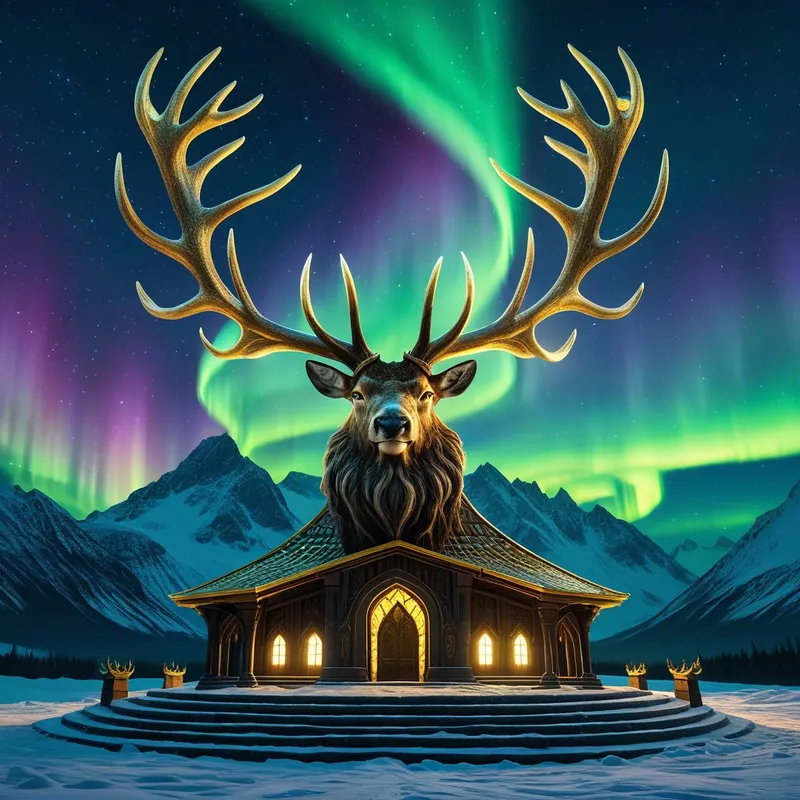
A celestial stag stands atop Valhalla, its antlers dripping dew into the worlds below, feeding the rivers of fate and sustaining the great tree of life.
The Tale of Eikþyrnir
Hear now, and listen well, for the winds that whip the high halls of the gods carry a tale not of thunder, but of quiet, ceaseless giving. In the realm of Valhalla, where the roof is thatched with golden shields and the rafters are spears, a sound softer than the clash of einherjar practice can be heard. It is the sound of dew falling.
Upon that golden roof, where no mortal foot may tread, stands a creature of pure, celestial majesty. His name is Eikþyrnir, “Oak-Thorny One.” He is a stag, but no beast of the earthly woods. His coat is the grey of morning mist over a mountain, and his antlers… ah, his antlers are a forest unto themselves, vast and branching, reaching towards the stars as if to gather the very light of the heavens. He stands, a silent, eternal sentinel upon the hall of the chosen dead.
And from the tips of those mighty antlers, a miracle drips. Not blood, not sweat, but dew. A constant, gentle weeping of moisture so pure it holds the light of the sun and the chill of the moon within it. This dew falls, not in vain upon the golden shields, but finds its destined path downward, through the layers of being.
It falls into the deep, dark well named Hvergelmir, the “Roaring Kettle,” that seething source from which all waters spring. And from Hvergelmir, the dew of Eikþyrnir is drawn forth, transformed, and sent coursing through the veins of the world. It becomes the rivers that feed the lands of gods and men, the streams that nourish the roots of the great Yggdrasil itself. The stag upon the roof does not fight, does not feast, does not speak in sagas. He simply is, and from his being, the worlds below are sustained. His is the silent, dripping heartbeat of the cosmos, a gift from the place of final glory to the roots of all life.
Cultural Origins & Context
The myth of Eikþyrnir is preserved for us in a single, potent stanza of the Grímnismál, one of the mythological poems of the Poetic Edda. Spoken by the god Odin himself while disguised and tortured, the poem is a litany of cosmic knowledge, a recitation of the hidden structures of the universe. Eikþyrnir is not the subject of a grand saga, but a piece of esoteric lore, a detail in the vast tapestry.
This tells us much. The myth was not a popular tale for the feasting hall, but deeper gnosis, shared by the god of wisdom and ecstasy. It functioned as a piece of sacred cosmology, explaining the hidden hydrological cycle of the Norse cosmos. It answered the profound question: how does life persist? The answer was not merely in the strength of Thor’s arm or the cunning of Odin, but in a quiet, automatic, and sacrificial process emanating from the very pinnacle of the warrior’s paradise. It connected the glorious end of the heroic path (Valhalla) directly to the sustenance of the world tree and all creation, suggesting that even in death and triumph, there is a duty of nourishment that flows back into the system.
Symbolic Architecture
Eikþyrnir is an entity of profound paradox. He stands atop the hall of frenzied, martial glory, yet embodies serene, passive fecundity. He is the pinnacle of a warrior’s aspiration, transformed into a font of gentle, life-giving moisture.
The highest achievement becomes not an end, but a vessel; the crown of the self is made to weep for the nourishment of the roots.
The stag is a near-universal symbol of spiritual aspiration, vitality, and connection to the forest (the unconscious). His antlers, shed and regrown, speak of cycles, renewal, and the branching complexity of thought and spirit. To place this symbol upon Valhalla’s roof is to state that the ultimate integration of the heroic, battling ego (the einherjar) results not in static reward, but in a transformation into a function. The ego’s struggle culminates in the ego becoming a conduit for something greater than itself.
The dew (dǫgg) is the distilled essence of the night, a liminal substance between sky and earth. It is not the torrential rain (chaos) or the solid ice (stasis), but the gentle, persistent gift. Eikþyrnir’s antlers act as a celestial condenser, drawing the intangible (starlight, cosmic potential) into a tangible, life-sustaining liquid. This is the alchemy of spirit into sustenance.
Finally, the flow is unequivocally downward. From the roof (the crown, achievement, consciousness) into the well (the source, the unconscious, the primal chaos of Hvergelmir), and then out through the roots (foundations, stability, connection). The myth beautifully inverts our typical focus on ascent. True power, it suggests, is proven not by how high one climbs, but by what nourishing influence one’s elevated state can rain down upon the depths from which one came.
The Dreamer's Resonance
When the image of Eikþyrnir stirs in the modern dreamer’s psyche, it often signals a critical phase of psychic integration. One may dream of a magnificent, silent animal observing from a high place, or of a structure (a house, a tower, one’s own head) from which a vital liquid slowly drips, feeding a garden or tree below.
Somatically, this can correlate with a release of tension from the crown of the head or the spine—a feeling of “melting” or gentle flowing after a period of intense mental or striving exertion. Psychologically, the dream speaks to the process of allowing one’s hard-won achievements, insights, or elevated status to become generative for the rest of the personality.
The individual may be struggling with a “Valhalla complex”: they have reached a goal, won a battle (career, creative, personal), but find the pinnacle lonely or strangely barren. The Eikþyrnir pattern emerges as the soul’s imperative to transform that trophy into a tool for nourishment. The dream asks: What dew drips from your antlers? How does your highest self feed your deepest roots? It is a call away from heroic isolation and towards ecological responsibility within one’s own psyche.
Alchemical Translation
In the vessel of individuation, the myth of Eikþyrnir models the stage following the coniunctio or major synthesis. The battle (the nigredo, the struggle) is done for now; the ego has attained its hall of recognition. The alchemical danger here is stagnation—becoming a glorious, static statue upon one’s own roof.
The work is never done. The final test of the integrated self is whether it can become a self-sustaining system that also sustains the world.
The Eikþyrnir process is the transmutation of achievement into essence. The gold won in the inner battle is not to be hoarded, but must be liquefied—made fluid and applicable. This is the creation of the aqua vitae, the water of life, from the solid lapis. The antlers represent the complex, branching structure of the now-sophisticated psyche. They do not grasp or gore; they condense and channel.
For the modern individual, this translates to a conscious practice of “dripping dew.” It is the author using their hard-won skill to teach others, not just to produce masterworks. It is the executive using their position and resources to create systems that empower and nourish their team and community. It is the individual, after deep personal therapy, allowing their healed perspective to gently inform and nurture their relationships and environment, rather than wearing their healing as a badge of superiority.
The myth assures us that this downward flow is not a diminishment, but the completion of the cycle. By feeding the roots of Yggdrasil—our own foundational being and our interconnected world—we ensure that the tree, and we upon its branches, do not wither. We move from being a hero on the roof to becoming a vital, sustaining function in the great, breathing organism of life.
Associated Symbols
Explore related symbols from the CaleaDream lexicon: