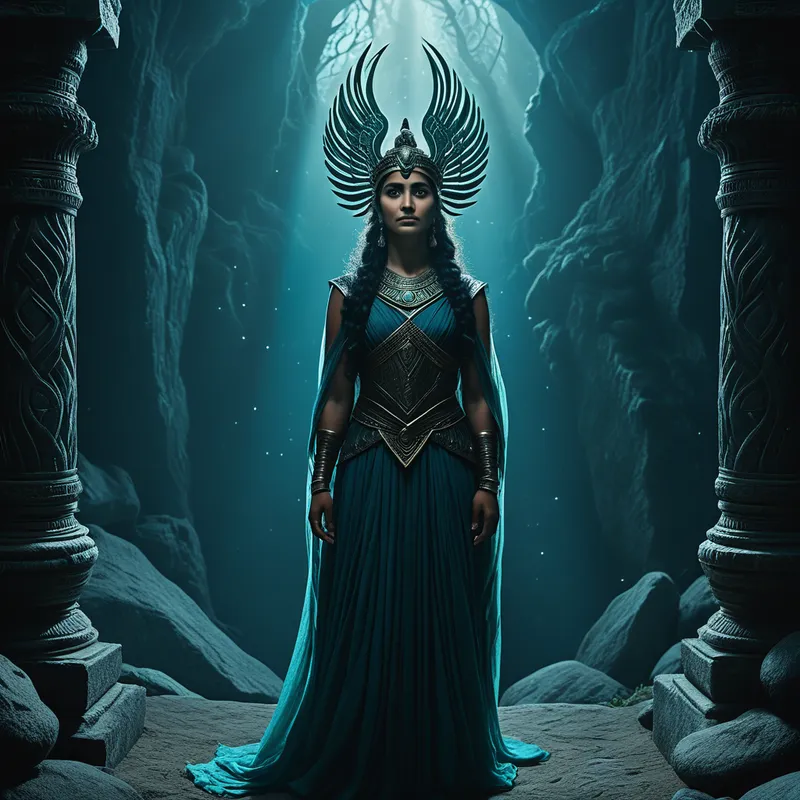
Ehecatl Wind God
The Aztec wind deity who brought life-giving breezes and destructive storms, intimately connected to creation myths and the movement of celestial bodies.
The Tale of Ehecatl Wind God
In the time before time, when the world lay formless and silent under the primordial waters, a breath stirred in the darkness. This was Ehecatl, the Wind. He was not yet a god with a face, but a presence, a pressure, a potential for motion in the stagnant deep. When the great dual divinity, Ometeotl, willed the sun and the dawn into being, it was Ehecatl who was summoned first. His was the sacred task of clearing a path through the chaotic waters, of carving out space for creation itself. He swept across the void with a mighty roar, pushing back the endless sea, and in the hollow of his passing, the first land emerged.
Yet his most profound tale is woven with the fate of the suns. After the gods created the Fourth Sun, a world of water, it was destroyed by a catastrophic flood. The heavens themselves fell, crushing the earth. In the profound stillness that followed, the gods gathered at the sacred city of Teotihuacan. A new sun was needed to set the cosmos in motion once more, but it required a sacrifice—a god must leap into a divine, consuming fire. Two noble gods stepped forward: the proud, rich Tecuciztecatl and the humble, diseased Nanahuatzin. As the great brazier blazed, Tecuciztecatl faltered in fear. Nanahuatzin, without hesitation, threw himself into the flames and emerged as the brilliant Fifth Sun, Tonatiuh. Shamed, Tecuciztecatl followed, becoming the pale Moon.
But the new sun hung motionless in the sky, blazing fiercely. It would not move. Without its journey across the heavens, time was frozen; life could not begin its cycles. The gods knew a final, ultimate sacrifice was required. Only the wind could move the sun. And so Ehecatl, taking the form of the feathered serpent Quetzalcoatl, blew with all his force. His gale was not enough. He then summoned the other winds, the Ehecatotontli, but still the sun remained fixed, scorching the earth below.
Understanding the necessity, Ehecatl turned his breath inward, drawing the very essence of life from the gathered gods. In a moment of collective offering, the wind god became the instrument of their sacrifice. He blew again, a gust forged from divine will and mortality, and this time, the sun shuddered. It began to move, to journey from east to west, initiating the dawn, the day, the night—the rhythm of the world. But to keep it moving, to prevent it from stalling and burning all creation, Ehecatl’s breath had to become constant. He became the ceaseless wind that pushes the sun on its path, a breath that is both the animating force of life and a reminder of the sacrifice that sustains it. He is the gentle breeze that brings rain clouds and the hurricane that tears them apart, forever dancing his duality across the plains of heaven and the face of the earth.
Cultural Origins & Context
Ehecatl was not merely a weather phenomenon personified; he was a fundamental cosmological principle for the Aztecs, the Nahua peoples of central Mexico. His worship dates back to earlier Mesoamerican traditions, finding a profound synthesis in the Postclassic Aztec worldview. As a manifestation of the vital force of movement, he was intrinsically linked to Quetzalcoatl, one of the most complex and revered deities. Ehecatl-Quetzalcoatl represented the breath of life, the wind that brings the rains, the intellectual spirit that sweeps away stagnation, and the gentle air that carries the prayers of the people to the gods.
His temples were architecturally unique, built as circular structures to minimize wind resistance, ensuring his essence would not be angered by corners. These round temples stood in stark contrast to the pyramidal bases of other gods, a physical testament to his fluid, unbounded nature. Priests would invoke him for favorable winds for travel and commerce, for the arrival of the life-giving rains, and for the cleansing of spiritual and physical miasma. Yet this supplication was always tempered with fear, for the same force that guided the clouds could summon a storm that flattened crops and homes. Ehecatl thus occupied a sacred, ambivalent space—a god whose presence was daily felt, whose necessity was unquestioned, and whose wrath was deeply feared. He was the palpable interface between the stable earth (Tlalticpac) and the dynamic, often perilous, forces of the upper heavens.
Symbolic Architecture
Ehecatl’s mythology constructs a symbolic architecture where wind is the primary medium of relationship. He is the connector between stillness and motion, sacrifice and animation, death and life. His breath is the first act of differentiation in the cosmic womb, separating the waters to create space. This establishes wind not as an element, but as the process that allows other elements to exist in relation.
He represents the psychic principle of pneuma—not just air, but the animating spirit. In the human soul, Ehecatl is that catalytic inner wind that must blow to disrupt stagnation, to move a frozen "sun" of potential into the arc of actualized life. This movement always requires a sacrifice of what is static and comfortable.
His role in moving the sun is the core of this architecture. The sun, a symbol of consciousness and luminous order, is inert without the wind. This illustrates a profound psychological truth: brilliant awareness or intention alone is powerless without the motivating force of spirit, the breath of passion, will, and sometimes, desperate necessity. Ehecatl’s duality—life-giver and destroyer—mirrors the nature of this animating spirit. The same inner wind that inspires creativity can, if unintegrated, become a whirlwind of anxiety or rage that scatters the self. His circular temples are mandalas of this integrated psyche, where the spirit flows without obstruction, without the sharp corners of dogma or rigid identity that would cause turbulent, damaging psychic eddies.
The Dreamer's Resonance
To encounter Ehecatl in the imaginal realm—whether in dream, vision, or active imagination—is to encounter the archetypal force of change itself. He is the atmosphere of a transformative moment. Dreaming of a powerful, purposeful wind often signals that a long-static situation in the dreamer’s life is being compelled to move. A gentle, guiding breeze may suggest the arrival of inspiration or a new spirit entering one’s life, while a destructive gale speaks to necessary, if violent, upheaval—the tearing down of outdated structures within the psyche to make way for something new.
Ehecatl does not build; he prepares the ground and sets things in motion. His resonance is felt in the chest, in the breath. He is the anxiety before a breakthrough, the exhilarating rush of a new idea, the sigh of release after a long-held tension finally breaks. He asks the dreamer: What in you is stagnant? What brilliant potential lies motionless, waiting for the sacrificial wind to set it on its journey? To work with this resonance is to learn to breathe consciously into areas of psychic paralysis, to offer up the pride or fear that keeps one frozen, allowing the transformative wind to do its work, trusting that even in destruction, it clears a path.

Alchemical Translation
In the alchemy of the soul, Ehecatl represents the stage of Solutio—dissolution by the aerial element. This is not the flooding of Nigredo, but the sweeping away, the scattering, the separation of the fine from the coarse by wind. His breath performs the crucial alchemical operation of separatio. He is the winnowing fan that separates wheat from chaff in the harvest of experience, the gust that scatters dead leaves so new buds can emerge.
The wind god’s essence is the spiritus mercurialis, the volatile, penetrating, and unifying spirit of Mercury. He is the agent that connects the above and the below, carrying the seeds of the heavenly down to earth and lifting the prayers of the earthly toward the divine. His constant motion prevents fixation, ensuring the alchemical process does not stall in any one state, whether putrefaction or premature illumination.
His most profound alchemical secret is that sacrifice is the fuel for motion. The gods’ offering gave his breath the power to move the sun. Psychologically, this translates to the understanding that to set a new phase of life in motion, one must sacrifice something of the old self—a comfort, an identity, a cherished grievance. This sacrificed energy becomes the pneuma, the wind in one’s sails. Ehecatl teaches that animation comes not from hoarding, but from a sacred expenditure of self. The goal is not to become the unchanging sun, but to become the intelligent wind—capable of gentle persuasion and mighty force, in service to the great journey of the cosmos and the soul.
Associated Symbols
Explore related symbols from the CaleaDream lexicon:
- Wind — The fundamental symbol of invisible force, movement, spirit, and the breath of life that animates all things.
- Whirlwind — A concentrated vortex of transformative energy, representing sudden upheaval, chaotic change, or the focused power of the spirit.
- Breath of Wind — The gentle, animating inspiration that signifies the infusion of life, idea, or spirit into a stagnant form.
- Duality Mask — A representation of the god’s twin aspects as life-giver and destroyer, embodying the necessary and paradoxical nature of creative forces.
- Winding Road — The path of life and destiny, shaped and sometimes obscured by the unpredictable forces of change and fortune.
- Wind-Borne Seeds — The dissemination of potential, ideas, or new life across distances, carried by the invisible currents of fate or spirit.
- Fires of Creation — The sacrificial furnace into which the old must be thrown so that new, luminous consciousness can be born and set in motion.
- Wind Chimes — Objects that make the invisible wind audible and beautiful, symbolizing the translation of spirit into form, music, or discernible message.
- Cyclic Nature — The eternal rhythm of movement, change, and return that the wind god upholds by pushing the celestial bodies on their endless journeys.
- Ephemeral Nature — The essence of that which is powerful but intangible, here and then gone, like a gust of wind that cannot be grasped or held.
- Sacrifice — The essential offering of energy or self required to initiate and sustain cosmic and psychic motion.
- Quill of Creation — The instrument that inscribes destiny upon the void, akin to the wind that carved the first paths through the primordial chaos.