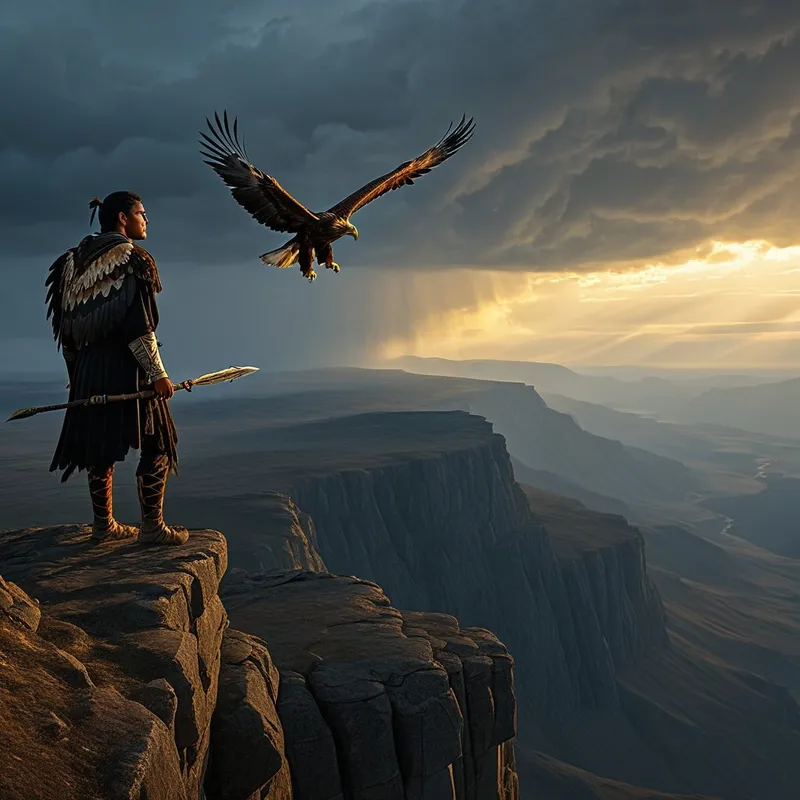
Eagle Feather Myth Meaning & Symbolism
A young man's perilous quest for an eagle's feather becomes a transformative journey of sacrifice, vision, and spiritual rebirth.
The Tale of Eagle Feather
Listen. The wind does not just blow across the plains; it carries the breath of the ancestors. In a time when the earth spoke more clearly, there lived a young man whose spirit was restless. He was not a great hunter, nor a famed warrior. His name has been lost to the whispering grass, but his story is remembered. We will call him Walks-With-Questions.
His people were strong, but a shadow had fallen upon them—a dullness of spirit, a forgetting of the old ways. The songs felt flat. The dances lacked fire. Walks-With-Questions felt this emptiness as a physical ache in his bones. He went to the elders. "How do we remember?" he asked. The oldest among them, her eyes like clouded stones, pointed a bony finger toward the distant mountains, where the clouds tore themselves on granite teeth. "You must bring back a feather from the living sun," she said. "A feather from the breast of Wanbli himself. Only its touch can cleanse our sight."
The young man’s heart trembled, for this was a task of impossible danger. The eagle nests in the realm between earth and sky, on cliffs where only shadows dare to cling. Yet, the ache in his people, and the deeper ache within himself, drove him forward.
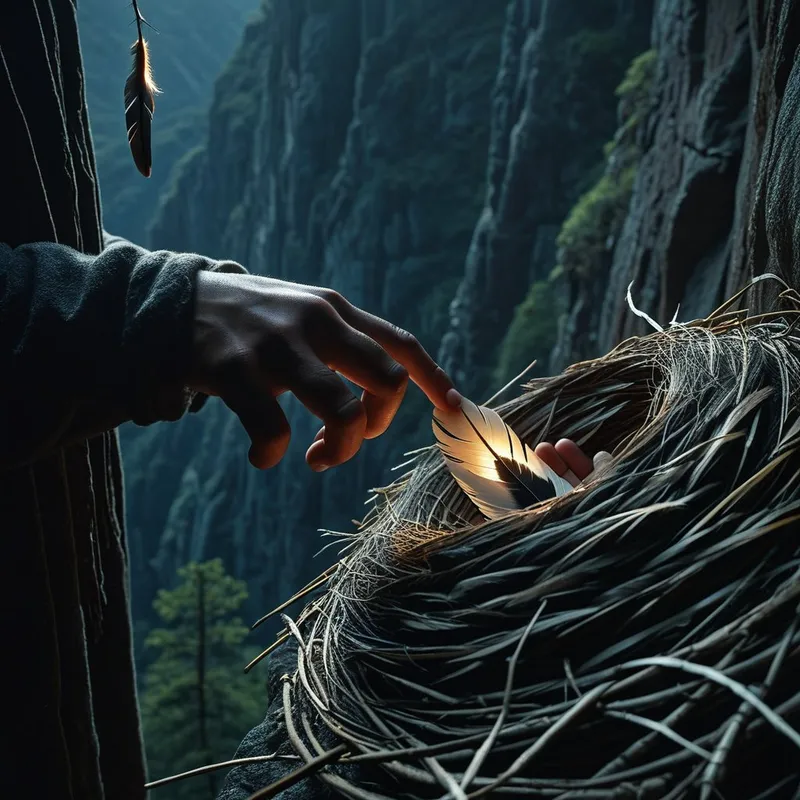
He walked for seven days, leaving the whispering grass for the groaning pines, and finally to the naked stone of the mountains. The air grew thin and cold. He climbed for three days and three nights, his fingers bleeding, his breath a ragged prayer. He found the nest, a fortress of sticks on a ledge that overlooked the whole world. And there he waited, hidden in a crack in the stone.
He did not wait for hours, but for days. The wind scoured him. The sun burned him. The cold night sought to steal his life. He had no food, only a pouch of water and the burning question in his chest. He grew weak. In his delirium, he heard the voices of the mountain—taunting, inviting him to let go and find peace in the long fall.
Then, on the morning when his spirit was thinnest, a shadow greater than any cloud fell upon him. Wanbli returned. The great bird landed in its nest, the air from its wings a holy gale. The young man saw not just a bird, but a creature of lightning and thunder, its eyes holding the patience of the ages. It saw him. It knew him.
Terror and awe held him frozen. The eagle regarded him, then, with a deliberate grace, it plucked a single, downy feather from its own breast. It did not drop it. It did not gift it casually. It turned, and with the tip of its beak, it touched the feather to the young man’s forehead, right between his eyes.
A bolt of silent lightning entered him. He did not see visions of battle or hunt. He saw the endless circle of life—the mouse nourishing the snake, the snake nourishing the eagle, the eagle’s feather falling to nourish the earth. He saw his people not as separate, but as one thread in a vast, shimmering web. He saw the sacredness of the breath in his lungs and the stone beneath his hands.
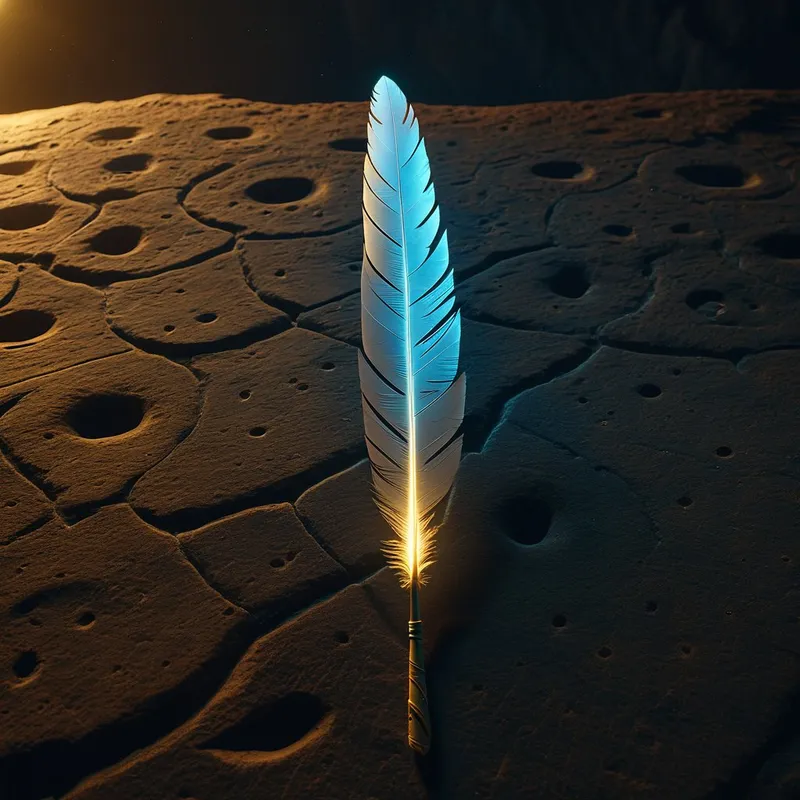
When the vision cleared, the eagle was gone. The feather lay in the nest, glowing with a soft, inner light. With the last of his strength, Walks-With-Questions took it. His journey back was not a climb down, but a walking dream. He found his people, held up the feather, and told no story. He simply sang the song the wind had taught him on the cliff. And as he sang, the dullness lifted. The people remembered. They saw the web again.
Cultural Origins & Context
The story of Eagle Feather is not one myth, but a pattern woven through the oral traditions of many Plains and Southwestern nations, including the Lakota, Cheyenne, and Pueblo peoples. It belongs to the rich corpus of Hanbleceya, or vision quest, narratives. These stories were not mere entertainment; they were pedagogical and spiritual technology, told by elders and medicine people to prepare the young for their own existential trials.
The societal function was multifaceted. It modeled the protocol for seeking vision: the sacrifice, the endurance, the humility. It explained the profound sacredness of the eagle feather itself, one of the highest honors and most powerful ceremonial objects, earned never by conquest of the eagle, but by surrender to the process it demands. The myth served as a map for navigating a crisis of meaning, guiding the community through periods of spiritual malaise by reminding them that renewal requires direct, personal encounter with the sacred.
Symbolic Architecture
At its heart, this is a myth of the ascent of consciousness. The young man, the unformed ego, feels the collective ennui—the neurosis of a culture disconnected from its numinous core. The quest for the feather is the quest for authentic vision, for a truth that is felt in the bones, not just understood in the mind.
The cliff is the threshold of the known self. To climb it is to willingly enter a state of crisis where old identities must be shed.
The eagle, Wanbli, is the archetypal spirit of the heights, representing a perspective unbound by earthly limitations. It is the objective psyche, the Self, that sees the whole pattern. The young man’s desperate wait is the crucial ordeal of emptiness, where the ego’s resources are exhausted, making space for the transcendent to enter.
The feather is not simply a trophy. It is a token of connection, a physical filament linking the human realm to the divine. The eagle’s act of plucking it from its own breast signifies that true power is given, not taken, and it often involves a sacrifice from the giver. The touch to the forehead—the seat of the mind’s eye—is an initiation. It is the implantation of a new organ of perception.
The Dreamer's Resonance
When this myth stirs in the modern dreamer, it often manifests as dreams of precarious heights, of seeking a precious object in a dangerous, elevated place, or of encounters with majestic birds of prey. The somatic experience is key: the feeling of vertigo, of clinging, of exhaustion, followed by a moment of terrifying yet awe-filled contact.
Psychologically, this signals a process of ego-destabilization for the purpose of reorientation. The dreamer is likely in a life phase where their old identity or worldview is proving inadequate—a career, relationship, or belief system is feeling "empty." The dream-ego’s climb represents the conscious, often painful, engagement with this crisis. The eagle’s appearance marks the intervention of a transpersonal authority, the Self, offering not a solution, but a new mode of perception. The dreamer is not being given a fish; they are being taught how to see the entire ocean.

Alchemical Translation
The alchemical journey mirrored here is the opus of individuation. The initial state is nigredo—the blackening, the collective dullness and personal despair. The quest is the active confrontation with this darkness (mortificatio), willingly undergoing the dissolution of the ego on the cliffside.
The prolonged waiting and suffering is the albedo, the whitening, where all color (all easy meaning) is stripped away, leaving the soul bare and receptive. The arrival of the eagle is the arrival of the lapis, the philosopher's stone—the symbol of the integrated Self.
The feather is the quintessence: the distilled, purified substance of the transformation. It is not the entire eagle, but a perfect, functional part of it, now able to be integrated into the human realm.
For the modern individual, the "eagle feather" may be a newfound clarity, a creative insight, or a core value that emerges from a period of breakdown. The myth teaches that this treasure cannot be grasped through force of will alone. It is earned through humble sacrifice, endured suffering, and, ultimately, a receptive surrender to a wisdom greater than one’s own. One must climb to the limit of one’s own understanding, and then wait, empty-handed, for the touch of the sacred. The feather one brings back is the proof that one has been touched, and with it, one can sing the world back into connection.
Associated Symbols
Explore related symbols from the CaleaDream lexicon: