Dzogchen the Great Perfection Myth Meaning & Symbolism
A myth not of creation but of recognition, revealing the luminous, self-perfected nature of mind that has been present since before time.
The Tale of Dzogchen the Great Perfection
Listen. This is not a story of something that happened long ago. It is the story of what has never not been. Before the first mountain heaved itself from the earth, before the first star kindled in the black womb of space, there was a ground. Not a place, but a condition. A luminous, boundless wakefulness, empty of substance yet pregnant with all potential. The Dharmakaya, the body of ultimate truth, was not born and did not act. It simply was, is, and will be: the Dzogchen.
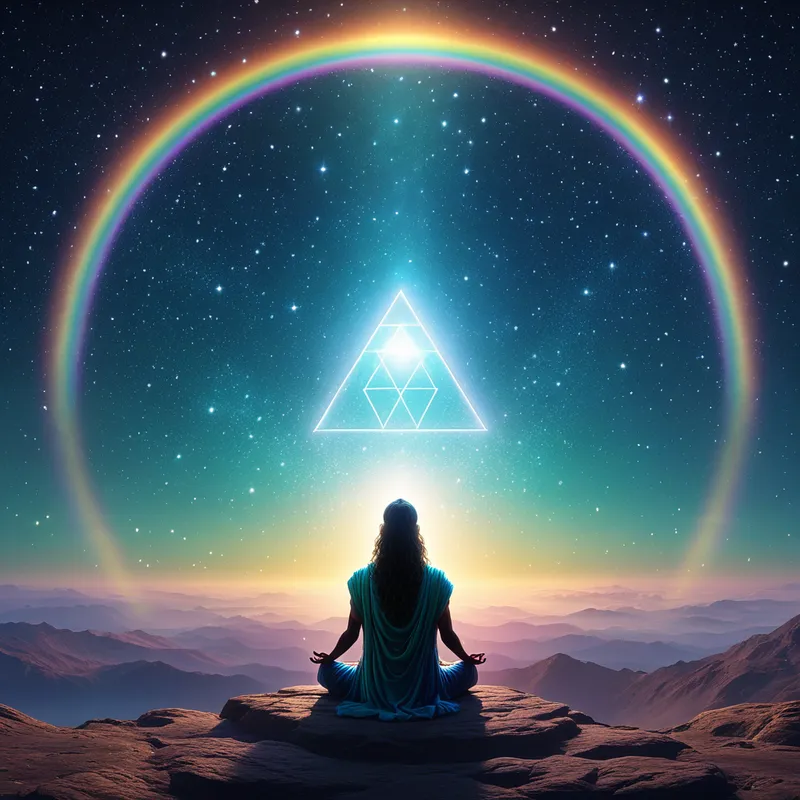
From this groundless ground, like rainbows appearing in a clear sky, the play of wisdom spontaneously arose. Five lights, pure and essential, radiated forth. From these lights, the Five Buddha Families manifested—not as creators, but as intrinsic aspects of the ground’s own intelligent luminosity. Vairocana of the center, Akshobhya of the east, Ratnasambhava of the south, Amitabha of the west, Amoghasiddhi of the north. Their mandala was not built; it was recognized.
Yet, within the infinite display, a subtle stirring occurred. A tender, compassionate impulse moved within the heart of the Adibuddha, Samantabhadra. Not a thought, but a knowing: that the radiant truth of this ground could be forgotten. That beings would spin themselves into worlds of solidity and suffering, mistaking the rainbow for the stone. And so, from the expanse of his own being, the teachings of the Great Perfection emanated—not as words, but as direct transmission, a silent blessing cast into the stream of time.
This transmission, this unbroken lineage of light, descended through realms of form. It reached the human world not through grand conquest, but through the grace of recognition. In the land of Uddiyana, a child was born who was not merely a child. He was Garab Dorje, the "Joyful Vajra," the human emanation of this direct transmission. He did not learn; he remembered. Sitting in the radiance of his own nature, he became the conduit. To his disciple, Manjushrimitra, he gave the essence in three statements that pierced to the core: "Direct introduction to one’s own nature. Decide upon this unique state. Continue with confidence in liberation."
The myth is this: the transmission was never given, because it was never absent. The teacher only holds up a mirror, and in it, the disciple sees, at last, the face they have always worn.
Cultural Origins & Context
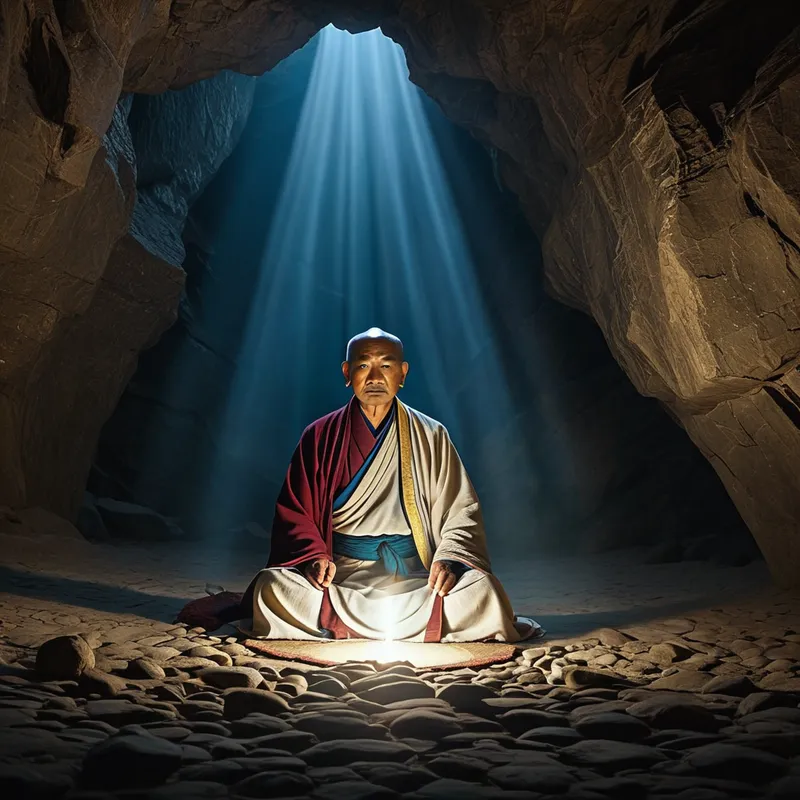
The mythos of Dzogchen is the pinnacle of the Nyingma tradition, Tibet’s oldest Buddhist school. Its origins are considered sanatana, timeless, but its human history is traced to the mystic lands of Uddiyana and the pivotal figure of the Guru Padmasambhava. Unlike philosophical treatises, Dzogchen teachings were transmitted through terma—spiritual treasures concealed in the landscape of the mind and the physical world, to be discovered by destined tertöns at auspicious times.
This method of transmission underscores its cultural function: Dzogchen is not a gradual path of improvement, but a revelation of what is already complete. It served as the ultimate, secret heart-essence instruction for advanced practitioners, a radical affirmation that enlightenment is not a distant achievement but the immediate, ground of present awareness. It was passed from master to disciple in intimate, often wordless settings—a gaze, a gesture, a profound silence—emphasizing direct experience over scholarly elaboration. Its societal role was to anchor the entire spiritual edifice of Tibetan Buddhism in the experience of primordial freedom, a reminder that all practices and deities ultimately point back to the nature of the practitioner’s own mind.
Symbolic Architecture
The myth dismantles the architecture of seeking. Its core symbol is not a goal, but a ground.
The journey ends where it began, and knowing the place for the first time, you realize you never left.
The Dharmakaya represents the unconditioned, primordial basis of all psyche—what in depth psychology might be called the Self in its pure, unconstellated form. It is the unus mundus, the one world underlying both conscious and unconscious. The Five Buddha Families are not external gods but archetypal patterns of energy and wisdom inherent within this ground. Their spontaneous manifestation symbolizes the innate, ordered potential within the psyche that can manifest as either neurotic complexes or as enlightened qualities.
Garab Dorje’s three statements model the entire path of awakening: 1) Direct introduction (the shock of self-recognition, the confrontation with the unconscious as oneself), 2) Decide upon this unique state (the conscious commitment to that recognition, integrating it into one’s identity), and 3) Continue with confidence (the lived process of individuation, where all experiences are met from the stable ground of the Self). The myth asserts that wholeness is not constructed; it is recognized. The conflict is only ignorance of our true nature; the resolution is the dissolution of that ignorance, not the attainment of something new.

The Dreamer's Resonance
When this myth stirs in the modern dreamer, it often appears not as a grand narrative, but as a profound shift in perception. One might dream of finding a secret, utterly ordinary room in their own house they never knew existed—a room filled with light and a sense of infinite peace. Or they may dream of looking into a mirror and seeing not their own face, but a vast, starry sky, or the face of a serene, ancient being.
These dreams signal a somatic and psychological process of grounding into essence. The psyche is moving from a state of identification with the content of consciousness (thoughts, emotions, roles) to an identification with consciousness itself. It is a dream of homecoming that bypasses the ego’s striving. The feeling upon waking is often one of deep relief, a quiet certainty, or a mysterious joy without an object. It indicates the unconscious is presenting the possibility of resting in the basis, of finding sanity not by solving all problems, but by realizing the spacious awareness in which problems arise and fall.

Alchemical Translation
The alchemical work modeled by Dzogchen is the ultimate solve et coagula: the dissolution of the illusion of a separate self and the coagulation of awareness in its natural, pristine state. For the modern individual, this translates to the process of moving from ego-centeredness to Self-centeredness.
The alchemist sought the philosopher's stone not to create gold, but to discover that the base metal was gold all along.
The first step is the nigredo, the dark night, which here is the exhaustion of seeking outside oneself—the burnout of projects of self-improvement that subtly reinforce the sense of lack. The albedo, the whitening, is the direct introduction: the shocking, clear moment of self-recognition, often precipitated by crisis, profound therapy, or inexplicable grace, where one glimpses the silent witness behind the turmoil. The rubedo, the reddening, is to "continue with confidence": to integrate this recognition into daily life. Every emotion, every failure, every success is now seen not as a definition of self, but as a temporary expression appearing within the boundless space of awareness. The final gold is not a new state, but the realization that the innate, luminous clarity of mind has always been present. The work is to cease obscuring it, to allow the Great Perfection to reveal itself as the very substance of our being, here and now.
Associated Symbols
Explore related symbols from the CaleaDream lexicon:
- Mirror — The central symbol for the nature of mind in Dzogchen, reflecting all phenomena with perfect clarity without being stained or altered by them.
- Sky — Represents the Dharmakaya, the boundless, empty, luminous expanse in which all experiences arise like clouds and dissolve.
- Light — Symbolizes the self-arising wisdom (yeshe) and compassionate energy that spontaneously radiates from the ground of being.
- Mountain — Represents the unwavering stability of the natural state, the immutable ground upon which one rests, beyond the winds of circumstance.
- Cave — The secluded space of the heart-mind where direct introduction to one's true nature occurs, away from the distractions of conceptual thought.
- Circle — The mandala of wholeness and completion, symbolizing the self-contained, perfect, and timeless nature of the Great Perfection.
- Dream — The analogy for all apparent reality, which is experienced vividly yet is recognized as having no inherent solidity, arising from the mind's own display.
- Buddhist Lotus — Represents primordial purity; like the lotus unstained by the mud, the nature of mind is unstained by the adventitious defilements of thought and emotion.
- Seed — The potential for enlightenment that is innate within all beings, the essence of Buddha-nature that is present from the beginning.
- Great — The boundless, all-encompassing quality of the natural state, which is perfect and complete, lacking nothing.
- Perfect — The intrinsic completeness of the ground of being, where all qualities are spontaneously present without need for addition or subtraction.
- Buddhist Stupa — A symbolic representation of the enlightened mind, its structure mapping the journey from basis to result, which in Dzogchen are non-dual.