Dwarves Myth Meaning & Symbolism
Born from the earth's bones, the Dwarves are master smiths of fate, forging cosmic artifacts from the raw ore of potential and the dark fire of necessity.
The Tale of Dwarves
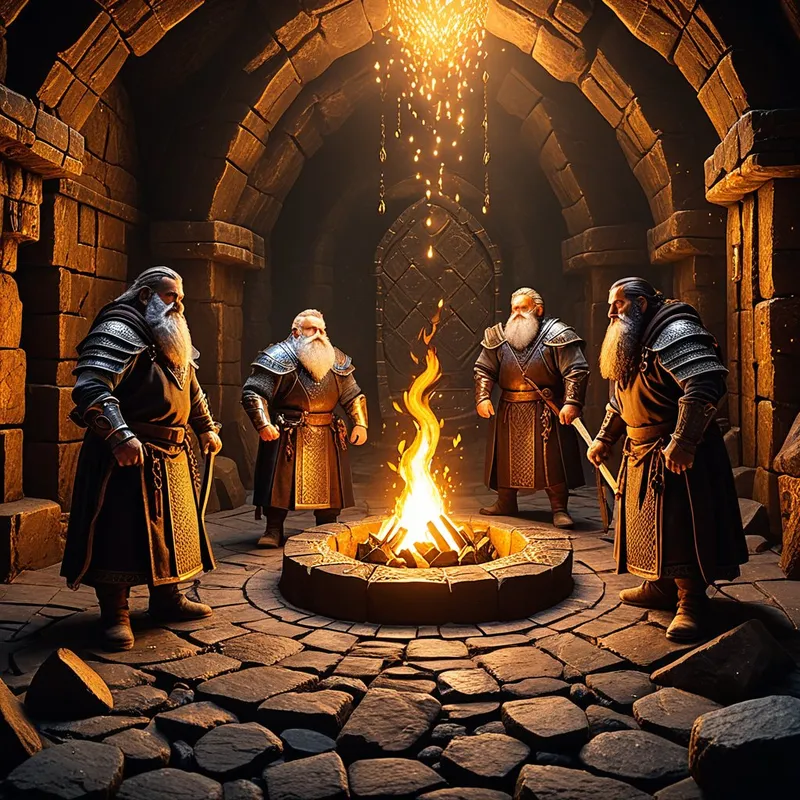
Listen, and hear the tale of the makers in the dark. In the time before time, when the giant Ymir was slain, his flesh became the earth, his blood the sea, and his bones the mountains. And from those very bones, from the marrow-stone and the deep, grinding pressure of the world’s foundation, they quickened. Not as gods, shining and remote, nor as men, fleeting upon the surface. They were the Dvergar, the Dwarves, born of the earth’s memory and the corpse of a giant.
They are the children of stone, and their realm is Svartálfheimr, a labyrinth of glittering caverns and echoing halls where no sun ever falls. Here, in the absolute dark, their world is lit by the forge-fire and the cold gleam of uncut gems. They are the smiths of necessity. When the gods, in their shining folly, found the sun and moon to be but wandering orbs with no guidance, it was to the deep-delving Dwarves they turned. The All-Father, Odin, and his brothers, laid the charge: fashion holders for these lights, and set them on chariots to trace the heavens. From what material could such a task be accomplished? Only from the last sparks of the primordial fire, from the dregs of chaos itself. And so the Dwarves, the sons of Mótsognir and Durinn, gathered the essence of muspelheim and the strength of the world’s roots. With hammers that sang a song of compression and heat, they wrought the chariot of the Sun, Sól, and the chariot of the Moon, Máni, and set the sky in its first, great order.
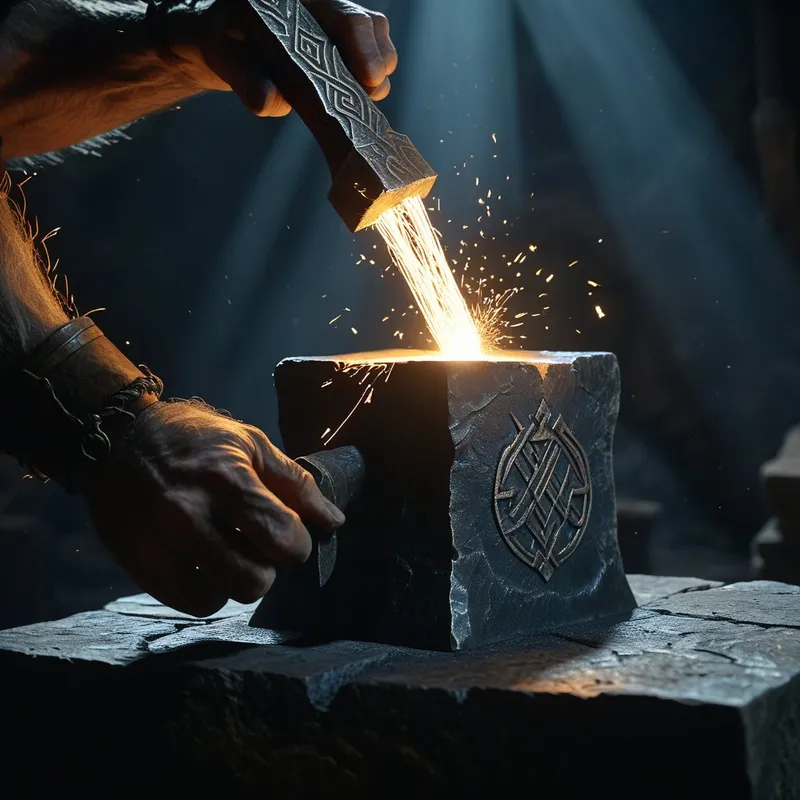
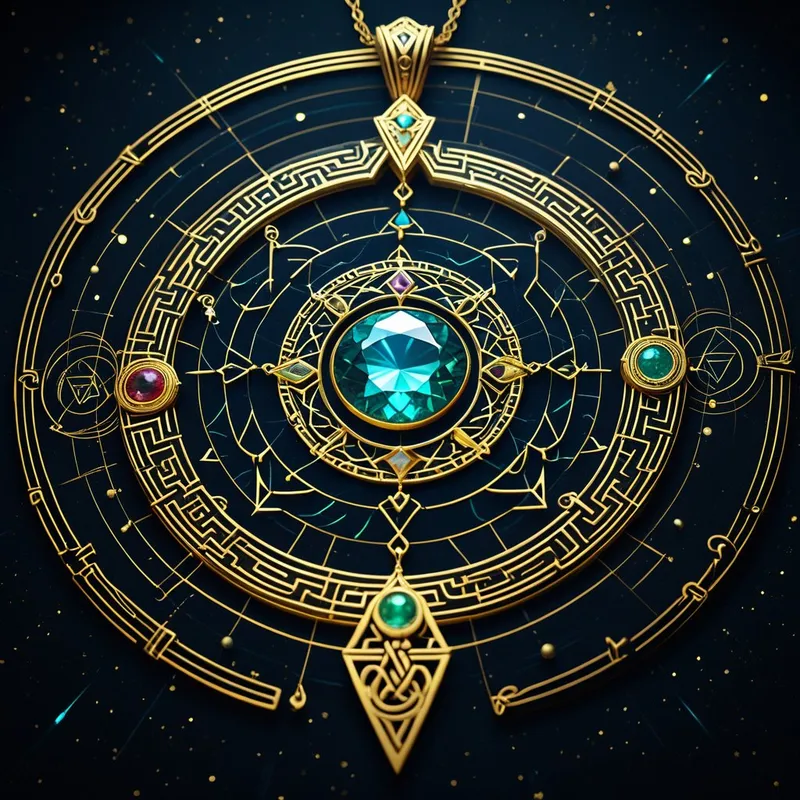
But their greatest works were born of darker fires still. It is said that from the spittle of the gods, they crafted the boar with golden bristles that shines in the dark. From the footfall of a cat and the beard of a woman, they made a chain to bind the terrible wolf Fenrir. And when the god of thunder, Thor, found his hammer stolen, it was to the Dwarven brothers Brokkr and Sindri that Loki was sent to commission a replacement. In a forge of such heat that Sindri commanded Brokkr to never cease the bellows’ blast, they worked their craft. Into the fire went a lump of iron. A fly—Loki in disguise—bit Brokkr’s hand, but he did not falter. From the fire, Sindri drew a living boar of gold. Again the iron went in; the fly bit Brokkr’s neck, drawing blood, but the bellows roared. From the fire came a ring of gold that would multiply itself eightfold every ninth night. A third time the iron entered the flame; the fly bit Brokkr’s eyelid, the blood blinding him, yet still he worked. From the final, searing heat, Sindri drew forth a hammer of such perfect proportion and terrible power that its handle was born just a hair too short. This was Mjölnir, the crusher, the unerring weapon that would return to its master’s hand. Thus, from ordeal, distraction, and pain, the Dwarves forged the very defense of the gods.
Cultural Origins & Context
The myths of the Dwarves come to us primarily through the Poetic Edda and the later Prose Edda of Snorri Sturluson. These were not the tales of a centralized priesthood but the living lore of a people intimately acquainted with the capricious power of the natural world. In the harsh climes of the Norse world, where the earth yielded iron ore and the sea could swallow ships, the Dwarf was a potent explanatory figure. They personified the mysterious, generative, and dangerous forces of the underground: the source of precious metals, the sudden collapse of a mine, the uncanny craftsmanship found in heirloom weapons.
Skalds and storytellers would have recited these tales in longhouses, their words weaving a cosmology where even the gods were not omnipotent but reliant on the specialized, ambivalent powers of others. The Dwarves served as a narrative device to explain the origin of incredible artifacts and natural phenomena, but more profoundly, they represented a fundamental principle: that the most essential, world-shaping work often happens out of sight, in the dark, by beings who are neither purely good nor evil, but utterly necessary.
Symbolic Architecture
The Dwarf is the archetype of the shadow as craftsman. They do not dwell in the bright, conscious realm of Asgard, but in the subterranean world of Yggdrasil’s roots, the place of raw material, memory, and latent potential. They are the psychic function that takes the unformed “ore” of our instincts, traumas, and unlived potentials—the buried bones of our personal Ymir—and subjects it to the intense pressure and heat of attention.
The forge is not a place of comfort, but of necessary violence. The hammer’s blow is the confrontation that shapes raw experience into usable form.
Their physicality is symbolic: short of stature, they are close to the earth, grounded in material reality. Their aversion to light speaks to the nature of unconscious content—exposed too suddenly to conscious scrutiny, it turns to stone, becoming rigid and defensive. They are hoarders not out of greed, but out of a deep, instinctual knowing of value. What they create—the unbreakable chain, the multiplying ring, the returning hammer—are symbols of containment, generativity, and sovereign function. They forge the tools that bind our inner chaos, that amplify our resources, and that define our ability to act with impact in the world.
The Dreamer's Resonance
To dream of Dwarves, or of being in a deep forge or workshop, signals a profound somatic and psychological process underway. It is the psyche announcing that the work of transformation has moved from the abstract to the tangible. The dreamer is in the nigredo phase, the blackening, where raw emotional or psychic material is being “cooked” in the darkness of the unconscious.
Somatically, this may manifest as a feeling of pressure, of being underground or weighed upon, often coinciding with periods of intense introspection, depression, or creative gestation. The Dwarf in the dream is not a mere character but an personification of the dreamer’s own crafting intelligence—that part of the self that knows how to work with heavy, difficult, elemental stuff. A dream of a Dwarven smith handing you a newly forged tool suggests the unconscious is presenting a new capacity or solution, born from endured pressure. A dream of a vast, silent hoard of gems in a cavern points to untapped talents or forgotten memories of value, waiting for the conscious mind to claim them.
Alchemical Translation
The Dwarven myth is a perfect map for the alchemical process of individuation—the forging of a coherent, resilient Self from the disparate elements of the personality. The gods (our conscious ideals and aspirations) are often helpless without the Dwarves (the deep, instinctual, crafting wisdom of the unconscious). The process begins with the prima materia: the chaotic, often painful “matter” of our lives—our flaws, our wounds, our primal drives. This is the iron ore, the spittle, the footfall of a cat. It seems worthless, even disgusting.
The masterpiece is always forged from what was initially rejected. The hammer must fall where it hurts to create the necessary shape.
We must, like Brokkr, endure the “bites” of distraction, doubt, and pain (Loki’s interference) without ceasing the work. The bellows’ blast is the breath of sustained attention, the willingness to stay with the heat of an emotion or a complex until it transforms. The too-short handle of Mjölnir is the critical lesson: the gifts from the deep self are never perfect by the standards of the conscious ego. They have a quirk, a limitation, a price. Individuation is not about achieving flawlessness, but about wielding an authentic power that is uniquely, imperfectly your own. To integrate the Dwarf is to become the smith of your own fate, to learn the dark, patient, glorious craft of making meaning from the very bones of your experience.
Associated Symbols
Explore related symbols from the CaleaDream lexicon: