Dwarven Smiths Myth Meaning & Symbolism
The myth of master craftsmen who forge divine treasures in subterranean forges, embodying the alchemy of transforming raw potential into sacred power.
The Tale of Dwarven Smiths
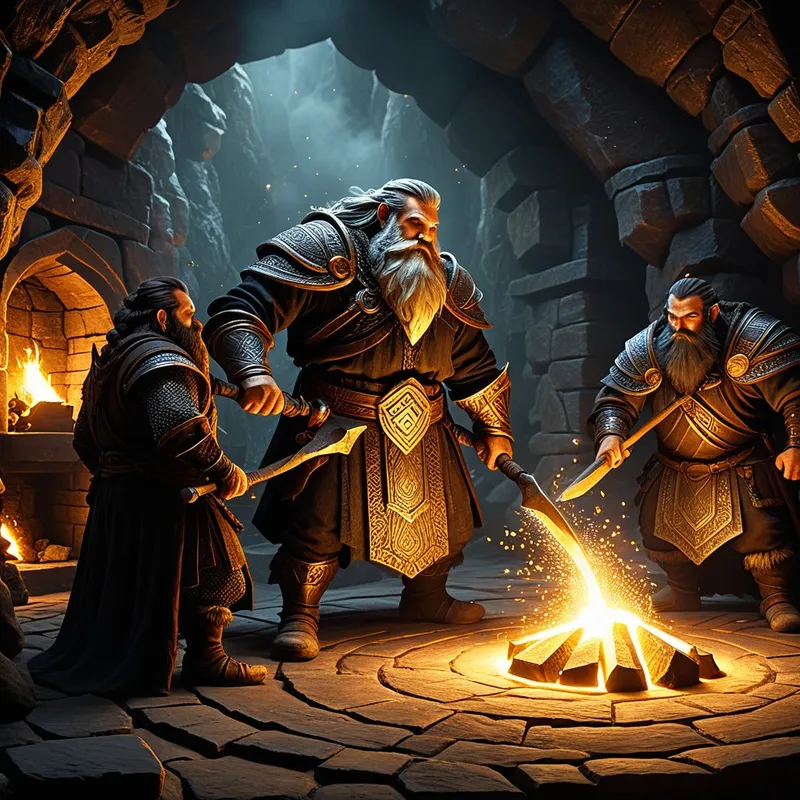
Listen, and hear the tale of the makers in the deep. Not in the golden halls of Ásgarðr, nor under the sun’s bright gaze, but in the roots of the world, in the dark, humming veins of Yggdrasil. Here, in Svartálfheimr, the air is thick with the scent of stone, hot metal, and ancient dust. Here dwell the dvergar, the smiths whose hammers ring a rhythm older than the gods themselves.
The story begins with mischief. Loki, silver-tongued and restless, had sheared the glorious golden hair of Sif, wife of the mighty Thor. To avert a thunderous wrath, Loki swore to replace it. He descended into the earth, to the forges of the sons of Ivaldi. There, in the fire’s heart, they wrought not only hair of spun gold that grew like living grain, but also Gungnir, the spear of Óðinn, and Skíðblaðnir. Treasures of impossible craft.
But Loki, ever boasting, proclaimed to the gods that no smiths could ever match these works. The dwarf Brokkr heard this and swore he and his brother Eitri could do better. A wager was struck: Loki’s own head against the treasures they would make.
In their cavern-forge, the alchemy began. Eitri placed a pig’s skin in the furnace. To Brokkr, he gave a sacred charge: “Pump the bellows without cease, until I return. Do not stop for any reason.” The bellows roared like a dragon’s breath. The fire burned with a blue-white soul. As the work neared its zenith, a monstrous fly—Loki in disguise—landed on Brokkr’s hand and bit deep. Brokkr did not flinch. The fly then bit his neck, drawing blood that ran in hot rivulets. Still, the dwarf pumped, his muscles screaming, his will a thing of iron. From the forge, Eitri drew Gullinbursti, a living boar of gold.
Next, Eitri threw gold into the flames. Again, he charged Brokkr: “Do not stop.” The bellows heaved. The fly attacked Brokkr’s eyelids, and the blood blinded him. Through a veil of pain, he pumped on. From the fire came Draupnir, a ring of multiplying gold.
For the final treasure, Eitri cast iron into the hearth. “Now, brother,” he said, “do not stop. This is the greatest work.” The fly, desperate, drove itself between Brokkr’s eyes, biting to the bone. The dwarf gasped, his head ringing with agony, but for one fleeting instant—a heartbeat of failure—his hand slowed. Eitri returned, his face fell. From the forge he drew a hammer of immense power: Mjǫllnir. Its handle was short, flawed by that single faltering breath. Yet its head was perfect, destined to shake the worlds.
The gods judged the treasures. Gullinbursti could run through air and water, brighter than day. Draupnir would breed endless wealth. And Mjǫllnir, though flawed, was declared the greatest of all, for it would defend Ásgarðr. Brokkr had won. He sought Loki’s head, but the trickster argued only his head was promised, not his neck. In bitter compromise, Brokkr sewed Loki’s lips shut with a thong. For a time, the silence was the sweetest treasure of all.
Cultural Origins & Context
These tales are preserved primarily in the Poetic Edda and, in fuller narrative form, in the Prose Edda of Snorri Sturluson. They were not mere children’s stories, but part of a sophisticated cosmological and ethical framework recited by skalds and storytellers. The dwarven smiths function as a necessary counterpart to the gods. The Æsir possess power, sovereignty, and destiny, but they lack the ability to create the tangible artifacts of that power. That genius belongs to the dvergar, beings of the earth, of craft, and of focused, relentless will.
This reflects a worldview where creation is not an act of divine fiat alone, but a collaboration—often fraught—between different orders of being. The myths served to explain the origin of sacred objects central to the gods’ identities and to model the values of perseverance, skill, and the sacred nature of the oath and the wager. The smith’s forge was a microcosm of the world’s creation: order shaped from chaos, utility born from raw element, through heat, sweat, and unwavering focus.
Symbolic Architecture
The dwarven smiths are not mere laborers; they are psychopomps of the underworld, facilitators who translate potential into form. They represent the unconscious, instinctual psyche—the dark, fertile ground of Svartálfheimr—where the raw materials of the soul (instincts, complexes, talents) are subjected to the transformative fire.
The forge is the crucible of the self, where the base ore of experience is hammered into the sacred weapon of identity.
Loki here is not merely an antagonist, but the necessary catalyst of chaos and tension. His bet forces the creation of greater treasures. His fly-form represents the inevitable distractions, doubts, and psychic irritations that arise during any profound act of creation or self-work. Brokkr’s endurance under this torment is the myth’s central spiritual act: the ego’s capacity to hold focus and suffer for the sake of a work greater than itself.
The flawed handle of Mjǫllnir is perhaps the most profound symbol. Perfection is not of this world. The greatest power we forge—our will, our character, our legacy—will always bear the mark of our mortal limitations, our fleeting moments of weakness. Yet this flaw does not negate its potency; it humanizes it, makes it wieldable. The sacred is rendered functional through imperfection.
The Dreamer's Resonance
When this myth stirs in the modern dreamer, it often manifests as dreams of basements, workshops, caves, or hidden rooms where urgent, creative work is being done. The dreamer may be laboring at an anvil, fixing a crucial but broken tool, or searching through cluttered, earthy spaces for a specific material. There is a somatic quality of pressure, heat, and intense focus.
Psychologically, this signals a process of psychic fabrication. The unconscious is actively working to synthesize disparate elements of the personality—a raw emotion, a buried memory, a nascent talent—into a usable “tool” for consciousness. The “fly” in these dreams may be a critical inner voice, a physical ailment, or an external stressor that threatens to break concentration. The dream is an enactment of the Brokkr-archetype: the part of the psyche that must hold steady, through discomfort, to allow the transformative process to complete. To dream of successfully forging an object is to experience the birth of a new psychic function—perhaps resolve, insight, or creative capacity.
Alchemical Translation
The myth of the dwarven smiths is a precise map of the alchemical opus, the journey of individuation. The journey begins with a descent (Loki going underground, the dreamer entering the basement of the psyche) into the prima materia—the chaotic, shadowy contents of the personal and collective unconscious (Svartálfheimr).
Individuation is not a journey to the light, but a responsible descent into the creative dark to retrieve the treasures forged there.
The furnace is the heat of emotional conflict and engagement. The bellows are the breath of attention, the conscious effort we must apply to keep the inner fire alive. The three treasures represent stages of the opus: Gullinbursti is the albedo, the “whitening,” a realization that illuminates the dark (a brilliant insight). Draupnir is the citrinitas, the “yellowing,” the fruitfulness of that insight as it begins to generate new patterns and abundance in life. Finally, Mjǫllnir is the rubedo, the “reddening,” the fully integrated, potent, and functional Self—the conscious ego now armed with a tool of immense spiritual power, yet humbled by its own inherent flaw (the short handle).
The modern individual lives this myth whenever they commit to a deep creative act, a course of therapy, or any sustained effort of self-development. We are both Eitri, who knows the formula and initiates the work, and Brokkr, who must endure the tedious, painful, insect-bitten labor of making it real. The treasures we forge are not physical, but psychic: a resilient character, a body of meaningful work, a capacity for love or justice. They are the sacred artifacts we contribute to the defense and enrichment of our own inner Ásgarðr.
Associated Symbols
Explore related symbols from the CaleaDream lexicon: