Dwarven Craft Myth Meaning & Symbolism
A tale of master smiths, divine bargains, and objects of impossible power, forged in darkness and sealed with fateful consequences.
The Tale of Dwarven Craft
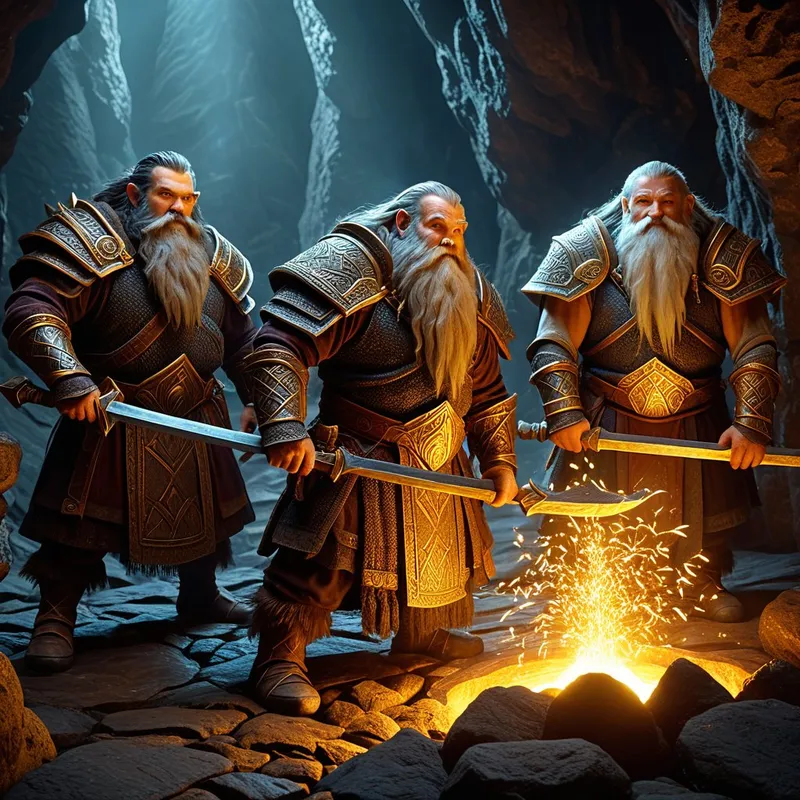
Listen, and hear the song of the deep places. Not the thunder of Aesir above, nor the whisper of the Vanir in the fields, but the clang-clang-clang that echoes up from the roots of the world. In the dark, where the bones of the earth press close, they work: the sons of Ivaldi and the brothers Brokkr and Eitri. Their forges are lit by the glow of molten stone, their breath is the smell of hot iron and ozone.
The tale begins with a trick, as so many do. The trickster Loki, his silver tongue having wagged him into peril, must replace the glorious golden hair of the goddess Sif, which he had sheared in malice. He descends, down past the roots of Yggdrasil, to the realm of Svartálfheimr. There, he finds the sons of Ivaldi. He does not ask; he provokes. He speaks of their skill, yes, but also of the gods' doubt. Could they, he whispers, craft not just hair of living gold, but a ship that folds into a pocket, and a spear that never misses its mark? Stung by pride and lured by the challenge, the dwarves set to work. The bellows roar. The hammer falls in a rhythm older than the sun. From the crucible, they draw Sif’s new hair, growing like a living thing; the ship Skidbladnir; and the terrible spear Gungnir.
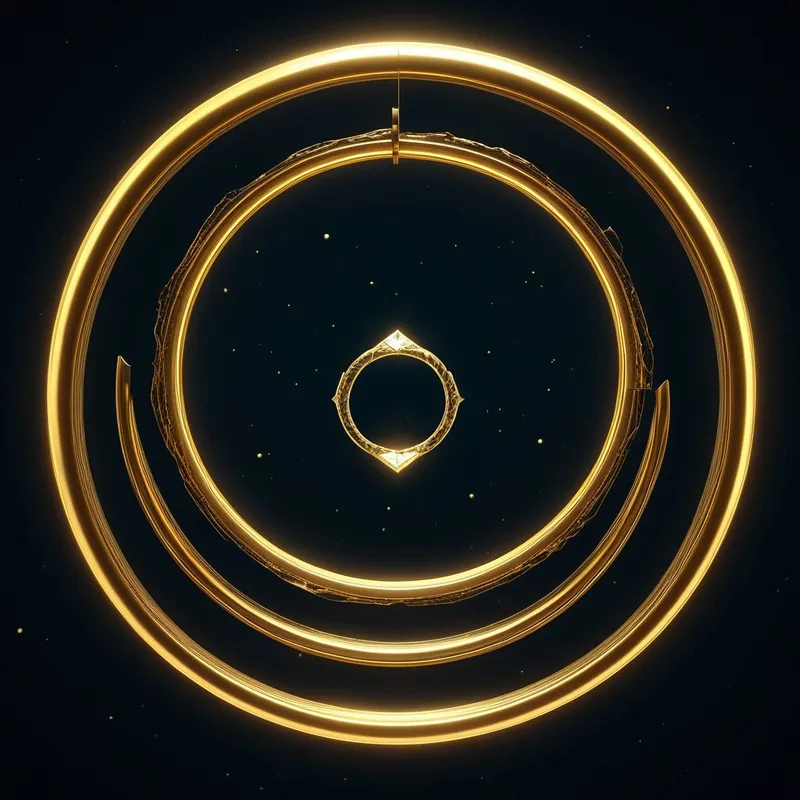
But Loki, ever restless, boasts of these wonders to another pair of brothers: Brokkr and Eitri. He wagers his own head that they cannot best the Ivaldi sons’ work. The bet is struck. In their forge, Brokkr works the bellows with a relentless, monstrous strength, while Eitri’s hands perform the sacred art. Into the fire goes gold. "Do not stop the bellows," Eitri commands, "no matter what enters." The air grows thick. A giant fly—Loki in disguise—bites Brokkr’s neck until blood runs, but the dwarf does not falter. From the fire, Eitri draws a living boar with bristles of gold that shine in the darkness: Gullinbursti. Next, a circle of gold, simple and perfect: the ring Draupnir. Finally, for the third wonder, the strain is immense. The fly lands between Brokkr’s eyes, biting so fiercely his eyelids swell shut with blood. He blinks—just once—and the bellows sigh. Eitri pulls from the fire a hammer. Its handle is short, a flaw born of that single blink, yet its head is a mountain of power: Mjölnir.
The gods gather to judge. Loki presents the gifts of Ivaldi’s sons. Odin claims Gungnir, Freyr takes Skidbladnir, and Sif’s hair is restored. Then Brokkr lays out his treasures. Freyr receives Gullinbursti, Odin takes Draupnir, and to Thor, the hammer Mjölnir, flawed but peerless in might. The judgment is clear: the hammer, protector of all realms, is the greatest work. Loki has lost. He tries to flee, but Thor drags him back. The price was his head. Yet Loki, the weasel of words, argues the wager specified his head, but not his neck. Cheated of their full due, Brokkr takes a needle and thread and sews the trickster’s lips shut—a silent, painful seal on a bargain forged in fire and sealed in cunning. The artifacts enter the world, carrying their destiny, while in the deep, the hammer’s fall continues, a heartbeat from the dark.
Cultural Origins & Context
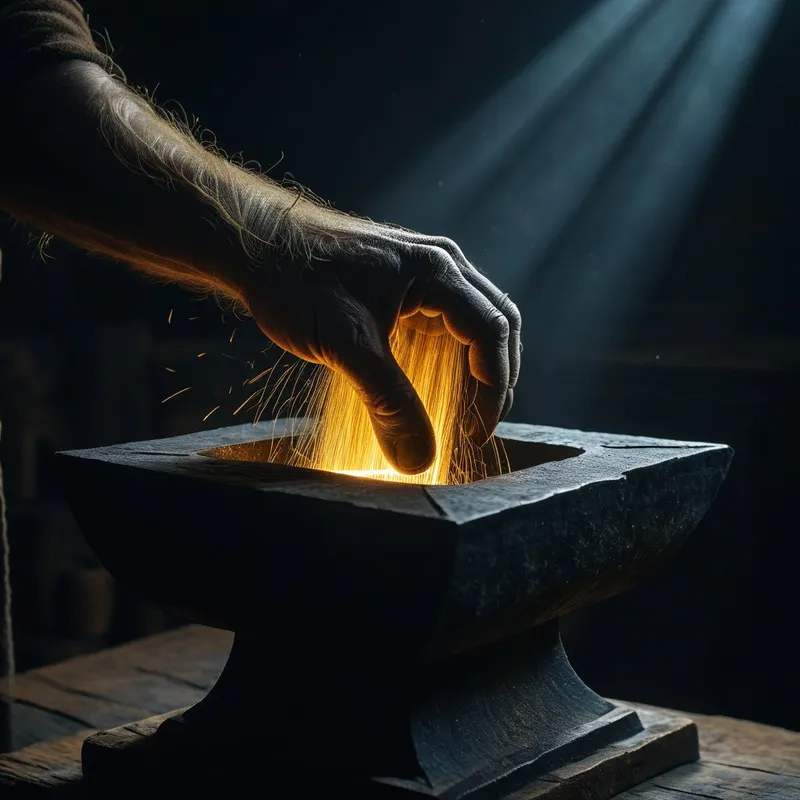
This myth, like the artifacts it describes, was forged in the oral traditions of the North, passed down through the skalds and poets long before being captured in the Poetic Edda and the later Prose Edda. It functioned not as a simple explanation for the gods' possessions, but as a complex narrative reflecting core societal values. In a world where survival depended on skill—in smithing, shipbuilding, and warfare—the myth elevated craft to a divine, almost cosmological level. The dwarves were not mere laborers; they were the indispensable counterparts to the gods, the hidden intelligences who translated raw potential (the elements of the earth) into manifest power (the artifacts of culture).
The story was told in halls smoky with firelight, serving multiple functions. It explained the origin of the gods' most iconic tools, grounding their power in a tangible, crafted reality. It reinforced a worldview where creation was never free, always involving a bargain, a sacrifice, or a flaw. It also mediated the tension between the chaotic, cunning aspect of the psyche (Loki) and the disciplined, enduring aspect (the dwarves). The myth taught that true creation requires withstanding distraction and pain (the biting fly), and that even the greatest works bear the mark of their difficult birth.
Symbolic Architecture
At its core, the myth of Dwarven Craft is a profound allegory for the process of psychological creation. The dwarves represent the focused, unconscious, and instinctual forces of the psyche that work in darkness—the depths of the unconscious mind. Their forge is the transformative crucible of the soul, where raw, chaotic emotions and potentials (the base metals) are subjected to intense pressure and heat to be reshaped.
The artifact is not found, but forged. The Self is not given, but made, under the relentless hammer of experience and the searing fire of consciousness.
Loki symbolizes the disruptive, trickster energy necessary to initiate the process. He is the provocative thought, the crisis, the wound (Sif's shorn hair) that forces the creative act. Without this provocation, the dwarves might slumber forever. The artifacts themselves are symbols of differentiated consciousness: Gungnir is focused will and intent; Skidbladnir is the adaptable vehicle of the personality; Draupnir is the self-renewing wealth of the psyche; Gullinbursti is the illuminating power of insight; and Mjölnir, the ultimate symbol of transformative and protective power, albeit with a "short handle"—a flaw indicating that even our greatest strengths have limits, born from our moments of weakness or distraction (Brokkr's blink).
The Dreamer's Resonance
When this myth stirs in modern dreams, it often signals a profound process of inner fabrication. To dream of laboring in a deep forge, of shaping a resistant, glowing material, speaks to a somatic engagement with the creation of one's own identity or life's work. The dreamer is in the "workshop of the soul."
Sensations are key: the heat of the forge may manifest as intense passion, anxiety, or a burning drive. The rhythmic hammering correlates to a persistent, often exhausting, psychological effort—working through a problem, integrating a trauma, or disciplining the self. Dreaming of a flawed masterpiece, like a hammer with a short handle, may point to the dreamer's acute awareness of an imperfection in their own "creation," be it a relationship, career, or artistic project, and the hidden fear that this flaw negates its value. Alternatively, dreaming of a Loki-figure offering a dangerous wager reflects a confrontation with one's own chaotic, risk-taking impulses, and the potential consequences of engaging with them.
Alchemical Translation
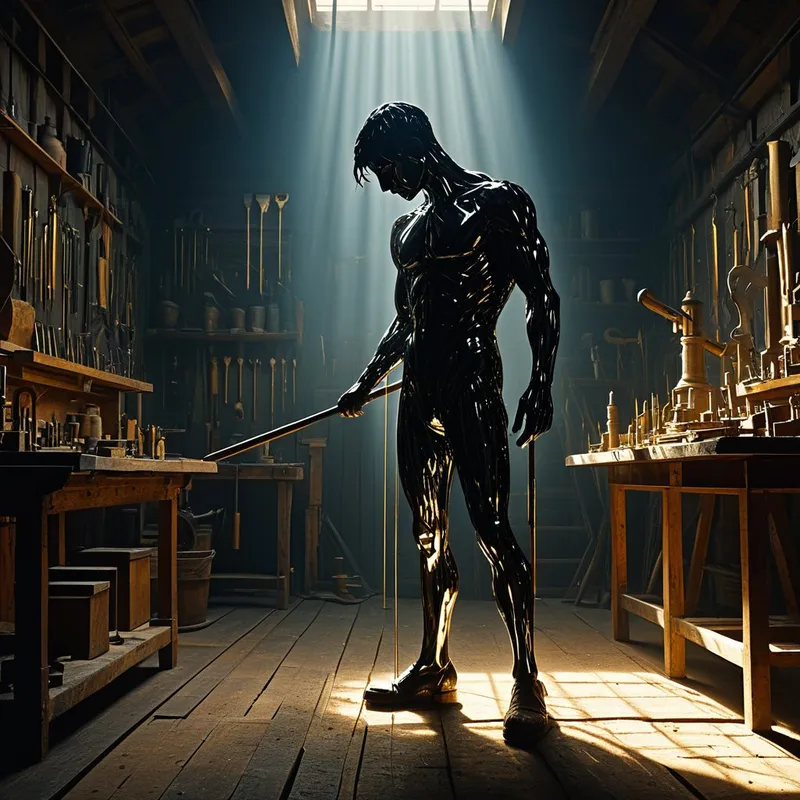
The myth provides a complete map for the alchemical process of individuation—the forging of the integrated Self. The prima materia, the raw stuff, is the unrefined psyche: our instincts, complexes, and latent potentials (the raw gold, the iron ore). The nigredo, the blackening, occurs in the darkness of Svartálfheimr, representing the necessary descent into the unconscious, into shadow and confusion.
The bellows must not stop. The ego, like Brokkr, must endure the bites of distraction, doubt, and pain to sustain the transformative fire.
The albedo, the whitening, is seen in the drawing forth of each shining artifact—moments of clarity, of emerging insight and capability. The final stage, the rubedo or reddening, is the production of Mjölnir: the fully realized, potent, and protective symbol of the Self. Its short handle is crucial; it signifies that the individuated Self is not a state of perfection, but of functional wholeness that includes one's limitations. The sealed lips of Loki represent the final integration of the trickster: the chaotic, creative impulse is not destroyed, but its disruptive power is bound and contained, made to serve the greater structure of the conscious personality. Thus, the individual becomes both the dwarf at the forge and the god who wields the hammer, capable of shaping their own destiny from the ores of experience.
Associated Symbols
Explore related symbols from the CaleaDream lexicon: