Dvorovoi Myth Meaning & Symbolism
The myth of the Dvorovoi, the capricious Slavic guardian of the household yard, embodies the sacred contract between humans and the untamed spirit of place.
The Tale of Dvorovoi
Listen, child of brick and beam, to the whisper in the dust between your doorstep and the wild wood. Before the first post was driven, before the first hearth-fire was kindled, the land was awake. It had its own children, spirits of stream and stone, of deep forest and open field. And when you came, with your axe and your hope, you did not build on empty ground. You built upon a living skin.
So you must know of the Dvorovoi.
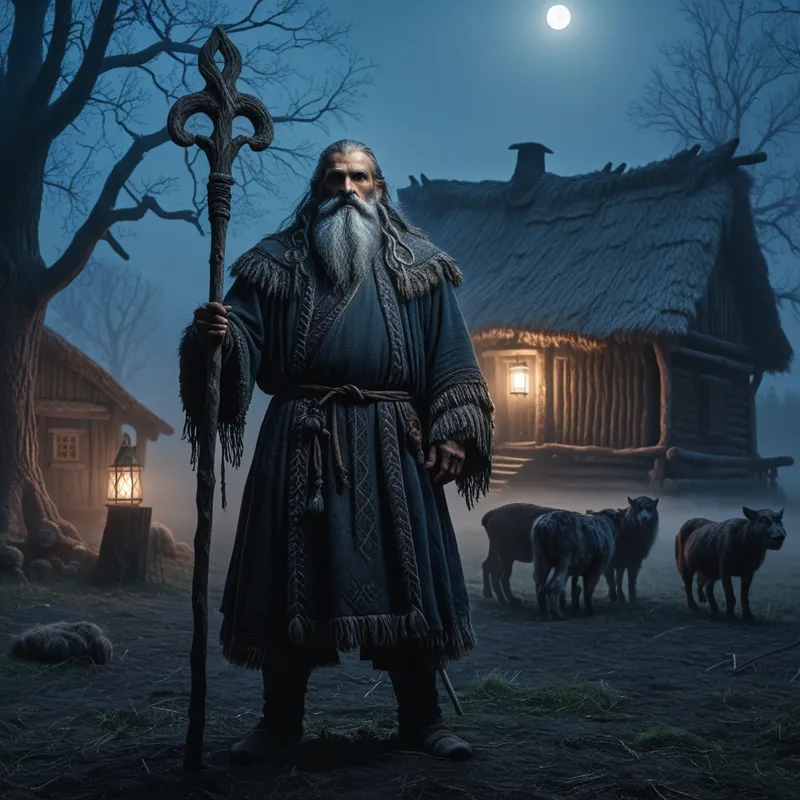
He does not live in your house, that is the domain of the Domovoi. His kingdom is the yard itself—the sacred, muddy, vital space between your threshold and the world’s edge. He is the master of the cattle shed, the guardian of the gate, the sovereign of the storage barn. You will rarely see him clearly, for he wears the shadows of the evening and the shapes of the beasts he tends. But you might glimpse a shaggy, grey-bearded form, or a pair of eyes like banked coals from the hayloft. You might hear his heavy, satisfied sigh when the horses are content, or his low, guttural grumble when a tool goes missing.
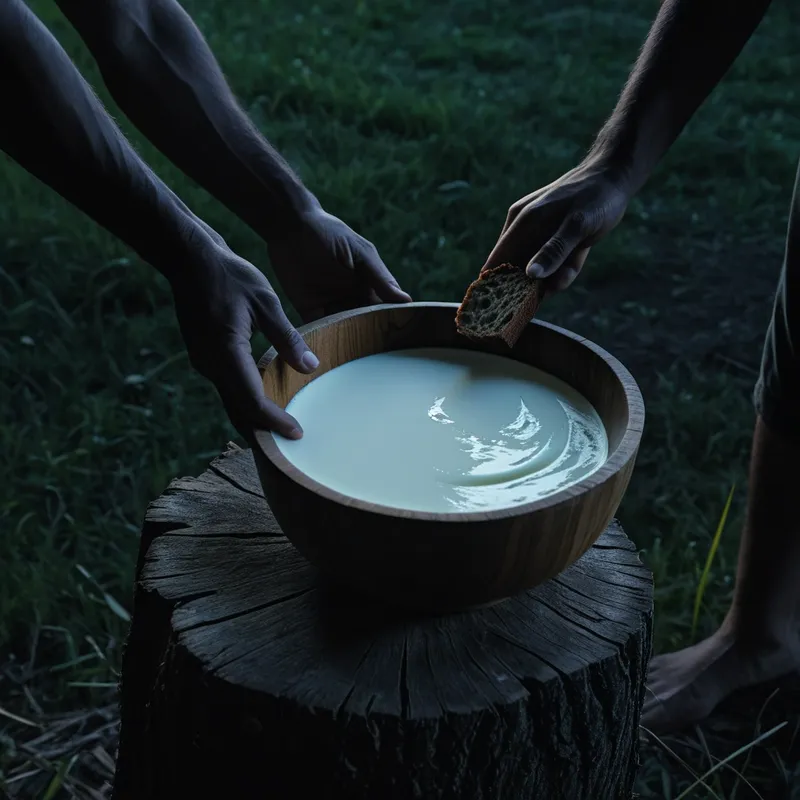
His mood is the weather of your homestead. Please him—leave a bowl of fresh milk by the barn, a crust of bread on the chopping block, speak to him with respect as you would a stern but just grandfather—and your yard thrives. The cows give rich milk, the geese avoid the fox, the axes stay sharp, and a profound, earthy peace settles over your domain. The boundary he guards is strong.
But offend him? Neglect his offering? Bring a new animal without introducing it properly, or worse, speak ill of him within his hearing? Then feel the Dvorovoi’s displeasure. He is a trickster at heart, a spirit of raw, untamed place. He will twist the fence posts. He will tangle the reins. He will pinch the cattle black and blue in the night, or lead a prized horse astray at dawn. He may mimic the voices of your loved ones to lure you into the dark yard, or simply sit, a heavy, invisible presence of dread upon your chest as you try to sleep, reminding you that your order is a temporary treaty with chaos.
There is no slaying him. There is only the pact. The understanding. You provide the respect, the acknowledgment, the token of gratitude. He provides the guardianship, the fertility, the fierce protection of the liminal space you call your own. He is the wildness you invited to your doorstep and promised to remember. Forget, and he will make you remember.
Cultural Origins & Context
The myth of the Dvorovoi springs from the very soil of pre-Christian, agrarian Slavic life. He is not a god of grand temples, but a spirit of immediate, tangible reality. His lore was passed down not in sacred texts, but in the practical wisdom of grandmothers warning children not to play in the barn after dark, and in the hushed stories shared by firelight after a strange night of disturbed animals.
This myth functioned as a vital piece of ecological and social psychology. It encoded essential knowledge: manage your resources wisely, treat your animals and tools with care, and acknowledge that human control is partial. The Dvorovoi personified the unpredictable forces of nature and fortune that could make or break a homestead. By anthropomorphizing these forces into a being with whom one could negotiate—a grumpy, easily-offended, but ultimately loyal being—the culture created a relational model for interacting with the environment. It fostered an attitude of reverence for the place itself, teaching that prosperity was not a right, but the result of a maintained sacred contract.
Symbolic Architecture
Psychologically, the Dvorovoi is the archetypal guardian of the limen—the threshold. He represents the raw, instinctual, and often ambivalent energy that constitutes the boundary of the Self.
The yard is the psyche's perimeter—not the inner sanctum of identity (the house), nor the untamed collective unconscious (the forest), but the defended space where "I" ends and "Other" begins.
The Dvorovoi is the shadow of the homestead. He embodies all the necessary but unacknowledged aspects of maintaining a life: the aggression required for defense, the cunning needed for survival, the messy, animalistic realities of fertility and decay that civilized life tries to sanitize. His trickster nature reflects the psyche's truth that the boundaries of the self are not static walls, but living, responsive membranes. Neglect your psychological boundaries (forget the offering), and this shadow energy turns destructive, creating chaos, self-sabotage, and a sense of being invaded. Honor it—acknowledge, contain, and relate to your instinctual nature—and it becomes your greatest protector.
The Dreamer's Resonance
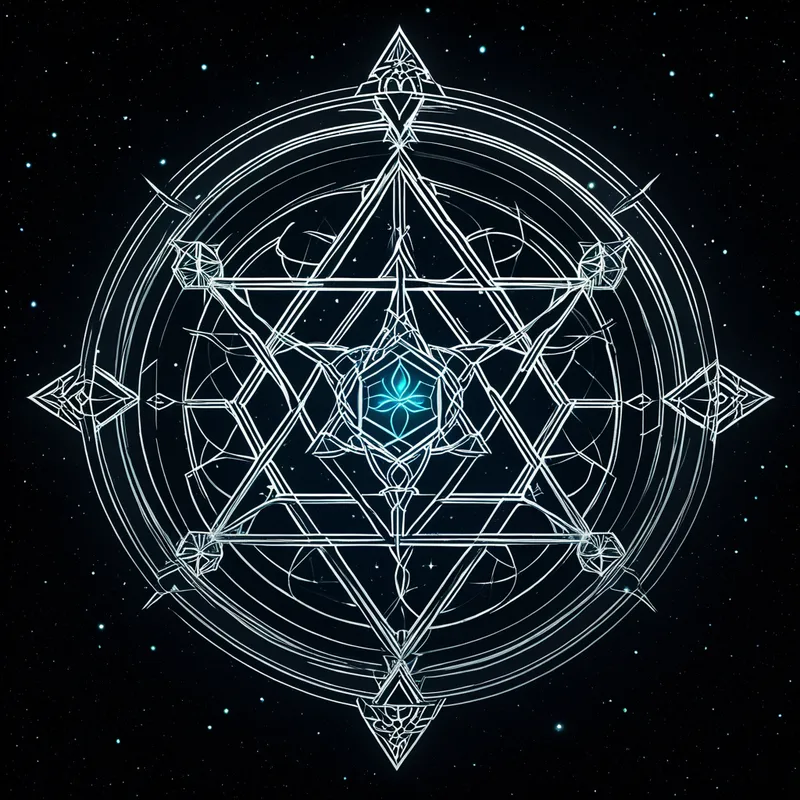
To dream of a Dvorovoi is to dream of boundaries in flux. You may dream of a familiar backyard that feels eerily watchful, of a garden shed from which a low growl emanates, or of trying to fix a fence that keeps collapsing. The somatic feeling is often one of being observed from just beyond the edge of your personal space, a prickling on the neck.
This dream pattern signals a psychological process of re-negotiating your personal limits. Are you feeling your resources are being depleted (the pinched cattle)? Are you neglecting your own instinctual needs or "animal" body (the forgotten offering)? Is a new aspect of your personality or a new responsibility trying to enter your life without proper integration (the new, un-introduced animal)? The dream Dvorovoi manifests as the psyche's corrective—an urgent, earthy intelligence demanding you tend to the perimeter of your life, to define what is yours to nurture and what must be kept out.
Alchemical Translation
The individuation process modeled by the Dvorovoi myth is not one of heroic conquest, but of sacred contract. It is the alchemy of relating to, rather than repressing, the shadow that guards our borders.
The first step is Acknowledgment: seeing the yard of your psyche, recognizing it is inhabited. You must turn toward the grumpy, neglected, instinctual guardian you've been ignoring. The second is Offering: this is the act of giving conscious attention and value to your boundaries, your physical being, your resources. It is setting limits, saying no, practicing self-care—the milk and bread for the spirit. The third is Integration: the point where the Dvorovoi stops his mischief and becomes a stalwart guardian. Your once-raw, reactive defenses become conscious, chosen protections. Your instinctual energy is no longer a sabotaging trickster, but a source of grounded power and resilience.
The ultimate transmutation is realizing you do not own your territory; you are in partnership with the wild spirit that was there first. Wholeness comes from honoring that pact.
You become, in a sense, the responsible steward of your own inner yard, and the Dvorovoi, once a figure of fear, becomes the embodied wisdom of place within you.
Associated Symbols
Explore related symbols from the CaleaDream lexicon:
- Spirit — The Dvorovoi is the quintessential land-wight, a localized spirit embodying the consciousness and mood of a specific, human-adjacent place.
- Shadow — He represents the psychological shadow of the homestead: the necessary but unacknowledged aggression, cunning, and animal instinct required to maintain a bounded self.
- Boundary — His entire domain is the boundary itself; the yard is a physical metaphor for the permeable membrane between the individual psyche and the outer world.
- Contract — The core of the myth is the sacred, reciprocal pact between human and spirit, modeling how we must consciously relate to the unconscious forces we depend upon.
- Horse — As master of the livestock, the horse is a primary symbol of the domesticated animal power under the Dvorovoi's care, representing tamed instinct and vitality.
- Earth — He is a chthonic spirit, deeply connected to the soil, mud, and raw, fertile matter of the homestead, grounding the human endeavor in physical reality.
- Fear — His initial manifestation is often through fear—the uncanny dread of the watched yard—which serves as the catalyst for establishing a conscious relationship.
- Ritual — The leaving of offerings is the simple, daily ritual that maintains the relationship, turning potential chaos into ordered protection through consistent practice.
- Home — While not in the house, he is essential to the holistic concept of Home, representing its vulnerable yet vital outer layer and its connection to the wild.
- Guardian — His primary function, once appeased, is as a fierce and loyal protector of the physical and psychic assets contained within his domain.