Dumangan Myth Meaning & Symbolism
A myth of celestial theft where the god Dumangan seizes seeds from the sky, bringing the gift of agriculture and the burden of labor to humanity.
The Tale of Dumangan
Listen. In the time before time, when the sky was a low, heavy blanket of stars and the earth was a soft, dark womb, humanity knew only hunger. They wandered the great green world, children of the soil, eating what the forest gave—a bitter root here, a sour berry there. Their bellies were hollow drums, their spirits thin as morning mist. Above them, in the vault of the heavens, the gods kept their treasures. The sky was not empty air but a granary, a celestial storehouse where the seeds of all things that could be—the golden grain, the fat tuber, the sweet fruit—were kept locked away in the constellations.
Among the gods was Dumangan. He was a quiet deity, one who watched the earth with a heart that ached. He saw the people stumble, saw their eyes grow dull with want. While other gods debated laws and sparked wars in the clouds, Dumangan listened to the whispering of the hungry soil.
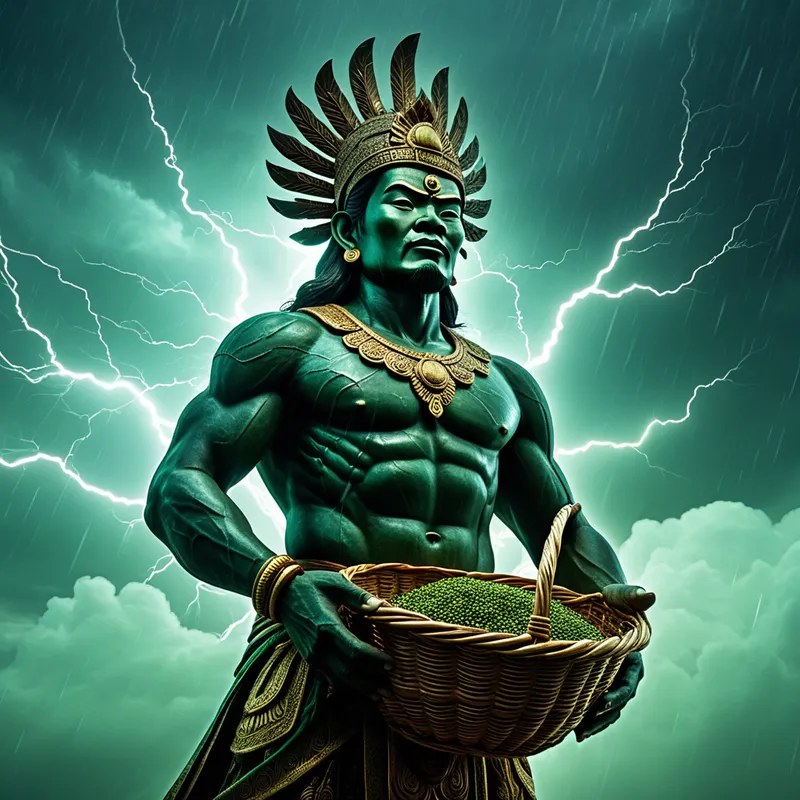
One fateful night, when the great sky-bull Tandang Bulan lowered its horns and the star-winds grew still, Dumangan made his choice. It was not a choice of pride, but of profound rupture. He approached the shimmering veil that separated the divine granary from the mortal air. With hands that could cradle thunderstorms, he did not knock. He tore.
The sound was the birth-cry of a new world—a great, silent ripping that vibrated in the bones of every sleeping creature. Through the rent in the sky, a torrent of light poured forth. Not fire, not water, but a cascade of living potential: seeds of every shape and color, each one a tiny, captured sun. Dumangan stood in the cataract, his form a silhouette against the blinding torrent, and he gathered them. He filled a basket woven from moonbeams and cloud-stuff, his arms straining with the weight of stolen tomorrows.
The heavens roared in outrage. Thunder was the voice of betrayed order; lightning was its searching, vengeful finger. But Dumangan was already falling, not as a defeated god, but as a purposeful comet. He descended to the highest peak of the waking world, where the first people huddled in fear of the celestial storm. Without a word, he opened his hands and let the seeds fall upon the earth. Where they touched the soil, they did not lie dormant. They sank, they ached, they quickened. Before the eyes of the astonished people, green shoots pierced the dark loam, climbing towards the very sky their father had violated.
He showed them the secret: the seed must be buried, as hope is buried in despair. The earth must be broken, as the sky was broken. Water must be given, like tears. And then, you wait. You labor. You tend. From his theft came not instant bounty, but the sacred covenant of work and wait, the first prayer of agriculture. The sky was wounded, but the earth was now pregnant. Dumangan, the thief, became Dumangan, the giver. And humanity’s long childhood of wandering hunger was over, replaced by the adult burdens and blessings of the sown field.

Cultural Origins & Context
The myth of Dumangan finds its roots in the pre-colonial Tagalog pantheon, a rich cosmology largely preserved through oral tradition and the meticulous work of early Spanish chroniclers like Pedro Chirino and Miguel de Loarca. Unlike the more centralized mythologies of archipelago neighbors, Tagalog belief was animistic and decentralized, with a pantheon of deities (anito) presiding over specific domains of nature and human life.
Dumangan’s story was not merely a fable of origin but a functional cosmology. It was a narrative held by agricultural societies whose survival was intimately tied to the cycles of planting and harvest. The myth was likely recited or invoked by the community’s spiritual leader, the babaylan or katalonan, during key agricultural rituals—at the breaking of the soil, the sowing of seeds, and the first harvest. Its telling served multiple purposes: it explained the origin of farming (a monumental technological leap), it justified the hard labor required (a divine mandate born from a divine crime), and it positioned humanity in a relational, albeit fraught, dialogue with the celestial powers. The sky’s anger, manifested in droughts or storms, could be interpreted as the ongoing consequence of Dumangan’s theft, a permanent tension in the cosmos that required constant ritual appeasement.
Symbolic Architecture
At its core, the myth of Dumangan is a profound allegory for the necessary transgression that sparks civilization and consciousness. It is the story of the Promethean impulse, but with a uniquely grounded, agricultural soul.
The gift of the gods is not given; it is taken, and in the taking, the taker is forever changed.
Dumangan represents the archetypal force that bridges a stagnant paradise (the sky-granary of effortless divine bounty) with a realm of potential suffering and growth (the hungry earth). His theft is the original creative act—a violent separation from a state of undifferentiated wholeness to initiate the process of becoming. The seeds are not just food; they are ideas, technologies, consciousness itself—the encoded potential for a new order. Their planting symbolizes the embedding of this divine spark into the messy, material reality of human life (work, waiting, uncertainty).
The torn sky is the irreducible wound at the heart of existence. It signifies the fundamental break between the ideal and the real, the spiritual and the material. There is no return to the innocence of simply receiving; one must now participate in the messy, laborious act of co-creation. Dumangan’s act brings abundance, but it also brings the knowledge of good and evil, of effort and failure, of seasonality and death—the very conditions of a conscious, responsible life.

The Dreamer's Resonance
When this myth stirs in the modern psyche, it often manifests in dreams of profound, ethical tension. One might dream of stealing something precious from a stern, authoritative figure (a parent, a boss, a king) not out of greed, but from a deep, compassionate need to feed or heal others. The dream is fraught with fear of punishment, yet carries an undeniable sense of righteous purpose.
Somatically, this can feel like a tearing sensation in the chest or gut—the "Dumangan rip." It is the physical correlate of a conscience being torn between obedience to an old order (which feels safe but sterile) and the imperative to enact a new, necessary truth (which feels dangerous but vital). The dreamer may wake with a sense of anxiety mixed with determination, as if they have committed to a course of action in their sleep that they must now see through in waking life. This myth patterns the psyche when we are at the threshold of a creative or moral act that requires us to "break the rules" of our own internalized sky—our limiting beliefs, familial mandates, or societal expectations—to bring something nourishing into the world.
Alchemical Translation
In the alchemical vessel of individuation, the myth of Dumangan maps the stage of Separatio and the beginning of Coniunctio. The psyche begins in a state of unconscious unity with the parental or cultural complexes (the sky-granary). This state may feel like safety, but it is a safety that starves the emerging Self of its unique potential.
Individuation is not a gift bestowed by the Self; it is a treasure seized from the collective unconscious, paid for with the guilt of separation.
The heroic ego, in the form of the Dumangan archetype, must perform the necessary transgression. It must "steal" the seeds of its own authenticity—its unique talents, passions, and insights—from the realm of mere potential (the collective). This act feels like a crime against the inner "gods" of tradition, superego, and conformity. The ensuing "storm" is the inner critic, the guilt, the anxiety of becoming an individual.
The labor of planting is the long, patient work of integrating this stolen potential into one's actual life. It is the discipline of nurturing a skill, the courage to live by a personal value, the commitment to a creative project. The harvest is the realized Self—no longer a hungry wanderer, but a cultivator of one's own soul's landscape. The wound in the sky remains; one never returns to naive unconsciousness. But one gains, in exchange, the dignity and burden of being a co-creator of one's own destiny, having brought something of the divine down to earth and made it real.
Associated Symbols
Explore related symbols from the CaleaDream lexicon:
- Seed — The stolen celestial potential, representing the divine idea, the spark of consciousness, and the encoded blueprint for future growth that must be buried in the darkness of the unconscious to sprout.
- Sky — The realm of the gods, the collective unconscious, the ideal, and the storehouse of all potential; its tearing represents the necessary rupture between the spiritual and material worlds.
- Earth — The realm of manifestation, material reality, the body, and the fertile ground where stolen potential must be planted, labored upon, and patiently grown.
- Theft — The necessary, guilt-laden transgression that initiates creation and individuation, the act of taking one's destiny from the hands of fate or authority.
- Harvest — The fruit of conscious labor and integration, the realized Self, and the abundance that comes from tending the seeds of one's own potential over time.
- Storm — The psychic backlash of guilt, fear, and anxiety that follows a transformative act of self-assertion or breaking from an old order.
- Labor — The conscious, sustained effort required to transform stolen potential into realized being; the work of individuation and soul-making.
- Gift — The paradoxical bounty that arises from a crime, representing how our greatest contributions to the world often stem from acts that initially felt like betrayals of the status quo.
- Hunger — The primal drive of the unconscious Self towards realization, the emptiness that compels the heroic ego to seek nourishment from beyond the permitted boundaries.
- Basket — The vessel of the soul or the conscious mind that must be strong enough to carry the weight of stolen potential from the divine realm into the human world.