Dullahan Myth Meaning & Symbolism
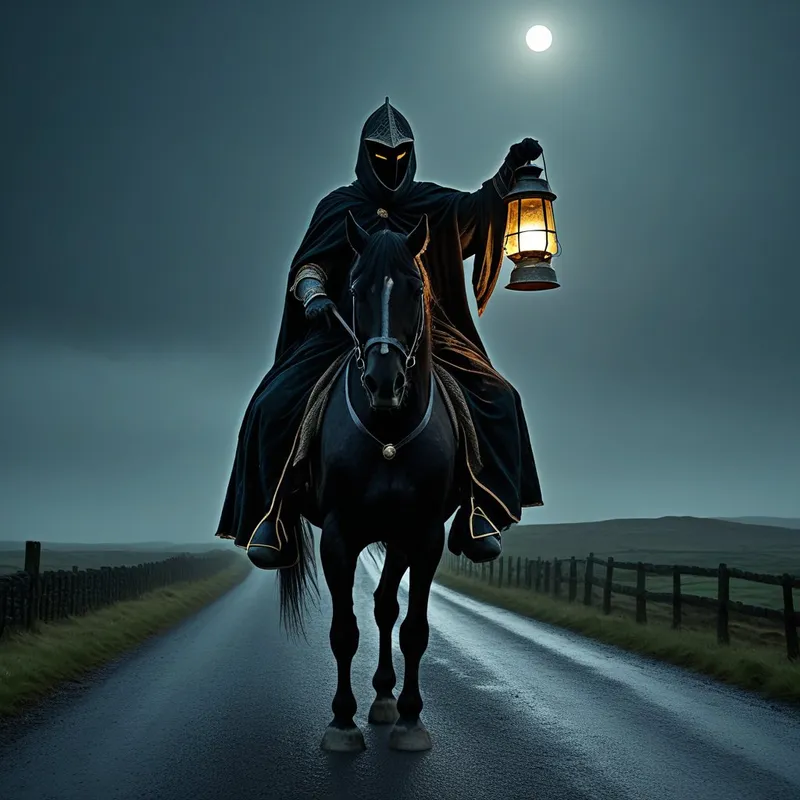
A spectral harbinger of death from Irish folklore, the Dullahan rides a black steed, carrying its head, to call the souls of the dying.
The Tale of Dullahan
Listen, and listen well. When the last light of day bleeds into the western sea and the world holds its breath in that deep, purple twilight, that is when you might hear it. Not with your ears, but in the hollow of your bones. A silence so profound it becomes a sound—the sound of a horse that makes no hoof-fall upon the earth.
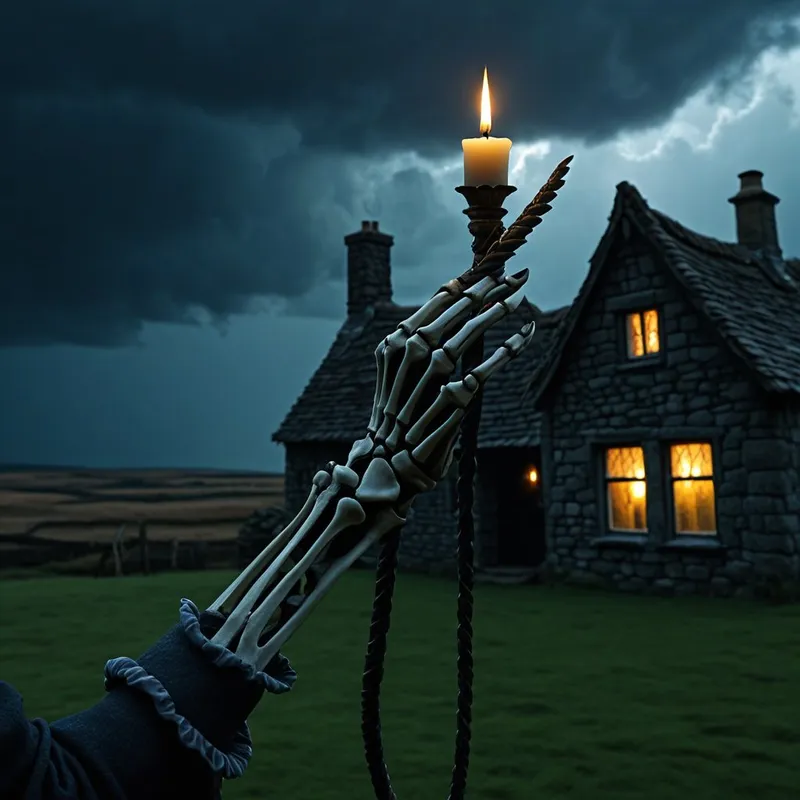
He comes from the Sídhe, from the mounds where the old gods sleep fitfully. He is the Dullahan. No head rests upon his shoulders, yet he sees all. In one hand, he carries a whip fashioned from the spine of a corpse, pale and clicking in the still air. In the other, he carries his own head. Its face is the color of moldy cheese, and a hideous, rictus grin splits it from ear to ear. Its eyes are black pools that roll and shift, seeing the roads of the world and the threads of fate that bind every soul. From that severed neck, a ghastly light sometimes spills, a corpse-candle to illuminate his terrible path.
He rides a steed as black as a starless midnight, its eyes burning with embers, its breath pluming like fog from a bog. Where the Dullahan stops, death is called. He speaks no word. He simply lifts his head, and with those awful, moving eyes, he fixes his gaze upon a dwelling. He calls out a name. It is not a shout, but a whisper that tears through wood and stone, a sound heard only by the one whose soul is being summoned. At that moment, the door of that house—no matter how stoutly barred, no matter if protected by iron or prayer—flies open of its own accord. And a life is extinguished.
There is no fighting him. No hero’s sword can bite his shadowy form. No saint’s relic can turn him aside. He is a decree, not a demon. Yet, the old stories whisper of a fragility. The Dullahan fears gold. A single coin tossed in his path will cause him to veer away, his purpose for that night thwarted. And they say he cannot abide the look of a pure, unblemished thing. To cast a freshly-made article of clothing, particularly a garment still warm from the maker’s hands, before him is to risk his wrath, but also to break his focus. He is absolute fate, yet he stumbles before the symbols of human craft and value. He rides until his task is done, and then he is gone, leaving behind only the chill of the grave and the certain knowledge that when your name is on his lips, all roads have ended.
Cultural Origins & Context
The Dullahan is a creature of the folk tradition, a fairy of the most fearsome order. Unlike the more literary phantoms of Gothic romance, his roots are sunk deep in the Irish soil and the pre-Christian understanding of death. He is often considered a specific manifestation of the Slua Sí, the Fairy Host, who were believed to collect souls. His tradition is strongest in the counties of the east and south, particularly in Leinster and Munster.
This myth was not written in illuminated manuscripts but passed mouth-to-ear beside peat fires, a story told to enforce a moral and cosmic order. It was a narrative of explanation, giving form to the sudden, inexplicable death that could visit a remote cottage. The storyteller, the seanchaí, wielded the Dullahan as a tool to teach respect for the unseen world, the power of fate (cinniúint), and the importance of communal taboos. The prohibitions against traveling certain roads at night, the reverence for iron and gold as protections, the dread of hearing one’s name called in the dark—all were reinforced by this tale. The Dullahan was the embodiment of the capricious, amoral power of the Aos Sí, a power that had to be acknowledged and cautiously appeased, never challenged.
Symbolic Architecture
The Dullahan is not merely a monster; he is a perfect, chilling symbol. He represents the absolute, impersonal face of mortality. He is death not as a release or a reward, but as an immutable fact, a function of the cosmos as inevitable as the tide.
To encounter the Dullahan is to stare into the architecture of inevitability. He is the final clause in the contract of existence, written in a language of silence.
His headlessness is profoundly symbolic. The head is the seat of identity, reason, and individual consciousness. By carrying it, he demonstrates that he is not a person, but a process. He is a functionary of a larger system. The head becomes a tool—a lantern to see fate, a mouth to speak the irrevocable word. He is consciousness divorced from humanity, serving a law beyond comprehension. The black horse connects him to the chthonic underworld, a beast of the soil and the grave. His fear of gold—the metal of kings, the sun, and immutable value—and of new cloth—the product of human creativity and warmth—hints that the absolute is momentarily baffled by the pure expressions of life’s vitality and craft. Yet it is only a stumble. The call always comes.
The Dreamer's Resonance
When the Dullahan rides through modern dreams, he rarely appears in his folkloric guise. The dreaming psyche translates ancient symbols into contemporary imagery. One may dream of a faceless authority figure—a judge without a face, a doctor who gives a terminal diagnosis in a flat, toneless voice. One may dream of hearing one’s own name called from an empty office building at night, or of a black car that follows no matter which turn is taken.
Somatically, these dreams are often accompanied by a feeling of profound paralysis, a crushing weight on the chest, or the sensation of being utterly seen and known in one’s vulnerability. Psychologically, this is the Self encountering a non-negotiable aspect of its own existence. It is not necessarily about physical death, but about the death of an era, an identity, a cherished plan. The Dullahan in dreams announces an ending that the conscious mind has refused to acknowledge. He is the herald of a fate one has woven for oneself through unconscious choices, a destiny that must now be faced. The dream is an initiation into powerlessness before a psychic truth, forcing the dreamer to relinquish control and confront the shadow of their own denied limitations or endings.
Alchemical Translation
The alchemical journey, or individuation, is not a path of endless light, but a process of integrating the blackness, the nigredo. The Dullahan is the personification of this essential, terrifying stage. To transform, one must first be named by the headless horseman. One must have the old self, the outworn identity, called to its end.
The gold that turns the Dullahan aside is the nascent Self, the first true value forged in the heart of the psychic ordeal. It is not a weapon, but an offering of one's own hard-won authenticity.
The process begins with the ride. The conscious ego, comfortable in its "house," is invaded by an annihilating truth from the unconscious (the flying open of the door). The old ways of thinking (the head) are severed and must be carried as an object to be observed, not as the ruler of the psyche. The dreamer must learn to "ride the black horse"—to consciously carry and direct the powerful, instinctual, and mortal energies of the body and the unconscious, rather than being trampled by them. The goal is not to defeat the Dullahan, which is impossible, but to undergo the calling he represents. In doing so, one moves from being a victim of fate to a witness of necessity. The pure, handmade garment that disrupts him symbolizes the new attitude, the consciously crafted life that can momentarily stay the execution, allowing for a more integrated, willing surrender to the transformative process. In the end, to integrate the Dullahan is to make peace with the annihilator within, to accept the rider of the dark night as a part of one's own wholeness, and in that acceptance, find a fearful kind of freedom.
Associated Symbols
Explore related symbols from the CaleaDream lexicon: