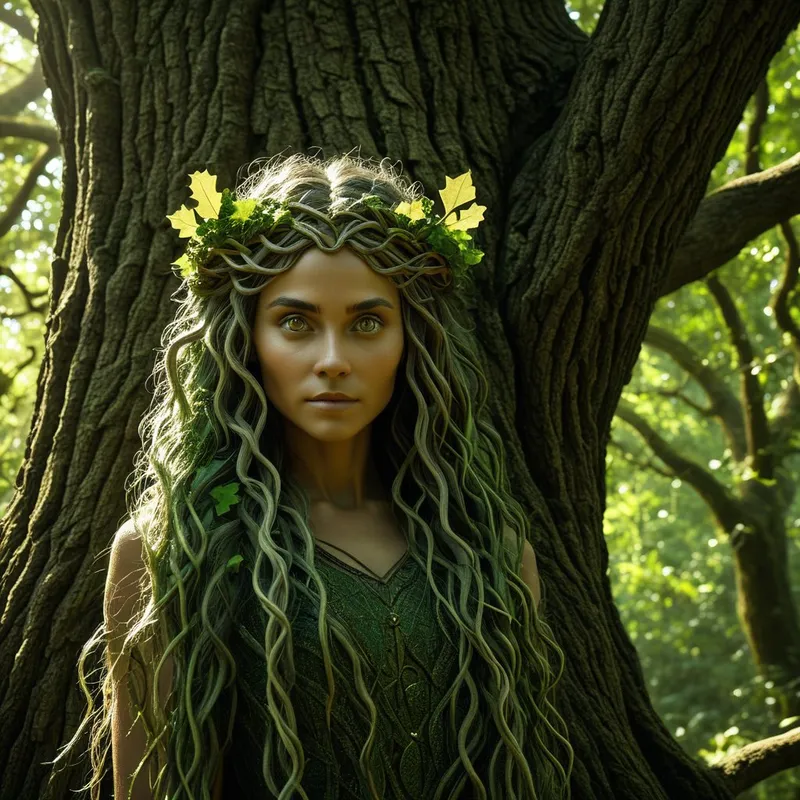
Dryad Myth Meaning & Symbolism
The myth of the Dryad, a tree-nymph whose life is bound to her sacred oak, embodies the soul's deep, mortal connection to the living world.
The Tale of the Dryad
Listen, and let the scent of pine and damp earth fill your senses. Let the rustle of a thousand leaves become the only sound. Here, in the deep, untamed groves where sunlight fractures into emerald shards, life is not as you know it. It is slower, deeper, rooted. And in these places, the nymph is born not of water or cloud, but of the tree itself.
She is the Dryad. Her first breath is the sigh of the sapling breaking the forest floor. Her first sight is the dappled light through a canopy older than kings. Her skin is the texture of bark, smooth in youth, rugged with age. Her hair is the cascade of leaves, changing with the seasons. Her blood is the sap that rises with the sun. She does not live in the oak, the ash, or the poplar; she is the tree. Its rings are the record of her days, its branches the reach of her spirit, its roots her hidden dreams delving into the dark, nourishing earth.
To see her is a rare gift, a moment when the forest holds its breath. A hunter, straying from the path at twilight, might glimpse a feminine form retreating into the trunk, leaving only the impression of a watchful gaze in the knothole. A woodsman, raising his axe, might feel a sudden, profound sorrow wash over him, a silent plea that halts his arm. For her life and the tree’s are one. The bond is absolute, a sacred marriage of spirit and form.
This is the heart of her tale, and its terror. Her existence is one of profound beauty and profound vulnerability. The Dryad’s fate is tied to her tree with a finality that makes mortal life seem fleeting and free. If the tree thrives, she flourishes, singing with the wind in its boughs. If it is wounded, she sickens. And if it is felled… her voice becomes a final, whispering sigh on the breeze, a fading imprint of life returning to the silence from which it came. She is the ultimate embodiment of place, of belonging so complete that destruction is not an event, but an erasure of a world.
Cultural Origins & Context
The Dryad belongs to the vast and intricate family of nymphs in Greek mythology. Unlike the grand, cosmic dramas of Zeus or Poseidon, the stories of nymphs were the local myths, the lore of the countryside. They were told by farmers, shepherds, and travelers—those who lived intimately with the land. A particular spring, a striking rock formation, or a grand, ancient tree was not merely a feature of the landscape; it was a being, a consciousness deserving of respect and often, propitiation.
This belief served a vital societal function: it enforced an ethic of conservation through reverence. To harm a tree known to house a Dryad was not simple lumbering; it was an act of sacrilege, of murder. It invited the wrath of other nymphs or of gods like Artemis, protector of the wilds. The myth encoded an understanding of ecological interdependence long before the term existed. The forest was not a resource; it was a community of sentient life, and humanity was a guest within it, obligated to tread with care.
Symbolic Architecture
At its core, the Dryad myth is a profound symbol of the anima mundi—the world soul—as it manifests in a single, specific locus. She represents the spirit of place, the unique genius of a living location.
The Dryad is the secret truth that every living thing is not merely an object in space, but a subject with an inner life.
Psychologically, she symbolizes the deep, symbiotic bond between the psyche and its "container." The tree is the body, the life, the tangible existence; the Dryad is the soul, identity, and consciousness inhabiting it. Their inseparability speaks to a fundamental condition of embodied life: our spirit is not a ghost in a machine, but is grown through and with our physical being. Our wounds are her wounds; our strength is her strength.
Furthermore, the Dryad embodies the tension between eternity and mortality. The tree may live for centuries, outlasting human generations, giving the illusion of permanence. Yet it, and she, are ultimately perishable. This makes her a tragic lover—deeply committed, profoundly vulnerable, and fated for a loss that is not separation, but annihilation. She is the archetype of the Lover, whose devotion is absolute and whose existence is defined by that bond.
The Dreamer's Resonance
When the image of a Dryad or her sacred tree emerges in modern dreams, it often signals a process of deep-rooted psychological work. It is rarely a casual symbol.
To dream of a vibrant, healthy Dryad in her tree suggests the dreamer is in a phase of profound symbiosis with their own life—their body, their home, their work. There is a sense of being "in place," where inner spirit and outer circumstance are in harmonious alignment. The psyche is rooted and nourished.
Conversely, to dream of a wounded or weeping Dryad, or of a tree being cut, points to a somatic or psychological violation. This could relate to physical illness, where the "tree" of the body is under attack. More often, it relates to a violation of one's sacred space: burnout from a job that consumes one's life-force, the trauma of a broken home, or a relationship that damages the core self. The dream is a signal from the deepest layer of the psyche that a fundamental bond—the bond between who you are and how you live—is in peril. The feeling upon waking is often one of deep, inexplicable grief or anxiety, a somatic echo of roots being severed.
Alchemical Translation
The individuation process, the alchemical journey toward psychic wholeness, requires us to first discover and then honor our own "sacred tree"—the unique, living structure of our authentic life. The Dryad myth models this not as a quest for liberation from the world, but for a conscious, sacred marriage with it.
The initial stage is Naming the Tree: identifying what your life is truly rooted in. Is it in family tradition? Creative passion? Intellectual pursuit? Spiritual practice? This is not about societal expectations, but the deep, often silent core that feeds your soul.
The central alchemical work is Tending the Grove. This is the daily, often unseen work of protection and nurture. It means setting boundaries (the sacred grove is not for everyone to trample), practicing self-care (watering the roots), and removing what is poisonous (clearing blight). It is the recognition that your vitality is not infinite; it is a living system that requires respect.
The ultimate transmutation is realizing you are both the tree and the nymph—the mortal vessel and the immortal consciousness within it. To harm one is to destroy the other; to honor one is to glorify both.
Finally, the myth confronts us with the necessity of Sacred Mortality. The Dryad’s bond means she cannot "transcend" her tree without ceasing to be. In our terms, we cannot become whole by rejecting our humanity, our history, or our wounds. Individuation is about fully inhabiting our specific, mortal life—with all its vulnerabilities and temporal limits—and finding the eternal within that commitment. We learn to love the tree, knowing it will one day fall, and in that conscious, bonded love, we discover a depth of soul that mere permanence could never provide. The Dryad does not seek to be free; she seeks to be utterly, devastatingly present, and in that presence, she touches the divine.
Associated Symbols
Explore related symbols from the CaleaDream lexicon: