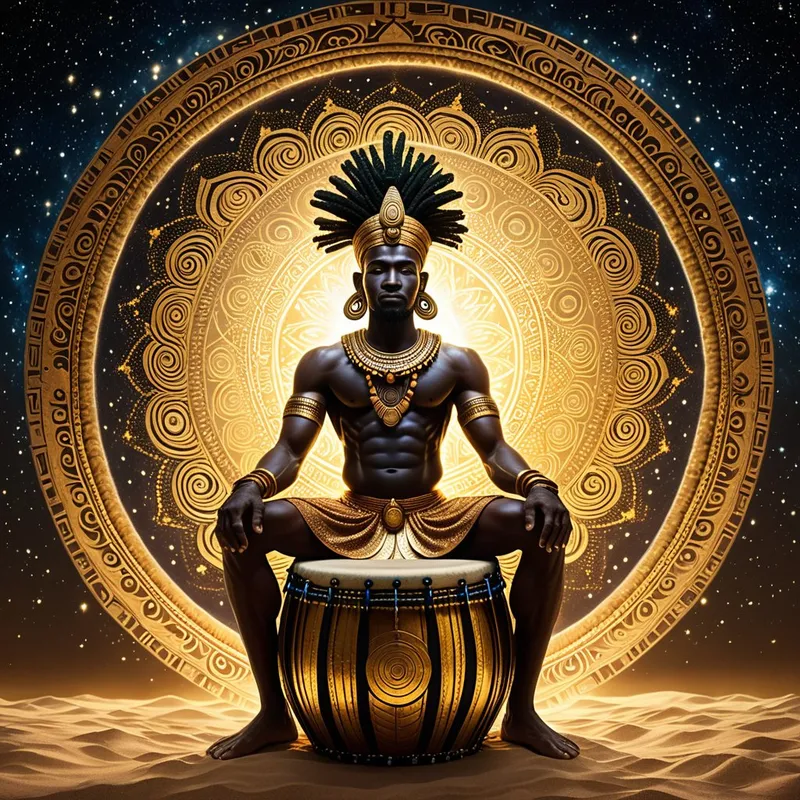
Drum of Creation Myth Meaning & Symbolism
A myth where the primordial silence is broken by a divine drumbeat, calling all things into being from the void through sacred rhythm and vibration.
The Tale of Drum of Creation
In the beginning, there was no beginning. There was only the Great Silence, a deep and dreaming void, pregnant with all possibilities yet holding none. It was not empty, but full—full of a potential so complete it was soundless, motionless, a single, eternal note waiting to be sung.
Within this Silence dwelt Nana Buluku, the Ancient One, the Source beyond gender, beyond form. Nana Buluku was the Silence and the Knower of the Silence. And within that vast consciousness stirred a desire—not a need, but a generous, overflowing urge to share being. To turn the solitary dream into a chorus.
So, from the essence of its own being, Nana Buluku fashioned the First Instrument. Not a tool, but a companion. It was a Drum. Its frame was carved from the wood of the World Tree that had yet to be planted. Its skin was stretched from the hide of the Primordial Ox that had yet to breathe. It was adorned with shells from oceans unborn and feathers from birds undreamed.
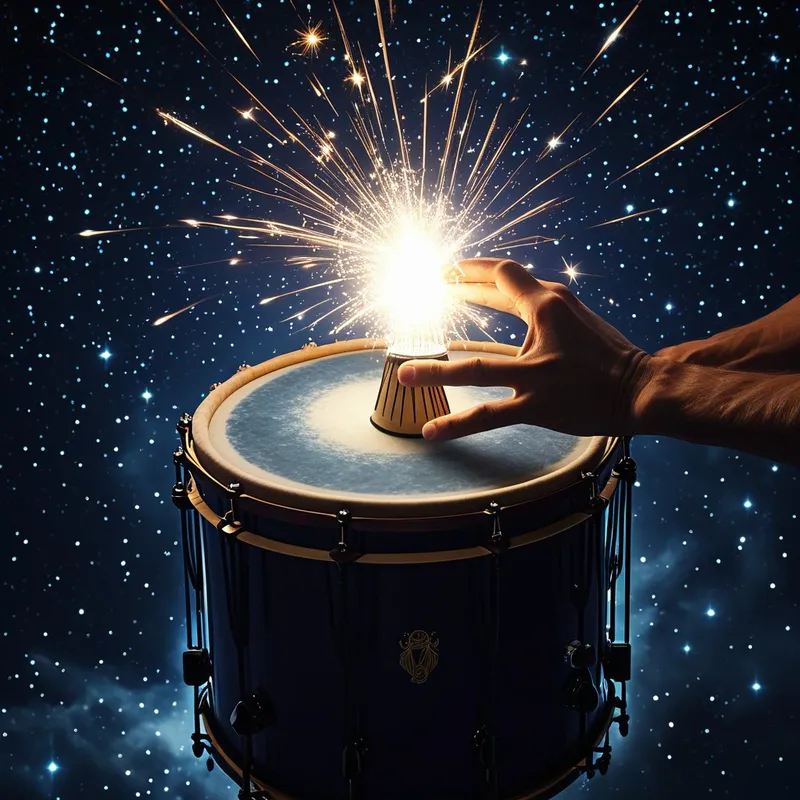
Nana Buluku held the Drum in the lap of eternity. A hand, formed from a thought, hovered over its silent skin. The Void held its breath. Then… it descended.
BOOM.
A single beat. A pulse that was not a sound, but the father and mother of all sound. It was a shockwave of pure Is-ness. The Great Silence rippled like water struck by a stone. From the epicenter of that first beat, Light burst forth—not as a harsh glare, but as a warm, golden radiance, differentiating itself from the surrounding dark.
BOOM-Da… BOOM-Da…
A rhythm began. A heartbeat for the cosmos. With each strike on the taut skin, a new reality was born. From the high tones came the shimmering spirits, the Orishas and Abosom. They danced into being on the vibrations. From the deep, resonant bass tones, matter coalesced—mountains pushed up like solidifying waves, rivers carved their first paths, the firmament of the sky stretched wide.
The rhythm became complex, a polyrhythm of creation. One hand beat the steady pulse of Time. The other danced across the drumhead, creating the syncopated melodies of individual lives, the counter-rhythms of predator and prey, the rising and falling patterns of seasons and stars. Everything that existed was a unique note in the grand composition, a distinct vibration called forth by the sacred Drum.
Finally, the rhythm achieved a crescendo, a flourishing, intricate pattern of such beauty that it gave birth to the first human souls. They emerged not from clay or word, but from a specific, loving rhythm—a rhythm that contained within it the memory of the original Silence, the pulse of life, and the capacity to listen, to dance, and one day, to create their own songs.
And when the universe was thrumming, vibrant, and complete in its diversity, Nana Buluku’s hands grew still. The Drum was not put away. It remained, its sound now the hidden hum at the core of all atoms, the rhythm in every heartbeat, the pattern in every growing vine. The creation was not an event that ended. It was—and is—a song that continues to be played.
Cultural Origins & Context
The motif of the Drum of Creation is not a single, monolithic myth from one tribe, but a profound archetypal theme woven through the oral traditions of many peoples across West and Central Africa, including the Fon, Akan, Yoruba, and Dogon, among others. In these cultures, the drum is far more than an instrument; it is a sacred technology, a conduit between realms.
This myth was not read but performed. It was the domain of master drummers, griots, and elder storytellers who would recite it during ceremonies of initiation, at festivals marking the new year, or at the enthronement of a king. To tell the story was to re-enact it. The storyteller’s voice would become the drum, using cadence, clapping, and call-and-response to make the audience feel the primordial beat in their bones. Its function was cosmological—it explained how an ordered, rhythmic world emerged from chaos—and sociological, reinforcing the understanding that community, like a good rhythm, requires each person to hold their unique part within a harmonious whole.
Symbolic Architecture
The myth is a masterclass in symbolic thought. The Great Silence represents the unconscious pleroma, the state of psychic wholeness before the ego’s differentiation. It is not nothingness, but the fertile ground of the Self.
The first act of consciousness is not a word, but a vibration—a differentiation that creates relationship between the beat and the silence that frames it.
The Drum itself symbolizes the principle of mediation. It is the vessel (the womb, the psyche) that translates the unmanifest will of the creator (the unconscious) into the manifest patterns of reality (conscious life). Nana Buluku, as the androgynous source, embodies the unified archetype of the Father-Mother, who creates not through separation but through rhythmic emanation.
Most crucially, the polyrhythm represents the nature of a healthy psyche and a healthy world. It is not monolithic uniformity. The steady pulse is the constant, the guiding principle (the Self, or destiny). The intricate counter-rhythms are the diverse complexes, emotions, talents, and challenges of the individual ego. Harmony is not the absence of conflict, but the conscious integration of multiple rhythms into a coherent, dynamic whole.
The Dreamer's Resonance
When this myth stirs in the modern dreamer, it often surfaces during periods of profound stagnation ("the Great Silence") or chaotic inner turmoil ("discordant noise"). To dream of a deep, resonant drumbeat in an empty space signals a call from the deepest Self. It is the psyche’s attempt to re-establish a foundational rhythm, to re-synchronize a life that has lost its beat.
Somatically, one might awaken with a feeling of vibration in the chest or a heightened awareness of one’s own heartbeat. Psychologically, the process is one of listening. The ego, which often tries to shout its own song, is being asked to become quiet and attend to a more ancient, organizing pulse. The dream may present images of broken instruments, mute singers, or frantic, disordered dancing—all pointing to a disconnect from the inner Drum. The healing lies in the recognition that one is not the drummer of this primary rhythm, but an essential note within its grand composition. The task is to find one's unique rhythm that aligns with the greater song.
Alchemical Translation
The individuation process mirrored here is the alchemy of finding one's authentic voice within the cosmic chorus. It begins in the silence of the nigredo—the feeling of meaninglessness, of being lost in the undifferentiated. The first beat is the spark of awareness, the call to adventure from the Self (the Orisha within).
The work of a lifetime is to carve your own drum from the World Tree of your experiences and stretch it with the hide of your resilience, so you may contribute your unique sound to the ongoing creation.
The rising action is the arduous practice—learning to hear the core rhythm (the Self’s intent) amidst the world’s noise (the persona, the expectations of others). Integrating the shadow is acknowledging the disruptive, syncopated beats that seem off-rhythm but are necessary for the music’s depth and interest.
The culmination is not becoming the sole drummer, but achieving a state of conscious participation. It is the Rubedo, where the individual, having differentiated their own rhythm (individuated), now plays it in conscious, joyful harmony with the rhythms of others and the world. One becomes a co-creator. In this myth, creation is not a one-time act; it is a continuous, participatory process. To live authentically is to pick up the drumstick of conscious choice and, with respect for the original score, add your own vital, irreplaceable beat to the eternal song of becoming.
Associated Symbols
Explore related symbols from the CaleaDream lexicon: