Druid's Wand Myth Meaning & Symbolism
A Druid surrenders his crafted power to the land itself, discovering that true sovereignty flows not from possession, but from sacred reciprocity.
The Tale of Druid’s Wand
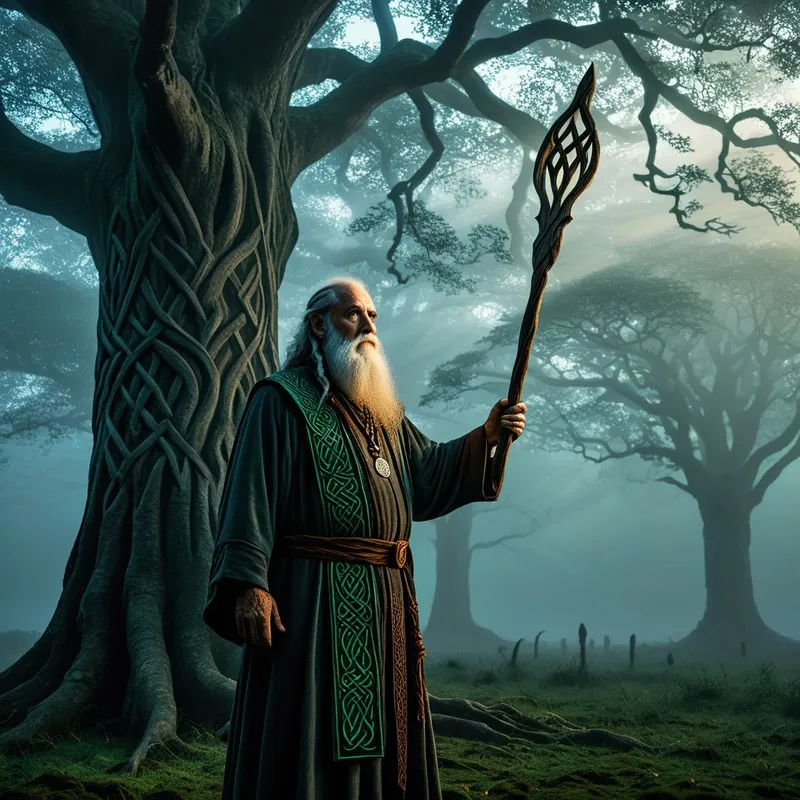
Listen now, and let the mists of the Sídhe gather close. In a time when the oak was king and the rivers sang with the voices of goddesses, there lived a Druid named Mac Coll. For seven times seven years he had studied the secret languages of the wind, the patterns of stars in the black belly of night, and the deep, green wisdom of the forest. His knowledge was vast, his will was strong, and from the sacred hazel that grew over the Well of Segais, he fashioned a wand.
This was no simple stick. He carved it under a full moon with a knife of bronze, inscribing it with the secret names of the land and binding to it the essences he had gathered: the first breath of a newborn foal, the last sigh of a winter gale, the steadfast silence of a standing stone. When he held it aloft, the wand hummed with a power that could bend the weather to his thought, calm the raging beast, or call forth visions from the smoke of a sacred fire. It was an extension of his own hard-won soul, a rod of his sovereignty. The people revered him, and he, in turn, wielded his crafted power with a stern and solemn pride.
Yet, a dryness came to the land. The wells sank low, the hazel nuts were hollow, and a silence fell over the spirits of the grove. Mac Coll used his wand, chanting until his voice grew hoarse, drawing upon its stored power to summon rain. Dark clouds gathered, but they passed over the hills, shedding not a drop. He commanded the rivers to rise, but they flowed thin and listless. His great tool, the focus of his life’s work, had become a seal, isolating him from the very world he sought to command. In a dream, the Cailleach, the ancient hag of the mountains, appeared to him. She said nothing, but simply held out a gnarled, empty hand over a cracked and barren stone.
Tormented, Mac Coll journeyed to the heart of the old forest, to the primordial mound where the first oak was said to have taken root. There, in a clearing bathed in the sickly light of a waning moon, he faced the truth. His power was a transaction, a demand. The land was not a subject to be ruled, but a living being to be heard. In an act that felt like tearing his own heart from his chest, he knelt before the great oak. He did not raise the wand. Instead, he laid it down upon the moss, its carvings facing the dark earth. He began to speak, not words of command, but of apology, of release, of gratitude for the lessons of the hazel and the silence of the stones.
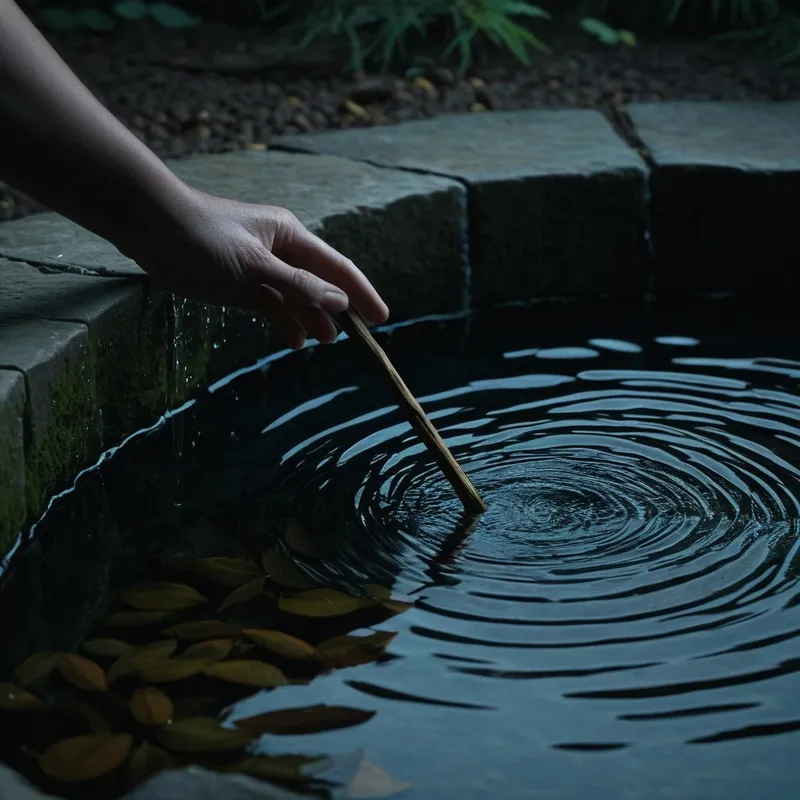
As his final word faded, the wand itself began to dissolve, not into nothing, but into a cascade of silver light that seeped into the roots of the oak. The tree shuddered. From its highest branch, a single acorn fell, striking the moss where the wand had lain. And from that spot, a clear spring bubbled forth, its waters cool and singing. Mac Coll cupped his hands and drank. The water held no magic of command, but a knowledge deeper than any spell: the knowing of the root, the patience of the stone, the cyclical grace of loss and return. He rose, not as a master with a tool, but as a man who was finally, truly, a part of the living land. His sovereignty was no longer held in his hand, but flowed through his veins, a shared pulse with the world.
Cultural Origins & Context
The motif of the Druid’s wand, or slat draoichta, is not a singular myth from a specific text, but a resonant archetype woven through the fragmentary tapestry of Celtic lore, preserved in early Irish and Welsh literature, and later folk traditions. Unlike the Greco-Roman world, the Celtic cultures left no systematic scripture of their myths; they were an oral tradition, the sacred province of the fili and the Druids themselves. Stories were not mere entertainment but functional incantations, tools for transmitting law, history, and cosmological truth.
A tale like that of Mac Coll would have served multiple societal functions. On one level, it is a teaching story for aspirants to wisdom, illustrating the peril of mistaking the symbol (the wand) for the source (the animate cosmos). It reinforces the core Celtic spiritual principle of sacred reciprocity—that relationship with the land, the genii locorum, and the gods is a dialogue, not a monologue of control. Furthermore, it legitimizes the Druidic order not just by showcasing power, but by defining its ultimate purpose: to serve as a conscious conduit between the human community and the wild, intelligent mystery of the natural world. The wand’s dissolution is a paradox central to this wisdom: ultimate authority is found in surrender to a greater order.
Symbolic Architecture
At its core, the myth is a profound map of psychological integration. The wand represents the constructed ego, the persona of the adept. It is the sum total of one’s accumulated knowledge, disciplined will, and hard-won skill—a brilliant and powerful artifact of the conscious mind.
The wand is the brilliant prison of the perfected self.
The ensuing drought symbolizes the inevitable crisis of meaning that arrives when the conscious attitude, however sophisticated, becomes rigid and cut off from the nourishing waters of the unconscious—the deep, instinctual, and transpersonal psyche. The land here is the Self, the holistic ground of being, which withdraws its vitality when approached only with tools of control.
The pivotal act of laying down the wand is the sacrifice of the ego’s prized possession. It is not an act of annihilation, but of offering. The ego’s power is not destroyed; it is transmuted by being given back to its source. The wand dissolving into the tree’s roots is a perfect image of the conscious mind’s insights being absorbed into the unconscious, fertilizing it. In return, the unconscious offers up the spring—a new source of life that emerges spontaneously, not from effort, but from right relationship. This is the birth of what Jung called the transcendent function, a new attitude that emerges from the dialogue between conscious and unconscious.
The Dreamer’s Resonance
When this mythic pattern stirs in the modern dreamer, it often manifests as a profound impasse. One might dream of a prized tool or instrument breaking at a critical moment, of a powerful vehicle that will not start, or of standing before a dried-up well or a dead tree with a full cup that cannot be poured. Somatically, this can feel like a constriction in the chest, a literal dryness in the throat, or a heavy fatigue that no amount of conscious will can overcome.
Psychologically, this is the soul’s signal that a long-held identity—the “Druid” or expert self—has served its purpose and is now blocking further growth. The dream ego is being confronted with the limits of its curated power. The process underway is a necessary deflation of the heroic ego. The psyche is initiating a dissolution of an old, rigid complex so that a more fluid and authentic connection to the inner and outer world can be established. It is a call to surrender one’s “knowing” in order to truly listen.
Alchemical Translation
The journey of Mac Coll is a flawless allegory for the alchemical opus and the Jungian process of individuation. It begins with the nigredo, the blackening: the drought, the failure, the dark night of the soul where all one’s acquired skills prove useless. This is a necessary humiliation, the burning away of arrogance.
The act of laying down the wand is the central alchemical sacrifice, the solutio—a dissolving of fixed form into the prima materia, the original, chaotic ground. The conscious will (the wand) is submitted to the unconscious matrix (the tree/land).
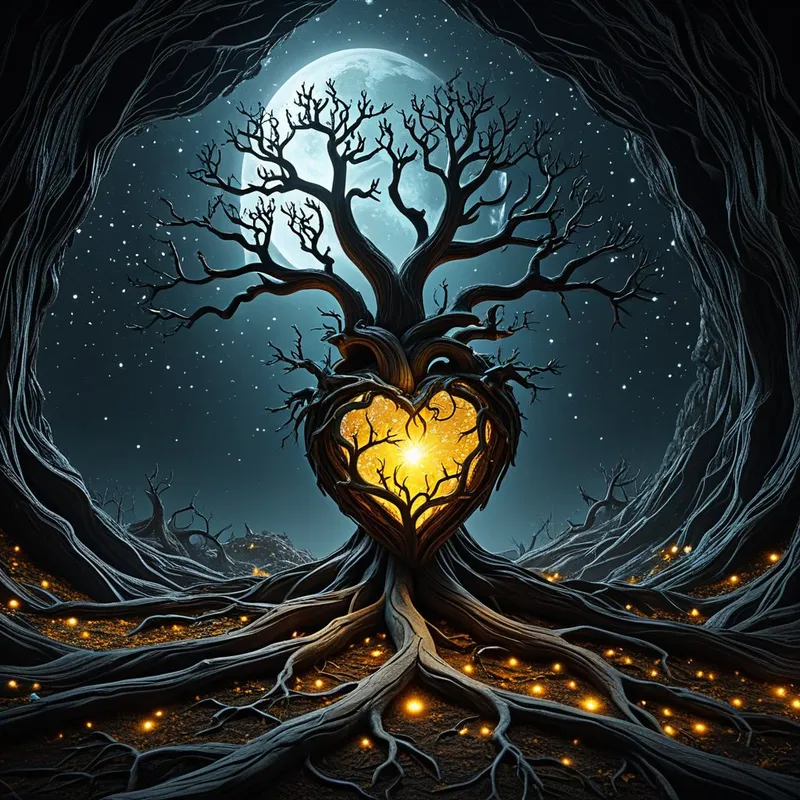
Individuation is not about building a better wand, but about becoming the living tree.
The bubbling forth of the spring is the albedo, the whitening, the emergence of a new, purer substance from the union. This is the transcendent function in action: a new attitude, symbolized by the nourishing water, that is neither the old egoic control nor passive dissolution, but a dynamic, flowing wisdom sourced from the depths.
Finally, Mac Coll drinking from the spring represents integration. He internalizes this new source. His sovereignty is no longer a property he owns (potestas), but an authentic power-in-relationship (auctoritas) that flows through him. He has moved from being a magician who commands, to a sage who participates. The myth thus charts the path from the loneliness of mastery to the communion of wisdom, a transformation where the greatest power is found in sacred surrender, and the true self is discovered only when the tool of the self is given away.
Associated Symbols
Explore related symbols from the CaleaDream lexicon: