Druid's Charm Pouch Myth Meaning & Symbolism
A Druid's quest to mend a sacred pouch becomes a journey into the underworld, confronting forgotten gods to restore the world's hidden balance.
The Tale of Druid's Charm Pouch
Listen now, by the fire’s crackling light, to a tale not of kings and battles, but of a silence that fell upon the land. It was a time when the rivers ran clear but whispered less, when the wind in the nemeton carried a hollow note. The balance, that delicate, unseen web woven between the world of the living and the Sídhe, had frayed.
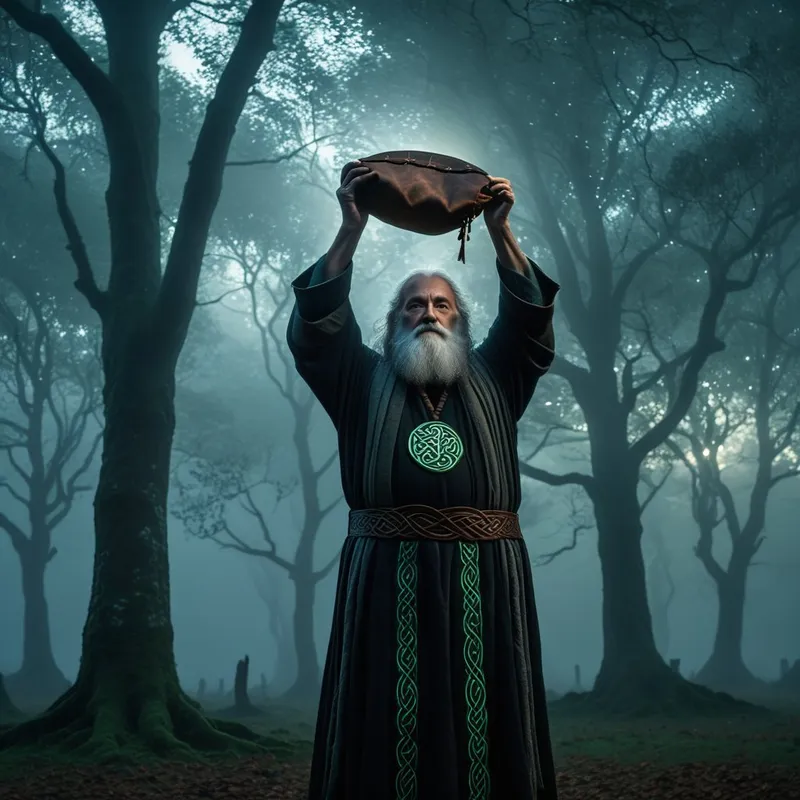
In the heart of a great forest, where the oldest oak touched the sky, lived a Druid named Mac Iúir. He was the keeper of the Pócán Draíochta, a pouch of worn leather, stitched with patterns older than memory. Within it lay not herbs or stones, but the geasa—the sacred vows—of the land itself: the promise of the spring’s return, the pact with the river’s spirit, the truce with the deep earth. One evening, as the sun bled into the west, he found the pouch lying open at the foot of the World Tree, its contents spilling not as objects, but as faint, fading lights that vanished into the soil. The seam had split, not from wear, but from a forgetting.
A cold dread, colder than the deepest well, settled in Mac Iúir’s bones. To mend it, he could not use common thread. The wisdom of the ancestors spoke in a faint echo: he must journey to Tech Duinn, the House of Donn, the Dark One. There, in the realm where all journeys end, he must petition the forgotten ones for a thread spun from the hair of the Cailleach in her deepest sleep, and a needle forged in the breath of the smith-god Goibhniu.
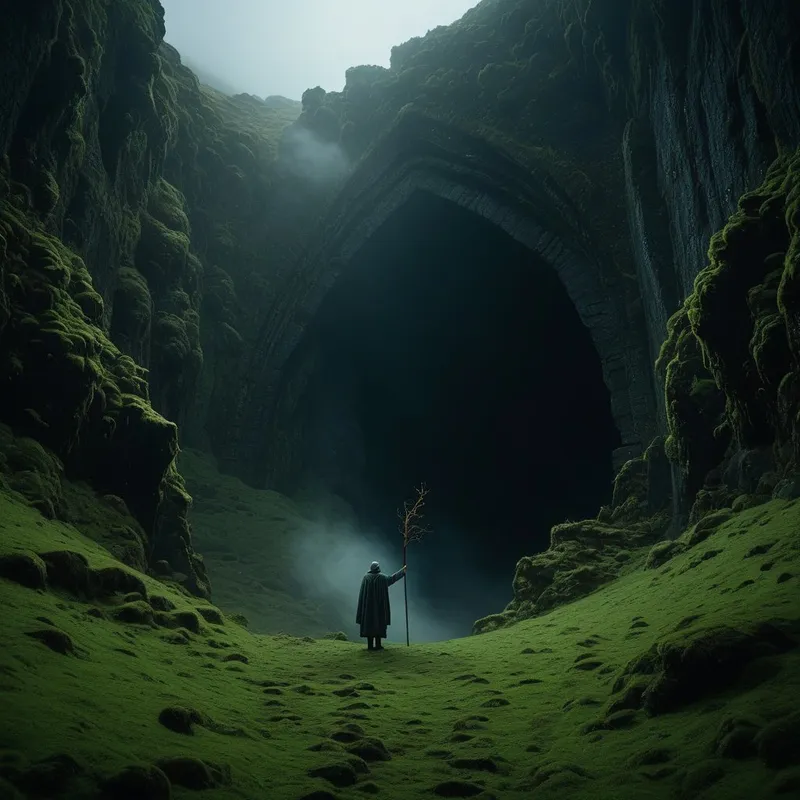
Guided only by the fading pulse from the empty pouch, Mac Iúir descended. He crossed the Hazel Strand, where the salmon of wisdom swam blind. He walked paths where the stars were beneath his feet. In Tech Duinn, he did not find skeletons, but shapes of shadow and memory—the gods as they were before men gave them names. They were vast, indifferent, and asleep. His chants were mere whispers against their dreaming. To awaken even one was to risk being unmade by its raw, untamed essence.
Yet, for the pouch to hold, the thread needed blessing, and the needle needed purpose. He offered not a sacrifice of blood, but of memory. Standing before the slumbering form of the Cailleach, the ancient hag of creation, he sang the names of every mountain she had shaped, every valley she had carved, until a single, silver hair loosened from her stony brow. Before Goibhniu’s silent forge, he breathed the memory of the first fire, the first tool, the first song shaped by hand, until the cold ashes glowed and a needle of dark iron formed itself.
With these, at the threshold between the deep below and the world above, Mac Iúir sat. As he drew the silver thread through the dark iron needle, he did not simply sew leather. With each stitch, he whispered a name—of a stream, a badger, a star, a child not yet born. He was re-weaving the geasa, not as rules, but as relationships. As the final stitch closed, the pouch did not just become whole. It became a heartbeat. The wind in the nemeton sighed a full, rich note. The rivers resumed their stories. And Mac Iúir understood the pouch was never meant to contain power, but connection. The charm was the web itself.
Cultural Origins & Context
The motif of the sacred container—the cauldron, the grail, the pouch—is a deep stream in Celtic narrative, flowing from the pre-Christian oral traditions preserved by the filid (poet-seers) and later recorded by medieval Irish and Welsh scribes. A "Druid's Charm Pouch" as a singular myth is not found in one specific text like the Táin Bó Cúailnge or the <abbr title="The "Four Branches" of Welsh mythology from the Mabinogion">Pedair Cainc. Rather, it is a scholarly and psychological reconstruction, a "myth in potentia" drawn from pervasive archetypal patterns: the Druid as custodian of cosmic balance (like Cathbad), the perilous journey to the Otherworld for a talisman (a core element of the Immram), and the sacred object that holds the fate of the land (like the Four Treasures of the Tuatha Dé Danann).
Its societal function was likely pedagogical and initiatory. Told within the context of bardic schools or around communal fires, such a story would encode the Druidic worldview of an animate, interconnected world where humanity’s role is one of mindful participation, not domination. The broken pouch symbolizes a broken fír (truth, cosmic order), and its mending is the ultimate priestly duty—to mediate, remember, and ritually repair the bonds between the community, the ancestors, and the natural world. It passes down not as history, but as a map for navigating spiritual crisis.
Symbolic Architecture
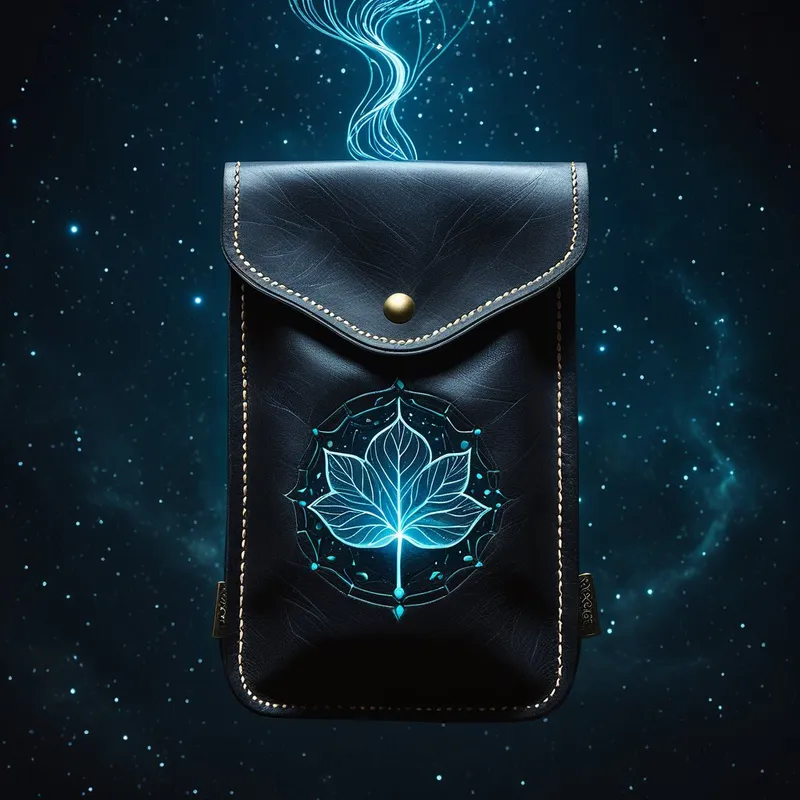
The myth’s power lies in its symbolic architecture, where every element is a facet of a psychological truth. The Pócán Draíochta is not a mere bag of tricks; it is the symbolic container of the Self—the fragile, crafted vessel that holds the individual’s (and the culture’s) most sacred contracts with life, its core values and connections. Its splitting represents a state of psychic disintegration, where one’s inner world feels emptied of meaning, and one’s "charms" (talents, relationships, beliefs) no longer hold power.
The journey to the underworld is never for treasure, but for the tools of repair. One must go down to the forgotten foundations to mend what is broken above.
The Tech Duinn represents the collective unconscious, the deep, impersonal layer of the psyche where archetypes—the "old gods"—reside in primordial form. They are not personal guides but fundamental, often terrifying, forces of nature and psyche. The thread from the Cailleach is the thread of fate and substance, drawn from the very fabric of one’s inherited and instinctual nature. The needle from Goibhniu is focused consciousness, the skilled, transformative application of will and intellect. The mending, therefore, is the act of individuation: using conscious insight (needle) to thoughtfully weave one’s innate, often raw, nature (thread) back into a cohesive whole (the mended pouch).
The Dreamer's Resonance
When this myth stirs in the modern dreamer, it often manifests as dreams of broken or lost containers: a prized bag with a hole, a leaking vessel, a safe that won’t lock, or a heart-shaped locket that springs open, empty. The somatic feeling is one of vital energy draining away, a profound lethargy or anxiety that "the center cannot hold."
Psychologically, this signals a rupture in the persona—the adapted, functional self we present to the world. The dreamer may be undergoing a life transition, a betrayal, a failure, or a creeping ennui that has severed their felt connection to what once gave life purpose (their "charms"). The dream is not a diagnosis of brokenness, but a call to the mythic task. The unconscious is presenting the image of the broken pouch as both the problem and the mandate: you must go down. You must confront what has been forgotten or put to sleep within you—perhaps a neglected talent, a buried trauma, or an unlived life—to find the unique thread and needle for your own repair.

Alchemical Translation
The alchemical process mirrored here is the opus contra naturam: the work against (or through) nature. The initial state is the nigredo, the blackening—the split pouch, the sense of meaninglessness. The descent into Tech Duinn is the mortificatio, a symbolic death of the old, surface-level understanding of the self. Confronting the sleeping gods is the encounter with the irreducible, autonomous complexes of the unconscious; one does not conquer them, but respectfully petitions them for their essence.
The pouch, once mended, does not simply return to its old state. It is transmuted. It becomes a conscious vessel, holding both light and shadow, connection and solitude.
The retrieval of the thread and needle is the separatio and coniunctio—distilling the pure materials from the chaotic mass of the unconscious and uniting them with conscious intent. The final act of sewing, of speaking the names, is the albedo and rubedo—the whitening and reddening. It is the laborious, meticulous integration of these depths into a new, more resilient psychic structure. The restored pouch is the lapis philosophorum, the philosopher’s stone of the psyche: not a static perfection, but a dynamic, living center that can contain paradox, sustain connection, and transform the base metal of experience into the gold of meaning. For the modern individual, the myth teaches that healing is not a return to a naive wholeness, but a deliberate, brave re-weaving of one’s story with threads drawn from the darkest, most forgotten parts of one’s own soul.
Associated Symbols
Explore related symbols from the CaleaDream lexicon: