Druidic Tradition Myth Meaning & Symbolism
A myth of a bard who journeys into the Otherworld to retrieve the lost songs of the ancestors, guided by a spectral stag and the memory of the sacred grove.
The Tale of Druidic Tradition
Listen. The wind in the oaks is not merely wind. It is the breath of the ancestors, whispering through a veil grown thick with forgetting. In a time when the world was woven tighter with the Otherworld, there lived a people whose memory was their greatest treasure. They remembered the true names of rivers, the secret songs that made crops grow, and the stories that held the stars in their courses. This memory was kept by the Druí, who learned for twenty years in the dark, silent groves.
But a shadow fell—a forgetting, slow as winter’s creep. It came not with fire and sword, but with a turning away. The songs grew faint. The sacred wells were covered with brambles. The great Nemed stood empty. The last true Filí, an old man named Bran, felt the songs slipping from him like water through cupped hands. In a dream, a figure cloaked in mist and oak leaves spoke: “The root remembers, but the branch has forgotten. To drink from the source, you must become the root.”
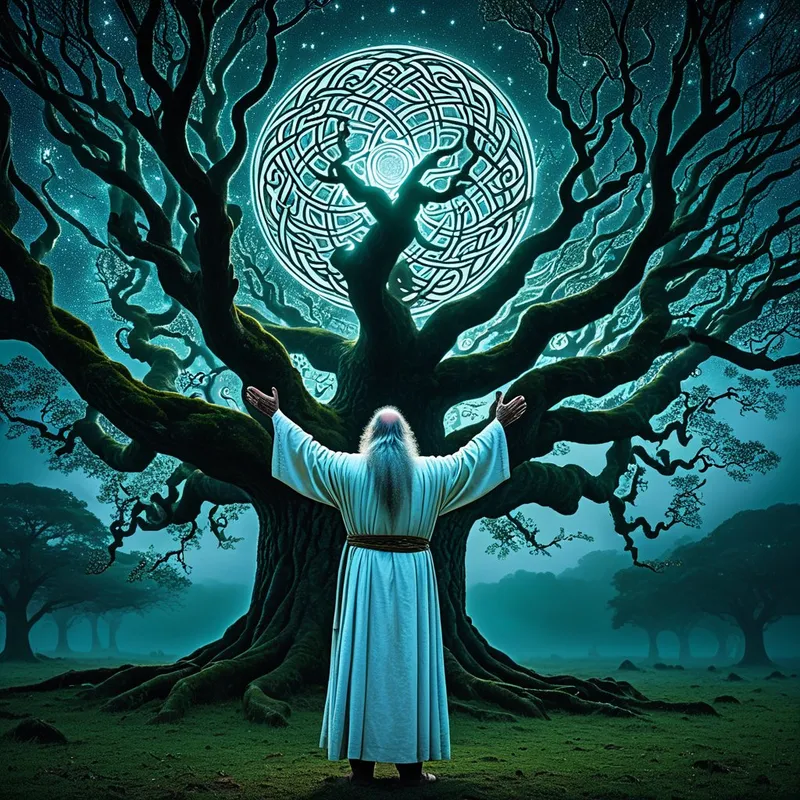
Driven by a sorrow deeper than his own life, Bran left the fading warmth of the hearth and walked into the deepest forest, to the Nemeton of his youth, now a ruin of fallen stones and choked saplings. He sat at the foot of the great central oak, its heart rotted out. He did not chant or pray with words. He offered his silence, a vessel for the emptiness. For three days and nights, he sat, the cold seeping into his bones.
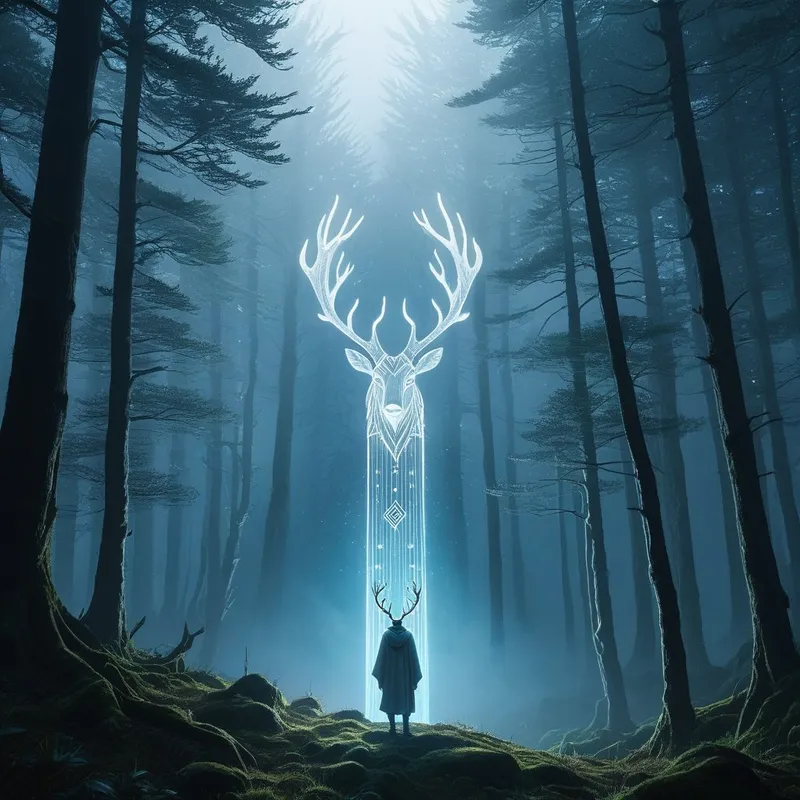
On the third night, as the moon cast skeletal shadows, a white stag stepped from the hollow of the oak. Its antlers were not of bone, but of woven, glowing light—Ogham script flowing like liquid silver. It regarded him with eyes that held the depth of still pools. Without sound, it turned and walked into the solid trunk of the tree. Bran, his breath a ghost in the air, knew this was the threshold. He did not hesitate. He followed.
He passed into a world of inverted truths. The sky was a tapestry of roots, the earth a canopy of stars. Rivers flowed upwards. Here, memory was not recalled; it was lived. He saw the first fire being kindled, heard the first law being sung. But the price of witnessing was participation. To carry a song back, he had to leave a part of himself behind—his fear, his certainty, his very name, which unraveled from him like a thread. He stood before a well where nine hazel trees dropped their nuts of wisdom into the water. The spectral stag bowed its head. Bran drank.
He did not return with tablets of law or scrolls of genealogy. He returned with a single, resonant note humming in his chest, and the knowledge that the grove was not a place, but a state of being—a pattern of connection between all things. The old oak at the Nemeton burst into leaf, though it was deep winter. And those who listened to the wind through its branches heard, not the old man’s stories, but the stories telling themselves anew through him. The tradition was not preserved; it was reborn, not in monument, but in transmission.
Cultural Origins & Context
The mythic core of the Druidic Tradition arises from the pre-Christian, orally transmitted world of the Celtic peoples of Iron Age Europe. It is not a single story with a fixed text, but a resonant pattern gleaned from fragmentary references in early Irish and Welsh literature (like the Táin Bó Cúailnge or the Mabinogion), classical commentaries (notably by Caesar and Pliny), and the enduring motifs of Celtic folklore. The Druids themselves left no written records, adhering to a sacred prohibition against committing their vast learning to perishable script. Thus, their “myth” is inherently one of orality and memory.
This tradition was not merely religious; it was the cultural operating system. The Druí, the Filí, and the Fáith were the historians, judges, philosophers, and mediators between the human tribe and the animate, spirit-filled world. The myth of their tradition functioned as a societal meta-narrative, explaining the source of cosmic order (Fír), the importance of poetic inspiration (Imbas), and the sacred contract between the people, the land, and the ancestors. It was told not for entertainment, but for initiation—to shape the mind of the learner to perceive the interconnected web of reality.
Symbolic Architecture
At its heart, this myth is about the psyche’s relationship to ancestral wisdom and the peril of cultural or personal amnesia. The sacred Nemeton represents the temenos, the protected inner sanctum of the soul where deep knowledge resides. Its desolation symbolizes a state of alienation from one’s own depths.
The journey to the Otherworld is not a voyage outward, but a descent inward. The forgotten grove is the neglected psyche.
The white stag is a classic psychopomp, a guide to the unconscious. Its antlers, as the crown of the forest, symbolize the branching structure of knowledge and the nervous system itself. The Ogham script glowing upon them signifies that true wisdom is encoded in the very patterns of nature, waiting to be “read” by the prepared mind. The hero’s loss of his name is crucial; it represents the dissolution of the egoic identity, which must occur to make room for the transpersonal knowledge of the Self. He does not retrieve an object, but becomes a conduit. The single note he returns with is the prima materia of consciousness—the fundamental vibration from which all specific thoughts and stories can be regenerated.
The Dreamer's Resonance
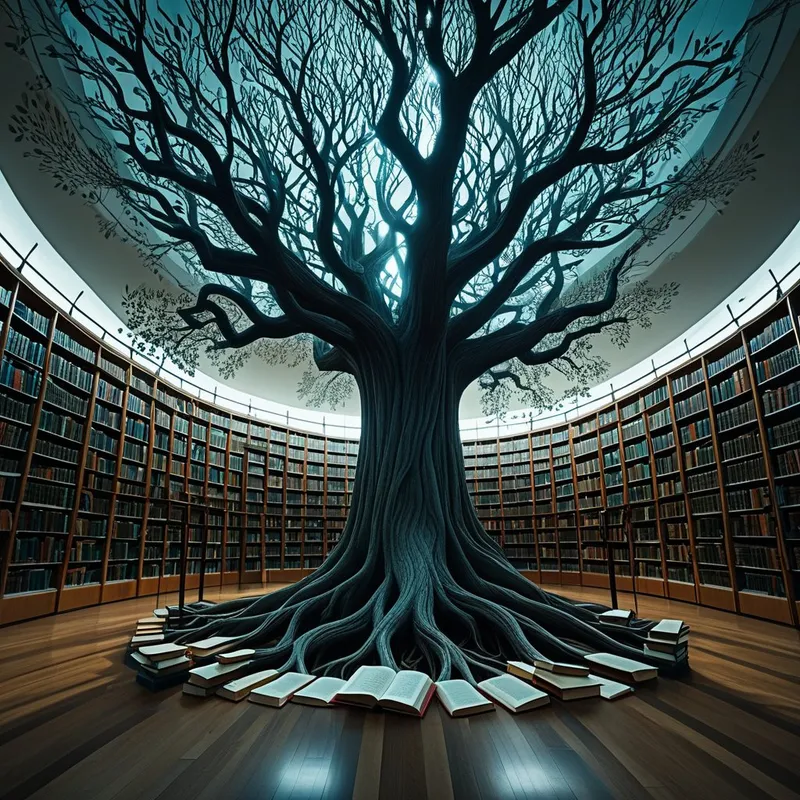
When this mythic pattern stirs in the modern dreamer, it often manifests as dreams of seeking lost knowledge in labyrinthine libraries, following animal guides through unfamiliar yet eerily familiar landscapes, or encountering ancient, wise figures in ruined or overgrown places. There may be a somatic sensation of roots growing from one’s feet, or of hearing a language one cannot understand yet profoundly feels.
Psychologically, this indicates a process of reconnecting with what psychologist James Hillman called the “acorn theory”—the sense of an innate destiny or daimon that has been obscured by life’s adaptations. The dreamer is undergoing a recall of personal or ancestral soul-code. The conflict is between the modern, forward-rushing ego and the deep, patient pull of the ancestral soul. The resolution in the dream is rarely a full recovery, but often a finding of the path or the guide, symbolizing the ego’s willingness to submit to a deeper guidance system. It is the psyche’s attempt to heal the rupture between the individual and the lineage of wisdom that flows through them.
Alchemical Translation
The alchemical process mirrored here is the Nigredo leading to a new Albedo. The “forgetting” and the desolate grove are the Nigredo—a necessary, dark night of the soul where old structures of meaning and identity crumble. The seeker’s silent vigil is the mortificatio, the death of the old self.
The sacrifice is not of something you have, but of something you are. You trade the known self for the possible Self.
The journey into the inverted Otherworld is the Solutio, a fluid immersion in the unconscious. Drinking from the well of wisdom is the Coniunctio, where the conscious mind integrates the nourishing, chaotic waters of the deep. The return is not to the old life, but to a life informed by the depths. The individual becomes a living Nemeton—a centered space where the world-tree of the psyche can grow, connecting the underworld of instinct and ancestry, the middle world of human experience, and the upper world of spirit and aspiration. The tradition is kept alive not by rote repetition, but by each individual’s courageous descent and authentic return, transmuting inherited wisdom into a living, present truth.
Associated Symbols
Explore related symbols from the CaleaDream lexicon: