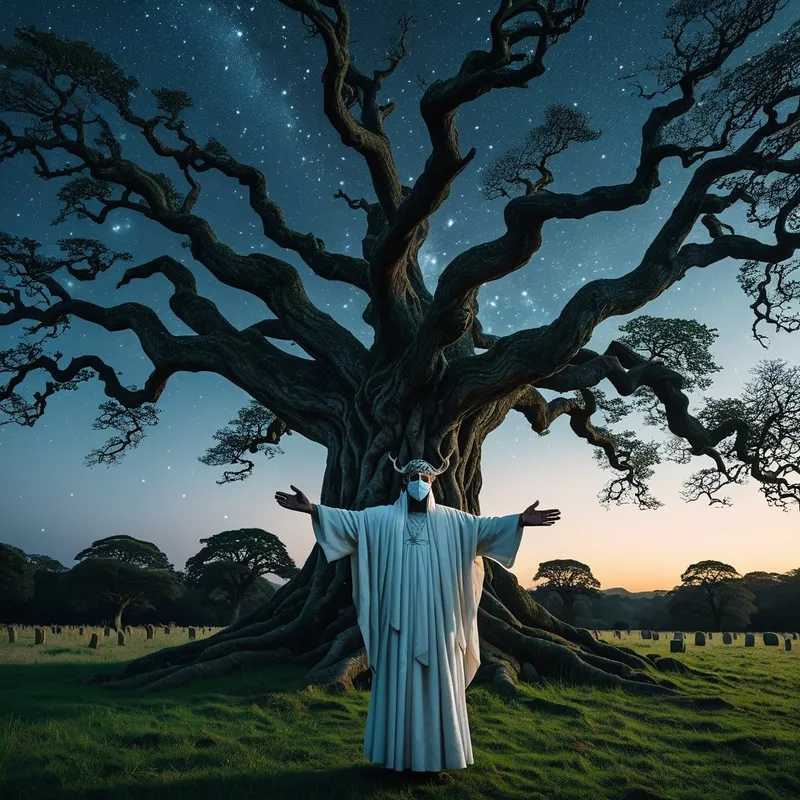
Druidic Ritual Myth Meaning & Symbolism
A myth of the eternal duel between the Oak King and Holly King, a ritual sacrifice that ensures the turning of the wheel and the balance of the world.
The Tale of Druidic Ritual
Listen. The wind in the nemeton does not whisper; it chants. It carries the memory of a time when the world was not a place, but a living breath held between the earth and the sky. In that time, there were two kings, and they were brothers. Not of blood, but of spirit, bound to the great wheel of the year.
He of the long, green days was the Oak King. His crown was woven of living oak leaves, shimmering with the emerald fire of the sun at its zenith. His cloak was the meadow, his breath the warm southerly wind that coaxed life from the soil. Where he walked, barley grew tall and rivers ran clear and full.
His brother, his shadow, his other self, was the Holly King. His crown was of dark, prickly holly, studded with blood-red berries that glowed like captured stars. His cloak was the deep forest at midnight, his breath the frost that painted intricate ghosts upon the stone. Where he stood, the world grew quiet, turned inward, and dreamed beneath the snow.
They did not rule together. The wheel must turn. And so, at the peak of his power, when the sun hung fat and golden on the longest day, the Oak King would feel a chill in his green blood. He would journey to the sacred grove, the place of the world’s navel. There, in the blue twilight of the solstice, his brother awaited. No words were spoken. Words were for mortals. This was a law written in the sap of trees and the orbit of stars.
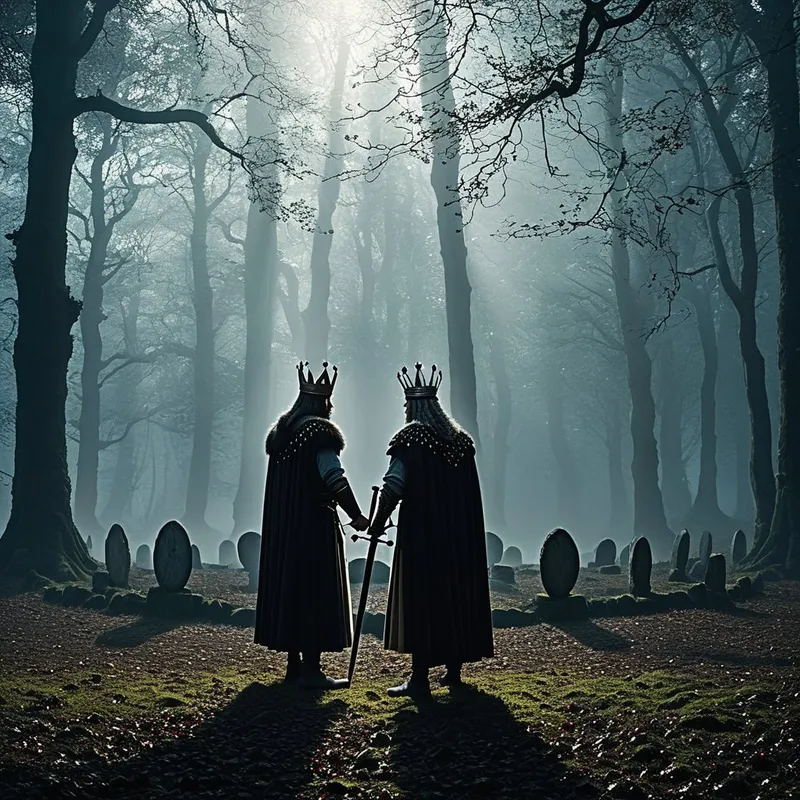
The clash was not of hatred, but of necessity. The Oak King’s sword, bright as a sunbeam, met the Holly King’s blade, dark and sharp as winter ice. It was a dance as old as the roots of the hills—a pushing, yielding, a transfer of essence. And as the last light bled from the sky, the Oak King, with a sigh that was the sound of falling leaves, would yield. He would kneel upon the cool earth, and the Holly King, with a touch both merciful and terrible, would claim the crown.
The victor did not rejoice. He bore the weight of the dark half of the year, guiding the sun into its tomb and guarding the secret seeds of life sleeping below. And the fallen king did not die. He retreated into the Tír na nÓg, the land of youth, to gather his strength. For he knew, as surely as the holly berry knows the snow, that at the depth of midwinter, when the night was longest, he would return. The ritual would be reversed. The Holly King would yield to the reborn Oak, and the light would be born again from the heart of the dark.
This was the ritual. This was the bargain. The kings sacrificed their throne so the world might live.
Cultural Origins & Context
This mythic pattern, often termed the "Duel of the Seasonal Kings," is not a single, codified story from an ancient text. The Celts, an oral culture spanning from Gaul to Ireland, transmitted their sacred knowledge through the Druids, who committed nothing of their core mysteries to writing. What survives are fragments: hints in medieval Irish and Welsh literature (like the eternal conflict in The Battle of the Trees), folk customs of the "Oak and Holly Boys" in British folklore, and the undeniable archaeological emphasis on solar and seasonal cycles at sites like Newgrange.
The societal function was profound. It was a cosmological anchor. The ritual drama explained the inexplicable—why the sun fled, why the land died and was reborn. It placed human kingship within this divine framework; a true king was one who understood his role was temporary, a steward who must ultimately sacrifice his power for the fertility of the land, mirroring the sacrifice of the divine kings. It transformed the anxiety of seasonal change into a sacred, predictable ceremony, affirming order in the face of chaos.
Symbolic Architecture
The myth is a masterclass in symbolic thought, depicting not a battle between good and evil, but between complementary and necessary opposites.
The sacrifice is not an end, but a translation of energy from one form of sovereignty to another.
The Oak King represents the conscious ego in its flourishing state: outward expression, growth, action, and solar clarity. The Holly King embodies the unconscious, the shadow self: introspection, wisdom, containment, and lunar mystery. Their duel is the psyche’s essential rhythm. We cannot live perpetually in summer’s expansion; we must also retreat into winter’s introspection to integrate our experiences and gain depth.
The ritual sacrifice is the key. The king who falls does not vanish; he journeys to the Tír na nÓg. This symbolizes the necessary dissolution of a dominant psychological attitude so its energy can be renewed in the unconscious (the Otherworld). The crown—sovereignty, identity, conscious control—must be willingly surrendered for transformation to occur.
The Dreamer's Resonance
When this mythic pattern stirs in the modern dreamer, it often manifests as dreams of poignant duels, changing crowns, or solemn ceremonies at turning points (solstices in dreams are powerful markers). You may dream of fighting a shadowy double, not with rage, but with a deep, ritualistic solemnity. Or you may dream of willingly handing over a prized possession—a key, a title, a weapon—to a darker, wiser version of yourself.
Somatically, this can feel like a profound fatigue at the peak of success, or a restless, creative quickening in a period of stagnation. Psychologically, you are navigating a liminal threshold. The ego-structure that has served you (the ruling "king") has reached its natural term and must be sacrificed to allow a new, more complex consciousness to form. The dream is the sacred grove where this transfer of power is negotiated. The anxiety felt is not about destruction, but about the necessary death of a current identity to serve the larger "kingdom" of the Self.
Alchemical Translation
The alchemical process mirrored here is solutio (dissolution) and coagulatio (coagulation), the eternal cycle of breaking down and re-forming. For the modern individual on the path of individuation, the Druidic ritual models how to navigate life’s major transitions not as crises, but as sacred rites.
Individuation is the conscious participation in the ritual duel within, claiming sovereignty not by defeating one's opposite, but by honoring the timing of its rule.
First, one must identify the ruling "King." Are you in an Oak King phase—all project, ambition, and external growth? Or a Holly King phase—withdrawn, introspective, in a period of incubation? Then, one must sense the turning of the inner wheel. The Oak King’s sacrifice teaches us to let go of outward expansion before it becomes brittle arrogance, to willingly enter a period of introspection. The Holly King’s sacrifice teaches us to leave the comfort of introspection before it becomes stagnant depression, to bring our hard-won inner wisdom back into the world.
The ultimate goal is not to choose one king, but to become the nemeton itself—the container that holds the entire cycle. The mature psyche learns to preside over its own inner rituals, consciously sacrificing outworn attitudes to make room for new growth, understanding that each "death" is in service to a greater, enduring life. In this, we move from being subjects of the cycle to being its Druidic stewards, performing the eternal ritual that turns the wheel of our own becoming.
Associated Symbols
Explore related symbols from the CaleaDream lexicon: