Druidic Oak Lore Myth Meaning & Symbolism
A tale of a Druid's sacred bond with an ancient oak, tested by a king's demand, revealing the price of true wisdom and the soul's hidden roots.
The Tale of Druidic Oak Lore
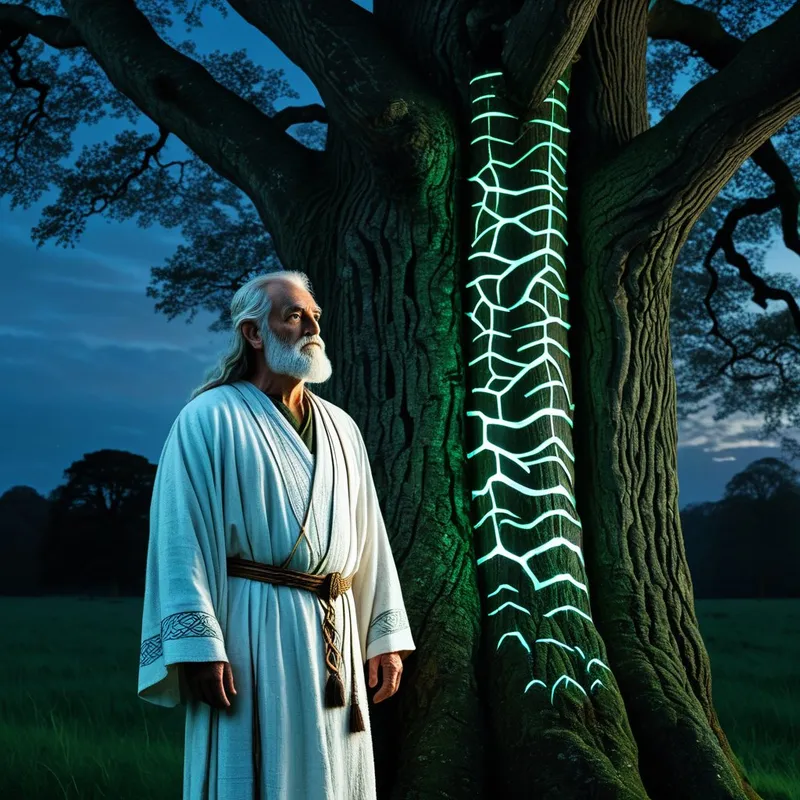
Listen, and hear the whisper in the wind through the leaves. In the deep green heart of the land, where mist clung to the hills like a memory, there stood an oak. It was no ordinary tree. Its girth was such that five men with linked arms could not encircle it. Its branches were a kingdom for the crow and the hawk, and its roots, they said, drank from the same springs as the Sídhe.
To this oak was bound a Druid named Mac Ibar. For seven times seven years, he had kept his vigil. He learned the language of its creaking boughs, the secret stories told in the patterns of its lichen, the wisdom pooled in the rainwater caught in its hollows. He did not own the tree; he was owned by it. His soul and the oak’s spirit were woven together like the warp and weft of a sacred cloth.
Now, a new king rose in the nearby fort, a man of iron and ambition named Mórchu. He desired a hall that would echo with his glory for a thousand years. He sent for Mac Ibar. “Druid,” the king commanded, his voice ringing in the smoky hall. “The great oak in the nemeton, the sacred grove. Its timber is mighty. It will be the central pillar of my house, and its strength will be my strength. You will sanctify its felling.”
A cold silence fell, deeper than the winter frost. Mac Ibar felt a pain in his own chest, as if an axe had bitten into his heartwood. To speak against the king was peril. To consent was a betrayal of his very breath. He looked not at the king, but through the open doorway, towards the green shadow of the forest. “I hear your will, King,” he said, his voice like dry leaves. “But the oak is not mine to give. It holds the memory of the land. To cut it is to sever a thread in the cloak of the world.”
Mórchu’s face darkened. “The tree is wood. I am king. You will do this, or you will be cast out, and another will take your staff and your honor.”
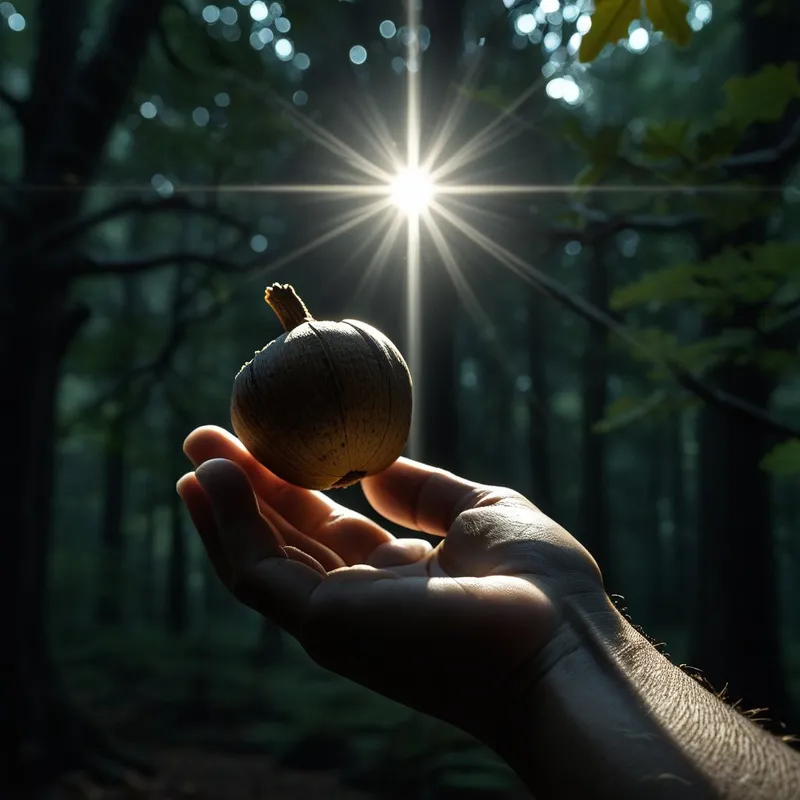
That night, Mac Ibar went to the oak. He pressed his forehead against its rough bark and wept. He did not ask for a solution, for the tree asked nothing of him. He simply poured out his sorrow. As dawn’s first light tinged the east, a single, perfect acorn fell from the highest branch and landed softly in his open palm. It was warm, and within it, he felt not just the potential of a tree, but the entire condensed history of its parent—every storm endured, every ray of sun absorbed.
With a resolve that quieted the trembling in his hands, Mac Ibar went to the king. “I will give you your pillar,” he said. “But you must cut it as I instruct, at the moon’s dark, and with an axe of bronze, not iron.” The king, satisfied, agreed.
At the appointed hour, the woodsmen raised the bronze axe. Mac Ibar stood before the oak, his back to the king. He placed the warm acorn upon his tongue and swallowed. As the first blow struck, a great shudder passed through the forest. But the oak did not cry out in a voice of wood. It sighed, a long, slow exhalation of acceptance. And as it fell, not with a crash, but with a deep, resonant thrum that vibrated in the bones of all present, Mac Ibar fell with it. His body lay still upon the moss.
The king had his pillar. But Mac Ibar was gone. Or so it seemed. For from the spot where his body lay, and from the great stump of the felled oak, a hundred thousand tiny shoots erupted. By the next full moon, a thicket of young oaks stood there, dense and impenetrable. And in the wind that stirred their new leaves, those with the ears to hear could discern a whisper, a wisdom now dispersed yet eternally present, saying: The form may fall, but the lore is rooted in the soul of the land.
Cultural Origins & Context
This tale, in its essence, is a refraction of core Druidic principles preserved in early Irish literature and later folk tradition. The Druids, the intellectual and spiritual elite of Celtic societies, were not merely priests but philosophers, judges, and historians. Their knowledge was oral, never committed to writing, making the tree—a living, growing, enduring entity—a perfect metaphor for wisdom itself.
The story likely functioned on multiple societal levels. For the community, it reinforced the sacredness of the natural world, specifically the nemeton, and the dire consequences of violating its integrity for mere temporal power. It established the Druid not as a servant of the king, but as a servant of a deeper, older sovereignty—the land itself. For the apprentice, it was a teaching story about the true cost of wisdom: it is not acquired without profound personal sacrifice and a willingness to transcend the individual self. The king represents the worldly, extractive principle, while the Druid and the oak embody the cyclical, regenerative principle.
Symbolic Architecture
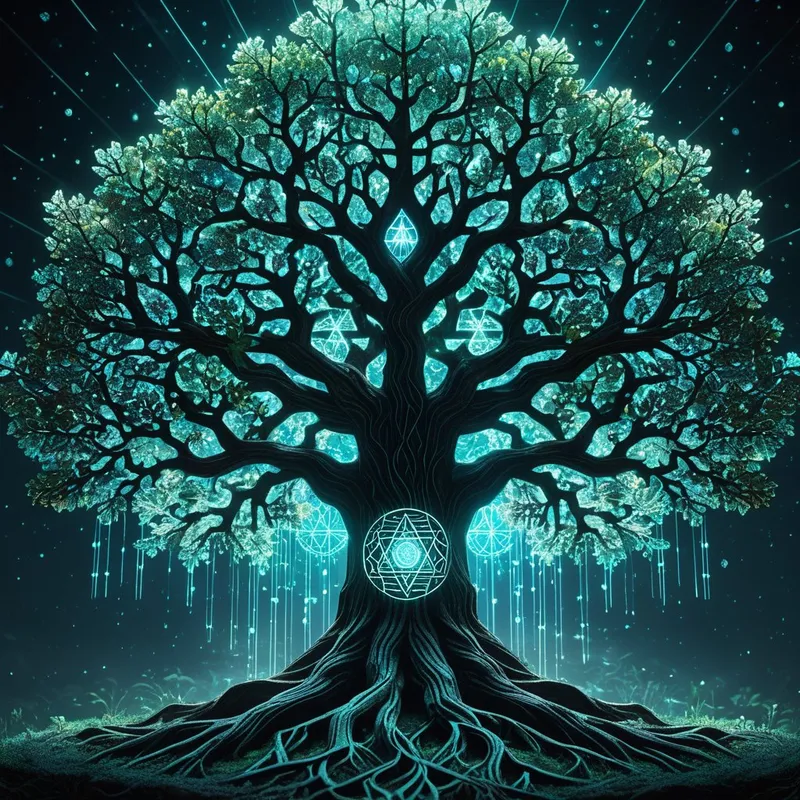
At its heart, this myth is an allegory of the psyche. The mighty Oak represents the Self—the ancient, foundational, and complete psychic structure that pre-exists the ego. The Druid, Mac Ibar, is the conscious ego that has aligned itself with this Self through lifelong devotion (his vigil). He has achieved a state of near-perfect identification.
The king’s demand is the crisis of the worldly ego, which seeks to use the power and stability of the Self for its own aggrandizement, to build a monument to its own identity.
The conflict is thus intrapsychic: the part of us that seeks legacy, control, and tangible achievement (the King) versus the part that is custodian of a deeper, more mysterious wholeness (the Druid). The felling is the inevitable trauma, the necessary de-structuring or “dark night of the soul,” required when identification becomes enmeshment. The ego must “die” in its current form to allow for a new relationship with the Self.
The swallowed Acorn is the genius of the myth. It is the germ of the future, the encoded essence of the old wisdom made portable and internal. It symbolizes the moment of insight where we internalize a truth so completely it becomes part of our very substance. The death of the old form (the felled oak, the fallen Druid) gives way to a proliferation of new life—not one giant tree, but a whole forest. This is the diffusion of integrated wisdom from a singular, heroic ego-consciousness into a more complex, resilient, and ecological psyche.
The Dreamer's Resonance
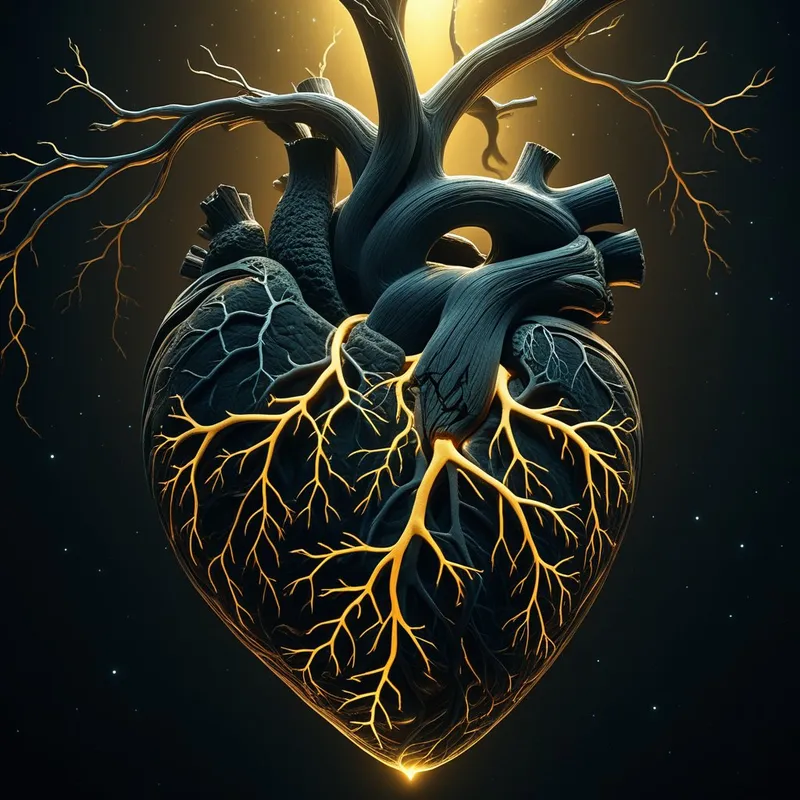
When this myth stirs in the modern dreamer, it often surfaces during periods of profound vocational or existential crisis. You may dream of a beloved, ancient tree being cut down, feeling a visceral, personal grief. Or you may be the one forced to wield the axe, filled with guilt and dread. The somatic experience is key: a deep ache in the chest, a feeling of being uprooted, or a strange warmth in the throat or gut (the acorn’s journey).
Psychologically, this indicates a process where a long-held identity structure—a career, a role, a foundational belief—is being demanded by external forces (the “King”) or an internal drive for achievement. This structure feels as intrinsic to you as the oak was to the Druid. The dream signals that a sacrifice is at hand. The psyche is preparing for a death, not a literal one, but the death of a way of being. The terror and sorrow are real, because a part of you is dying. The dream asks: What is the “acorn”? What is the irreducible, essential kernel of your knowing or your soul that you must swallow, protect, and carry through this dissolution?
Alchemical Translation
The alchemical process mirrored here is the Nigredo leading to a generative Albedo. The king’s command is the initial mortificatio, the killing of the old, inflated state (the ego identified with the Self). The felling is the brutal, necessary dissolution.
The true alchemical work is not in avoiding the axe, but in the Druid’s silent, intentional act of swallowing the seed. This is the separatio—distilling the quintessence from the perishable form.
The modern individual undergoing this “Druidic process” faces a similar ordeal. You may have to “cut down” a life you’ve lovingly tended—leave a job, end a relationship, abandon a long-pursued goal—because it has become a rigid idol, a pillar for a kingly ego that no longer serves the soul’s deeper growth. The triumph is not in saving the old tree, but in having the consciousness to recognize and internalize the essential “lore” it carried.
The resulting “thicket” symbolizes the outcome of individuation. You do not emerge from the crisis as a single, monolithic, “healed” self. Instead, you become a more complex ecosystem. Your wisdom, your energy, your identity becomes multifaceted, adaptable, and distributed—less a solitary pillar, more a living, interconnected grove. The myth teaches that wholeness is not found in preserving a singular, heroic form against all change, but in the courageous sacrifice that allows life, and wisdom, to take new, more resilient root. The central pillar of the king’s hall will one day dust, but the forest of the soul is eternal.
Associated Symbols
Explore related symbols from the CaleaDream lexicon: