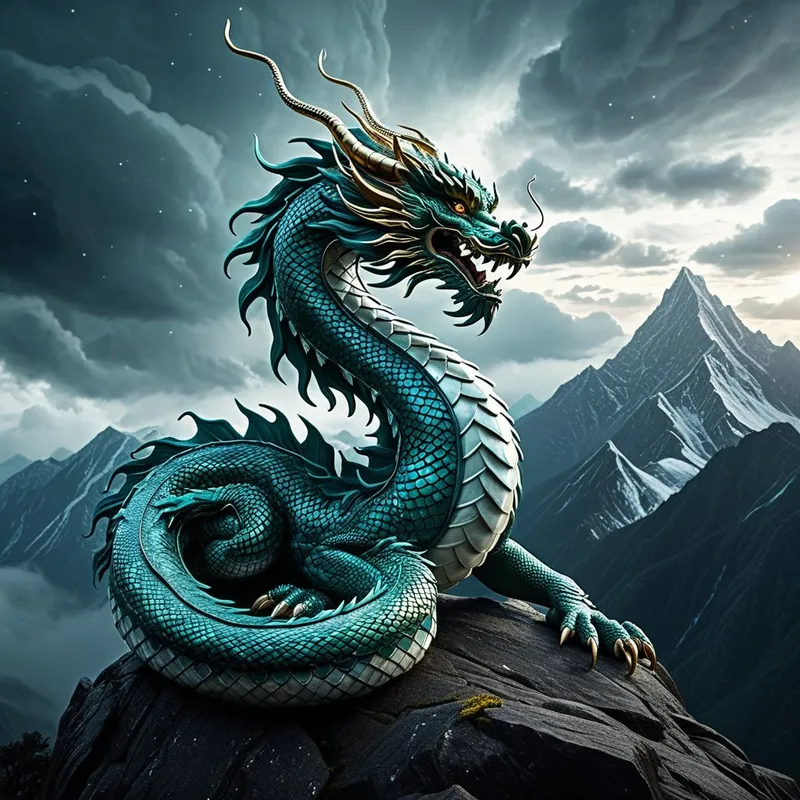
Dragon's Pearl Myth Meaning & Symbolism
A myth of a humble creature's ascent to dragonhood through the pursuit of a luminous pearl, embodying the alchemy of potential into transcendent power.
The Tale of Dragon’s Pearl
Listen, and let the mists of time part. In the ancient, flowing veins of [the world](/myths/the-world “Myth from Tarot culture.”/)—the great rivers of the Middle Kingdom—there lived a creature of simple destiny. It was a koi, swimming the endless, patient circles of its kind. But within its breast beat a rhythm out of sync with the current. It gazed not at the riverbed, but upward, through the shimmering skin of the [water](/myths/water “Myth from Chinese culture.”/), to where the [Dragon](/myths/dragon “Myth from Chinese culture.”/) Gate thundered.
This was no ordinary waterfall. It was a celestial staircase, a roaring veil between realms. The legends whispered that any fish who could ascend its furious height would be transformed. The koi, driven by a longing it could not name, began its ascent. Season after season, year upon year, it threw its body against the crushing torrent. Scales were torn away by the rocks. Its strength ebbed and flowed like the tides it had never seen. Many turned back. Many perished. But this one, its spirit forged in relentless failure, persisted.
Then, on a night when [the moon](/myths/the-moon “Myth from Tarot culture.”/) was a sliver of silver and the stars seemed close enough to touch, a miracle occurred. From the heavens, or perhaps from the deepest wellspring of the mountain, a light descended. It was a [pearl](/myths/pearl “Myth from Chinese culture.”/), not of oyster but of condensed moonlight and thunder. It glowed with an inner fire, swirling with clouds and captured lightning. It came to rest in the turbulent pool at the waterfall’s base.
The koi saw it. The pearl was not just an object; it was a call. A final, impossible test. To claim it meant to brave the heart of the waterfall’s power. Summoning a resolve that bent destiny, the koi gathered its last strength. It did not merely swim; it became a bolt of living determination. It shot through the raging column of water, past the point of breaking, and at the zenith of its leap, its jaws closed around the radiant pearl.
In that moment of contact, the world dissolved in a flash of incandescent energy. The humble fish-body was unmade. Bones lengthened and spiraled, scales hardened into jade and gold, fins stretched into vast, graceful wings. From the spray and light emerged the sinuous, magnificent form of a long. It roared, a sound that was both thunder and river song. Clutching the pearl in a clawed hand, it ascended into the storm clouds, now its rightful domain. The creature of the stream had become the master of [the sky](/myths/the-sky “Myth from Persian culture.”/), the guardian of the rains, a dragon complete.

Cultural Origins & Context
The myth of [the Dragon](/myths/the-dragon “Myth from Chinese culture.”/)’s Pearl is not a single, codified story but a vibrant, living motif woven through centuries of Chinese folklore, art, and literature. Its roots tap into ancient animistic beliefs, where dragons were deities of water and weather, and pearls were seen as congealed moonlight or dragon-essence. The tale synthesizes two powerful narratives: the Dragon Gate legend, which dates back to the Han Dynasty and served as a metaphor for the imperial civil service examinations, and the widespread belief in [the dragon](/myths/the-dragon “Myth from Chinese culture.”/)’s pursuit of a luminous pearl.
It was a story told by river fishermen, painted on [porcelain](/myths/porcelain “Myth from Chinese culture.”/) vases, enacted in operas, and carved into temple eaves. It functioned on multiple societal levels: as an allegory for scholarly perseverance leading to mandarin status, as a folk explanation for the origins of dragons and storms, and as a spiritual parable about the rewards of unwavering ambition. The pearl itself often appears in iconography clutched by a dragon, chased by a dragon, or balanced on a dragon’s snout, representing the eternal pursuit of perfection, wisdom, and cosmic power.
Symbolic Architecture
At its core, the myth is a masterclass in symbolic [alchemy](/symbols/alchemy “Symbol: A transformative process of purification and creation, often symbolizing personal or spiritual evolution through difficult stages.”/). The koi represents latent potential, the unactualized self bound by circumstance and a humble [origin](/symbols/origin “Symbol: The starting point of a journey, often representing one’s roots, source, or initial state before transformation.”/). The [Dragon Gate](/symbols/dragon-gate “Symbol: A powerful threshold symbol representing transformation, ascension, and overcoming impossible challenges through perseverance and destiny.”/) is the formidable [obstacle](/symbols/obstacle “Symbol: Obstacles in dreams often represent challenges or hindrances in waking life that intercept personal progress and growth. They can symbolize fears, doubts, or external pressures.”/), the initiatory ordeal that cannot be bypassed, only endured and overcome through relentless [effort](/symbols/effort “Symbol: Effort signifies the physical, mental, and emotional energy invested toward achieving goals and personal growth.”/). It is the painful, necessary [friction](/symbols/friction “Symbol: Friction represents resistance, conflict, or the necessary tension required for movement and transformation in dreams.”/) that forges [spirit](/symbols/spirit “Symbol: Spirit symbolizes the essence of life, vitality, and the spiritual journey of the individual.”/) from flesh.
The pearl is not a prize to be won, but a catalyst for a becoming that was always implied. It is the luminous core of the Self, glimpsed only after the ego has been shattered against the rocks of its own limitations.
The [pearl](/symbols/pearl “Symbol: The pearl symbolizes purity, wisdom, and the beauty derived from overcoming adversity.”/) is the most profound [symbol](/symbols/symbol “Symbol: A symbol can represent an idea, concept, or belief, serving as a powerful tool for communication and understanding.”/). It is the [lapis](/symbols/lapis “Symbol: A deep blue stone historically revered as a celestial connection and symbol of wisdom, truth, and spiritual enlightenment.”/) philosophorum of this Eastern narrative—the [philosopher](/symbols/philosopher “Symbol: A seeker of wisdom and truth, representing deep contemplation, questioning reality, and the pursuit of fundamental knowledge about existence.”/)’s [stone](/symbols/stone “Symbol: In dreams, a stone often symbolizes strength, stability, and permanence, but it may also represent emotional burdens or obstacles that need to be acknowledged and processed.”/). It does not merely grant power; it is power in its essential form: wisdom, condensed spiritual [insight](/symbols/insight “Symbol: A sudden, deep understanding of a complex situation or truth, often arriving unexpectedly and illuminating hidden connections.”/), the integrated Self. The koi does not become a [dragon](/symbols/dragon “Symbol: Dragons are potent symbols of power, wisdom, and transformation, often embodying the duality of creation and destruction.”/) and then find the [pearl](/symbols/pearl “Symbol: The pearl symbolizes purity, wisdom, and the beauty derived from overcoming adversity.”/); it finds the pearl and in that act becomes the dragon. The transformation and the attainment are one and the same [event](/symbols/event “Symbol: An event within dreams often signifies significant life changes, transitions, or emotional milestones.”/). The final form, the long, is the fully realized individual—no longer subject to the [river](/symbols/river “Symbol: A river often symbolizes the flow of emotions, the passage of time, and life’s journey, reflecting transitions and movement in one’s life.”/)’s current (the unconscious flow of [life](/symbols/life “Symbol: The symbol of ‘Life’ represents a journey of growth, interconnectedness, and existential meaning, encompassing both the joys and challenges that define human experience.”/)) but a conscious co-[creator](/symbols/creator “Symbol: A figure representing ultimate origin, divine power, or profound authorship. Often embodies the source of existence, innovation, or personal destiny.”/), commanding the rains (influencing one’s [reality](/symbols/reality “Symbol: Reality signifies the state of existence and perception, often reflecting one’s understanding of truth and life experiences.”/)) from a higher [perspective](/symbols/perspective “Symbol: Perspective in dreams reflects one’s viewpoints, attitudes, and how one interprets experiences.”/).

The Dreamer’s Resonance
When this myth stirs in the modern [psyche](/myths/psyche “Myth from Greek culture.”/), it often surfaces in dreams of intense striving and luminous breakthroughs. To dream of swimming upstream against an impossible current speaks to a somatic experience of life pressure, of pushing against a career, a relationship, or an internal barrier with a feeling of exhausting repetition. The body in the dream feels the strain of the koi.
Dreams of finding a glowing orb in water, in a cave, or in darkness point directly to the pearl. This is the dream ego contacting a numinous, transformative content from the unconscious. There may be awe, but also fear—the pearl is potent and demands a change. A dream of metamorphosis, of scales turning to harder substance, of growing wings, mirrors the psychic restructuring underway. The individual is in the throes of what psychologist James Hillman called the “acorn theory”—the felt sense of a destiny or potential pressing for actualization, often against the grain of one’s current life.
Alchemical Translation
For the modern individual, the myth maps the terrifying and glorious process of individuation. We all begin as the koi in our personal river, identified with our family systems, social roles, and inherited narratives. The first stirring of [the Self](/myths/the-self “Myth from Jungian culture.”/) is that restless gaze upward, the feeling that “this is not all I am.”
[The Dragon Gate](/myths/the-dragon-gate “Myth from Chinese/Japanese culture.”/) is the conscious engagement with [the shadow](/myths/the-shadow “Myth from Jungian culture.”/), the undertaking of analysis, the descent into depression or crisis that forces a reevaluation of everything. It is the hard, repetitive work of therapy, creative practice, or spiritual discipline. Many attempts fail. [The ego](/myths/the-ego “Myth from Jungian culture.”/) is battered. We want to turn back to the familiar, murky comfort of [the river](/myths/the-river “Myth from Buddhist culture.”/).
The pearl appears only when the striving is pure, when the desire for transformation has eclipsed the desire for comfort. It is the moment of insight that reconfigures the entire psychic landscape.
To “seize the pearl” is to integrate a profound realization. It might be the acceptance of a deep wound, the owning of a powerful talent long denied, or a spiritual awakening. This integration is not a calm addition but a cataclysm. The old identity—the fish—cannot contain it. It must die. What emerges is the dragon: a self that is more than the sum of its parts, capable of holding immense power (the pearl) with wisdom, and operating from a sovereign, elevated perspective. The journey is from creature within the environment to a consciousness that can, with responsibility, influence its own atmosphere. The myth assures us that the most humble origin contains the blueprint for the most majestic becoming, if only we have the courage to leap.
Associated Symbols
Explore related symbols from the CaleaDream lexicon: