Dragon Pearl Myth Meaning & Symbolism
A tale of a dragon's selfless sacrifice, where a luminous pearl born from its essence brings life to the world, embodying the ultimate alchemical gift.
The Tale of Dragon Pearl
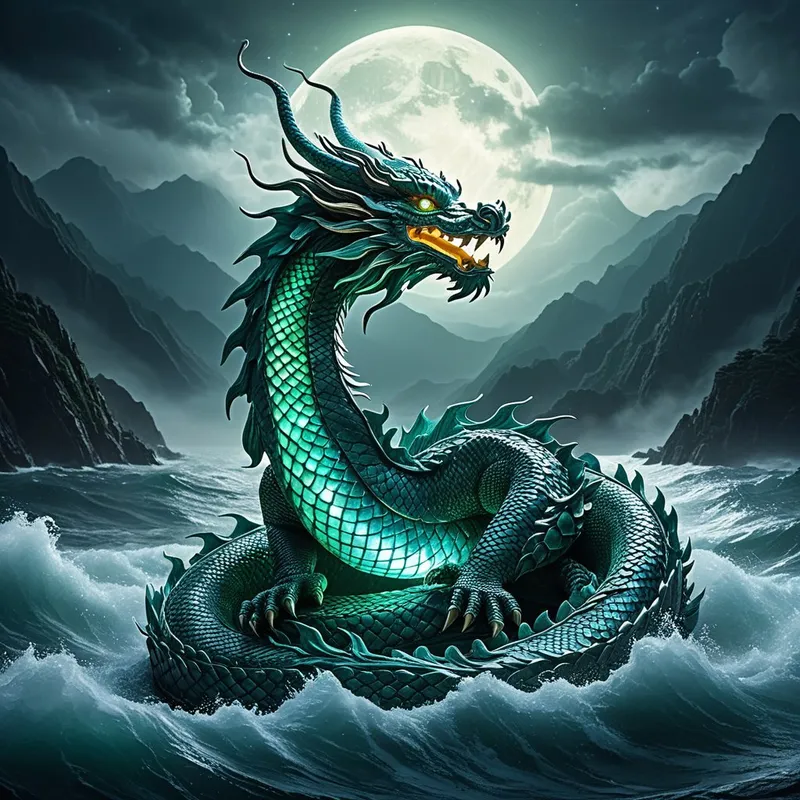
Listen, and let the mists of time part. In the age when the world was young and the rivers were the veins of the earth, there lived a great dragon. He was not a beast of hoarding malice, but a sovereign of the deep waters, a keeper of the celestial balance between rain and drought. His scales were the color of the deepest jade, and his eyes held the patience of the mountains. Within him, he nurtured a treasure not of gold, but of essence: a luminous pearl.
This pearl was no mere jewel. It was the dragon’s own vital force, cultivated over eons, a miniature moon that held the power of creation itself. With it, he commanded the rains, coaxed springs from stone, and ensured the harmony of his watery domain. The pearl was his heart, outside his body.
Then came the Great Dryness. The skies turned to brass, and the sun became a merciless eye. Rivers shrank to cracked mud, the earth gasped, and the people despaired. Their prayers rose like smoke, thin and brittle. The dragon, from his abyss, felt the withering of the world. He saw the fish dying in the shallows, the rice stalks turning to dust, the life-force of the land ebbing away.
A terrible conflict arose within his ancient soul. To keep the pearl was to preserve his own majestic power, his celestial nature. To part with it was unthinkable—it was his very being. Yet, the cries of the dying world echoed in the hollows left by the retreating waters. The dragon wrestled with this cosmic dilemma, his mighty form stirring tsunamis of conflict in the deep.
The resolution was not a battle, but a surrender. With a sound that was both a roar of anguish and a sigh of release, the dragon ascended from the depths. He flew not to the heavens to summon storms, but to the most desolate, parched riverbed at the heart of the drought. All living things watched, breathless. There, under the pitiless sun, the great being hovered. He looked once upon his pearl, the condensed light of his long life. Then, with infinite gentleness, he let it fall.
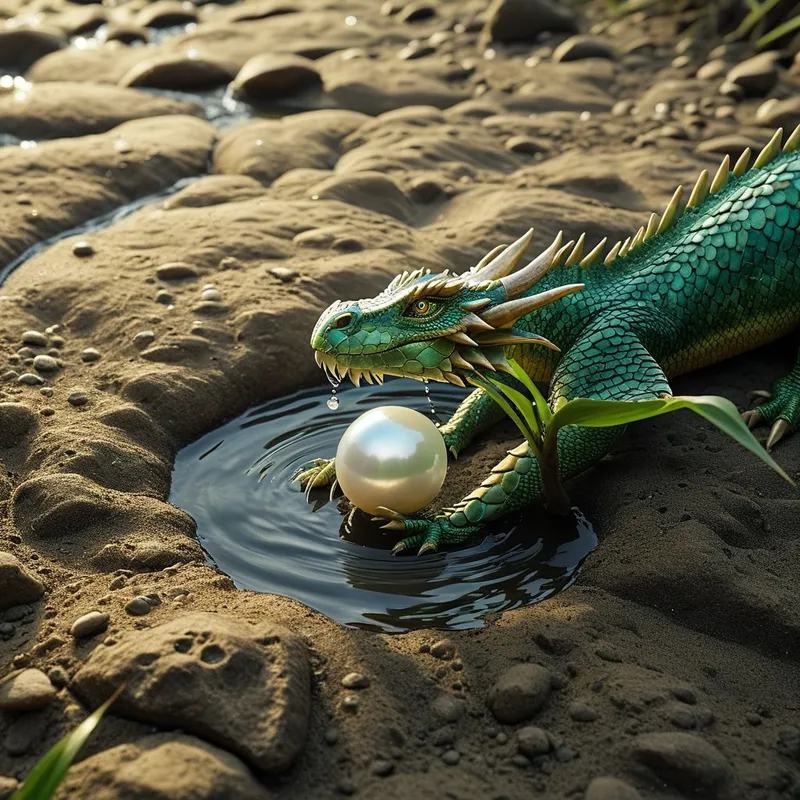
The pearl did not shatter. It struck the dead earth and sank beneath the surface. For a moment, silence. Then, a deep, resonant hum trembled through the ground. A brilliant light erupted from the point of impact, not a flash, but a sustained, nurturing glow. From that light, clear, cool water began to bubble forth, first a trickle, then a stream, then a mighty river reborn. Grass and flowers erupted along its banks. The rain clouds, long absent, gathered as if drawn by a magnet, and a gentle, life-giving rain began to fall.
The dragon watched. As the waters rose and the green returned, his magnificent form began to fade, becoming translucent, then insubstantial as mist. He did not die; he translated. His physical essence dispersed, joining the rain, the river, the renewed vitality of the world. He had become the gift itself. The pearl remained, some say, at the source of the new river, a hidden heart of the world, and the dragon’s spirit lived on in every flowing stream and every drop of rain.
Cultural Origins & Context
The myth of the Dragon Pearl is woven into the very fabric of East Asian, particularly Chinese, folklore and cosmology. It appears in myriad forms—in ancient texts, local folktales, operas, and temple art. Unlike the centralized canon of some mythologies, this story thrives in the oral tradition, told by village elders and traveling storytellers. Its primary function was not merely entertainment but education in cosmic principles.
It served to explain the vital, often paradoxical, relationship between the dragon (a symbol of imperial power, yang energy, and celestial might) and the life-giving, nurturing forces of water. The dragon is typically a ruler, but here, it becomes the ultimate caregiver. The myth reinforced a core societal value: that true authority and spiritual power are demonstrated not through domination, but through responsible, self-sacrificial stewardship. It taught that the greatest strength is found in benevolent expenditure for the collective good, a principle that resonated deeply within agrarian communities utterly dependent on the harmony of water and earth.
Symbolic Architecture
At its heart, the Dragon Pearl myth is a profound allegory of the source of life and the price of creation. The pearl symbolizes the concentrated essence—be it spiritual wisdom (de), psychic energy, or creative potential. It is the unified Self before the act of generation.
The pearl is the intact soul, the potential world contained within a single point of luminous consciousness.
The dragon represents the powerful, instinctual force that guards and generates this essence. It is the dynamic, yang aspect of the psyche—the will, the vitality, the libido. The Great Dryness is the state of psychic or spiritual aridity, a crisis of meaning, a depression of the life force where the inner waters have ceased to flow.
The dragon’s sacrifice is the critical symbolic pivot. It is not a destruction, but a willing diffusion. The hoarded, self-contained power (the pearl/ego-complex) must be surrendered to the barren outer world (the unconscious or the demands of life) to catalyze transformation. The dragon’s dissolution into the world illustrates a central alchemical and psychological truth: the ego does not truly perish, but is recontextualized. It moves from being the central, controlling “I” to becoming a functional, animating principle within a larger, living system—the integrated psyche or the community.
The Dreamer’s Resonance
When this myth stirs in the modern unconscious, it often manifests in dreams of profound sacrifice or release. A dreamer may find themselves holding a glowing object—a gem, a light, a child—that they know they must give away to save a dying landscape or a loved one. There is intense somatic resonance: a feeling of tearing in the chest, of light leaving the body, followed by an unexpected sense of relief and expansion.
Psychologically, this signals a critical juncture in the process of individuation. The dreamer is confronting the necessity to relinquish a long-held, ego-identified treasure. This “pearl” could be a cherished identity (“the successful one,” “the caregiver”), a stored-up creative potential never acted upon, or an old wound nursed in secret. The “drought” is the resulting sterility in their outer life—stagnant relationships, blocked creativity, emotional emptiness. The dream is the psyche’s dramatic enactment of the truth: that clinging to this inner essence for oneself alone is causing the outer world to wither. The call is to spend the treasure, to risk the self for the sake of a greater life.

Alchemical Translation
The myth provides a flawless map for psychic transmutation. The process begins with the cultivation of the pearl: a period of introspection, discipline, and gathering of one’s essential qualities and strengths. This is a necessary, inward-focused phase.
The crisis is the recognition of the drought: the realization that this hoarded inner wealth has created an existential desert. One is rich in potential but poor in lived experience. The alchemical fire is ignited by the tension between the desire to preserve the self and the moral or spiritual imperative to engage with the world.
The ultimate act of self-possession is the courageous choice of self-dispersion.
The sacrifice is the alchemical solve (dissolution). The ego, represented by the dragon, must voluntarily release its central treasure—its claim to absolute autonomy and control—into the thirsty ground of the unknown. This is not a loss of self, but an investment of self.
The result is the coagula (re-coagulation). The released essence fertilizes the barren fields of the psyche and life. What returns is not the pearl as a separate object, but its power made manifest as a flowing river—a renewed capacity for relationship, creativity, and adaptive life. The dragon-ego is not dead; it is now the animating spirit within that flowing life, no longer its isolated master. The individual achieves a higher order of being: they become a conduit for the very forces they once sought to personally possess. They move from caretaker of a private jewel to a source of living water for their world.
Associated Symbols
Explore related symbols from the CaleaDream lexicon: