
Dragon Gate Koi Myth Meaning & Symbolism
A myth of humble koi fish swimming upstream to leap a waterfall, transforming into celestial dragons through sheer will and perseverance.
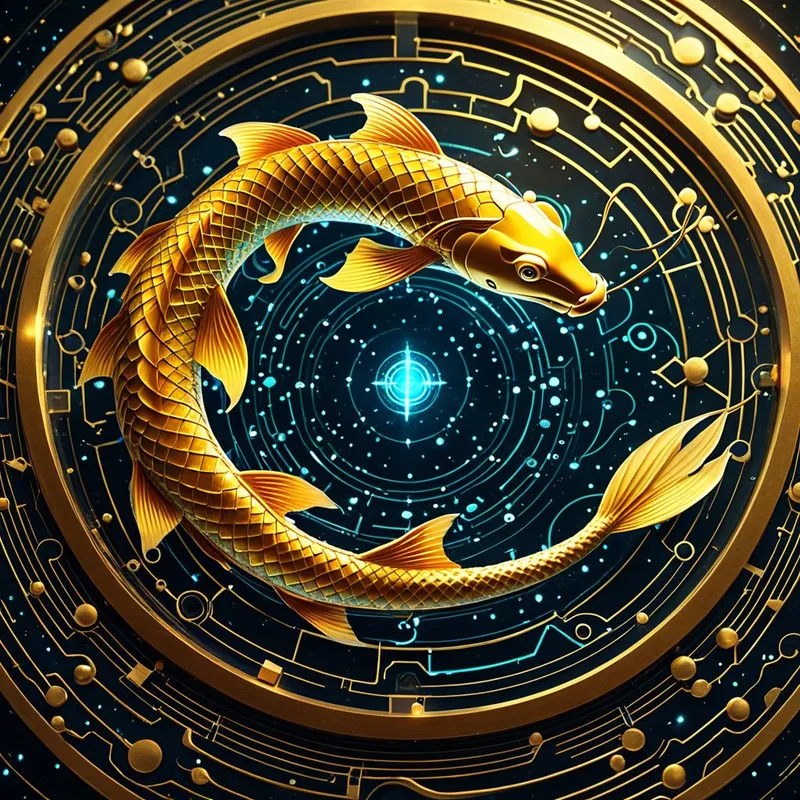
The Tale of Dragon Gate Koi
Listen, and hear the roar of the [Yellow River](/myths/yellow-river “Myth from Chinese culture.”/), the mud-churned artery of the Middle Kingdom. In its depths, among the common carp, swam a tribe apart. They were the golden koi, their scales like captured suns flickering in the silted dark. But their hearts held a fire [the river](/myths/the-river “Myth from Buddhist culture.”/) could not quench, for they listened to a call that was not [water](/myths/water “Myth from Chinese culture.”/), but thunder. It was the distant, eternal roar of the [Longmen](/myths/longmen “Myth from Chinese culture.”/), [the Dragon Gate](/myths/the-dragon-gate “Myth from Chinese/Japanese culture.”/).
The legend whispered that this cataract, this furious wall of white water that crashed from the sacred mountains, was no mere waterfall. It was a celestial threshold, a gate forged by the gods. Any koi possessed of spirit enough to leave the comfortable, crowded flow, to fight the river’s mighty pull for a thousand li, and to summon the courage to leap—not once, but again and again against the crushing weight of the cascade—would be rewarded. If it could crest the final, impossible lip of the falls, the heavens themselves would intervene. Lightning would kiss its brow. Its humble, aquatic form would shatter and burn away in a crucible of divine power, and from the spray would rise a new being: a long, a [dragon](/myths/dragon “Myth from Chinese culture.”/) of the clouds, sovereign of rain and mist.
And so they swam. Against the current’s will, through gorges that squeezed [the sky](/myths/the-sky “Myth from Persian culture.”/) to a ribbon, past nets and fishermen and the lurking shadows of larger predators. Their golden scales grew dull with effort, their fins tattered like battle standards. Many faltered, their strength spent, returning to the anonymous drift of the river. But a few, the most stubborn, the most fiercely dreaming, pressed on. The roar became their world, a vibration in their bones.
Finally, they would arrive. [The Dragon](/myths/the-dragon “Myth from Chinese culture.”/) Gate towered, a veil of thunderous white between the earthly river and the sky. There was no path around, only through. The first leap was always hope; the second, desperation. The current smashed them back, down into the punishing boil at the base. Again. And again. For years, some say. It was a trial of pure essence, of will made flesh. There was no trick, no secret passage. Only the leap.
Then, for one—the one whose spirit had been tempered to a single, unbreakable point—the moment came. A final, convulsive surge of life-force, a tail-stroke that defied physics and fate. It would break the surface of the falls, not into the river beyond, but into the air… and keep going. As it hung, suspended between water and sky, the storm would gather. A bolt of celestial fire would strike, not to destroy, but to transmute. Scales would harden into jade-like plates, fins would stretch into vast, undulating sails, whiskers would grow long and wise. The plaintive splash became a roar that shook the mountains. The koi was no more. A dragon, born of its own relentless aspiration, ascended into the mists, its destiny rewritten among the stars.

Cultural Origins & Context
The myth of the Li Yu Tiao Long Men is ancient, with roots stretching back to the Han Dynasty. It is not a single, canonical text, but a living story that flowed through oral tradition, poetry, and folklore, eventually crystallizing in written records like the Shanhaijing and later commentaries. Its primary societal function was as a potent allegory for the imperial examination system. In a society where meritocratic advancement was theoretically possible but brutally difficult, the story provided a perfect metaphor: the scholar, like the koi, must leave his local stream (his village), undertake a long and arduous journey (to the capital), and face a nearly insurmountable test (the exams). Success meant a literal transformation in status—from commoner to mandarin, from “fish” to “dragon,” a servant of the celestial emperor.
It was a story told to inspire perseverance (hengxin) and validate struggle. It offered a narrative of hope that was not based on birthright, but on cultivated virtue, effort, and a touch of heavenly favor. The myth was painted on screens, carved into jade, and referenced in countless literary works, embedding itself deep in the cultural [psyche](/myths/psyche “Myth from Greek culture.”/) as a symbol of against-the-odds success and glorious metamorphosis.
Symbolic Architecture
At its core, the myth is an exquisite map of the [individuation process](/symbols/individuation-process “Symbol: The psychological journey toward self-realization and wholeness, integrating conscious and unconscious aspects of personality.”/), depicting the [journey](/symbols/journey “Symbol: A journey in dreams typically signifies adventure, growth, or a significant life transition.”/) from unconscious participation in the collective flow to conscious, self-actualized being. Each element is a profound psychological [symbol](/symbols/symbol “Symbol: A symbol can represent an idea, concept, or belief, serving as a powerful tool for communication and understanding.”/).
The Yellow [River](/symbols/river “Symbol: A river often symbolizes the flow of emotions, the passage of time, and life’s journey, reflecting transitions and movement in one’s life.”/) represents the [collective unconscious](/symbols/collective-unconscious “Symbol: The Collective Unconscious refers to the part of the unconscious mind shared among beings of the same species, embodying universal experiences and archetypes.”/), the deep, powerful, and often murky flow of inherited cultural patterns, [family](/symbols/family “Symbol: The symbol of ‘family’ represents foundational relationships and emotional connections that shape an individual’s identity and personal development.”/) expectations, and instinctual [life](/symbols/life “Symbol: The symbol of ‘Life’ represents a journey of growth, interconnectedness, and existential meaning, encompassing both the joys and challenges that define human experience.”/). To swim comfortably within it is to live an unexamined life.
The Koi symbolizes the nascent, aspiring Self. It is potential encased in a humble, earthly form. Its golden color hints at an inner value not yet recognized by [the world](/myths/the-world “Myth from Tarot culture.”/). Its [decision](/symbols/decision “Symbol: A decision in a dream reflects the choices one faces in waking life and can symbolize the pursuit of clarity and resolution.”/) to swim upstream is the first act of psychological [differentiation](/symbols/differentiation “Symbol: The process of distinguishing or separating parts of the self, emotions, or identity from a whole, often marking a developmental or psychological milestone.”/)—[the ego](/myths/the-ego “Myth from Jungian culture.”/)’s painful but necessary [separation](/symbols/separation “Symbol: A spiritual or mythic division between realms, states of being, or consciousness, often marking a transition or loss of connection.”/) from the collective to follow an inner calling.
The true Dragon Gate is not a geographical location, but the inner threshold where one’s deepest nature demands a sacrifice of one’s former self.
The Upstream Journey is the long, arduous work of [consciousness](/symbols/consciousness “Symbol: Consciousness represents the state of awareness and perception, encompassing thoughts, feelings, and experiences.”/). It is the discipline of therapy, introspection, and confronting one’s own “currents”—habitual thoughts, emotional patterns, and personal limitations. The scars and tattered fins are the necessary wounds of growth.
The [Dragon Gate](/symbols/dragon-gate “Symbol: A powerful threshold symbol representing transformation, ascension, and overcoming impossible challenges through perseverance and destiny.”/) [Waterfall](/symbols/waterfall “Symbol: Waterfalls in dreams often signify a release of emotions or a transformation, symbolizing the flow of life and the transition of feelings.”/) itself is the critical ordeal, the symbolic representation of the seemingly impossible [task](/symbols/task “Symbol: A task represents responsibilities, duties, or challenges one faces.”/) that stands between one’s current state and one’s potential. Psychologically, it is the confrontation with the [Shadow](/symbols/shadow “Symbol: The ‘shadow’ embodies the unconscious, repressed aspects of the self and often represents fears or hidden emotions.”/), or the [integration](/symbols/integration “Symbol: The process of unifying disparate parts of the self or experience into a cohesive whole, often representing psychological wholeness or resolution of internal conflict.”/) of a major complex. It cannot be bypassed; it must be met head-on with repeated [effort](/symbols/effort “Symbol: Effort signifies the physical, mental, and emotional energy invested toward achieving goals and personal growth.”/).
The Leap is the act of total commitment, the full expenditure of psychic [energy](/symbols/energy “Symbol: Energy symbolizes vitality, motivation, and the drive that fuels actions and ambitions.”/) toward transformation. It is the [moment](/symbols/moment “Symbol: The symbol of a ‘moment’ embodies the significance of transient experiences that encapsulate emotional depth or pivotal transformations in life.”/) of decisive [action](/symbols/action “Symbol: Action in dreams represents the drive for agency, motivation, and the ability to take control of situations in waking life.”/), [crisis](/symbols/crisis “Symbol: A crisis symbolizes turmoil, urgent challenges, and the need for immediate resolution or change.”/), or [breakthrough](/symbols/breakthrough “Symbol: A sudden, significant advance or discovery that overcomes a barrier, often marking a transformative shift in understanding, ability, or situation.”/) where one risks everything.
The [Lightning](/symbols/lightning “Symbol: Lightning symbolizes sudden insights or revelations, often accompanied by powerful emotions or disruptive change.”/) Strike and Transformation represents the transcendent function. It is the numinous, unexpected influx of meaning that arises from the [tension](/symbols/tension “Symbol: A state of mental or emotional strain, often manifesting physically as tightness, pressure, or unease, signaling unresolved conflict or anticipation.”/) of opposites (fish/[dragon](/symbols/dragon “Symbol: Dragons are potent symbols of power, wisdom, and transformation, often embodying the duality of creation and destruction.”/), [earth](/symbols/earth “Symbol: The symbol of Earth often represents grounding, stability, and the physical realm, embodying a connection to nature and the innate support it provides.”/)/sky, effort/surrender). The old ego-[structure](/symbols/structure “Symbol: Structure in dreams often symbolizes stability, organization, and the framework of one’s life, reflecting how one perceives their environment and personal life.”/) (the koi) is shattered, not by destruction, but by an [expansion](/symbols/expansion “Symbol: A symbol of growth, increase, or extension beyond current boundaries, often representing personal development, opportunity, or overwhelming change.”/) of consciousness so vast it requires a new form—the [Dragon](/symbols/dragon “Symbol: Dragons are potent symbols of power, wisdom, and transformation, often embodying the duality of creation and destruction.”/), the symbol of the fully realized Self, possessing sovereignty, wisdom, and a [connection](/symbols/connection “Symbol: Connection symbolizes relationships, communication, and bonds among individuals.”/) to the creative and spiritual [depths](/symbols/depths “Symbol: Represents the subconscious, hidden emotions, or foundational aspects of the self, often linked to primal fears or profound truths.”/).
The Dreamer’s Resonance
When the Dragon Gate Koi myth surfaces in modern dreams, it rarely appears as the full, literal legend. Instead, it manifests as the pattern of the ordeal. A dreamer may find themselves struggling to climb an endless staircase, to push against a crushing weight, or to complete a vital task against impossible resistance. The somatic feeling is one of immense exertion, frustration, and often, a deep, bodily fatigue upon waking.
Psychologically, this dream pattern signals that the dreamer is in the midst of, or on the cusp of, a major developmental push. The unconscious is mirroring a real-life “upstream swim”: perhaps a grueling creative project, a recovery process, a career transition, or the arduous inner work of breaking a toxic pattern. The dream confirms the difficulty but also, crucially, the direction. The struggle has a purpose—there is a “Gate” ahead, even if unseen. The feeling of being battered and sent back down reflects the inevitable setbacks in any meaningful endeavor. Such dreams are a call to cultivate the koi’s tenacity, to understand that the repeated failure is the process of strengthening the spirit for the final, successful leap.

Alchemical Translation
The alchemy of the Dragon Gate Koi is a precise model for psychic transmutation in the modern soul. It outlines the stages of turning leaden, unconscious existence into the golden, conscious sovereignty of [the Self](/myths/the-self “Myth from Jungian culture.”/).
First, the Calcination: The koi’s decision to leave the river is the burning away of complacency. In life, this is the painful, fiery realization that one’s current state is insufficient, that one must leave the “warm waters” of familiar suffering or comfort.
Second, the Dissolution: The upstream journey dissolves the ego’s certainties. Old identities (“I am just a fish”) are worn away by the current of experience and introspection. One feels formless, adrift in effort, yet propelled by a mysterious inner compass.
Third, the Coagulation: Reaching the base of the Dragon Gate represents the coalescing of all one’s efforts into a single, focused point. All disparate struggles are understood as part of one great ordeal. The Self begins to take a new, more resilient shape in the face of the ultimate challenge.
The dragon is not something you become; it is what is revealed when everything you are not has been courageously stripped away.
Fourth, the Sublimation: The leap is the supreme act of sublimation—the direct channeling of base, instinctual energy (the drive to survive) into a spiritual aim (transcendence). It is the moment where the physical struggle becomes a spiritual one.
Finally, the [Projection](/myths/projection “Myth from Alchemical culture.”/): The lightning strike and transformation are the [coniunctio](/myths/coniunctio “Myth from Alchemical culture.”/), [the sacred marriage](/myths/the-sacred-marriage “Myth from Various culture.”/) of heaven and earth, spirit and matter, within the individual. The “[projection](/myths/projection “Myth from Alchemical culture.”/)” is not outward, but inward—the realization that the divine power that transforms you was always your own latent potential, awaiting the friction of the ordeal to be activated. The newly formed dragon does not rule an external kingdom, but the internal landscape of one’s own being, capable of bringing the nourishing “rain” of creativity and meaning to one’s own life and, by extension, to the world.
Thus, the myth endures not as a quaint fable about fish, but as an eternal blueprint for the human spirit’s most profound journey: the transformation of struggle into sovereignty, and the breathtaking discovery that within our humblest, most persistent effort lies the seed of the divine.
Associated Symbols
Explore related symbols from the CaleaDream lexicon: