Dragon Boat Festival Myth Meaning & Symbolism
A poet-statesman's ritual drowning becomes a nation's soul, transmuting grief into the thunder of drums and the shared breath of zongzi.
The Tale of Dragon Boat Festival
Hear now the tale that rides upon the water’s pulse, a story not of stone and sword, but of ink, heart, and the river’s deep, swallowing embrace.
In the age of the Warring States, when kingdoms clashed like bronze bells, there was a kingdom named Chu. And in Chu, there was a man named Qu Yuan. He was not merely a minister; he was the kingdom’s conscience, its beating heart wrapped in scholar’s robes. His words were not just policy, but poetry that sought to bind the fractured land with threads of virtue and loyalty. He saw the creeping corruption at court, the honeyed lies of rival states, and he sang warnings with a voice that cut sharper than any dagger.
But the king’s ear was turned by flatterers. They painted Qu Yuan’s loyalty as ambition, his wisdom as treachery. The poet-minister was cast out, exiled from the palace that was his world. He walked the roads of Chu, a ghost in his own homeland, watching the shadows of conquest darken its borders. His grief was a vast, internal country. He composed the <abbr title=""Sorrow after Departure,” a foundational poem of Chinese literature expressing lament and political idealism”>“Li Sao”, a river of verse flowing with sorrow, fragrant with the metaphor of orchids and fragrant herbs—symbols of uncorrupted virtue now trampled.
Then came the day the news rushed down the river paths like a cold flood: the capital of Chu had fallen. The kingdom was broken. For Qu Yuan, the world shattered. His life’s purpose—the preservation of Chu’s soul—was extinguished. If the body of his state was dead, how could its conscience live?
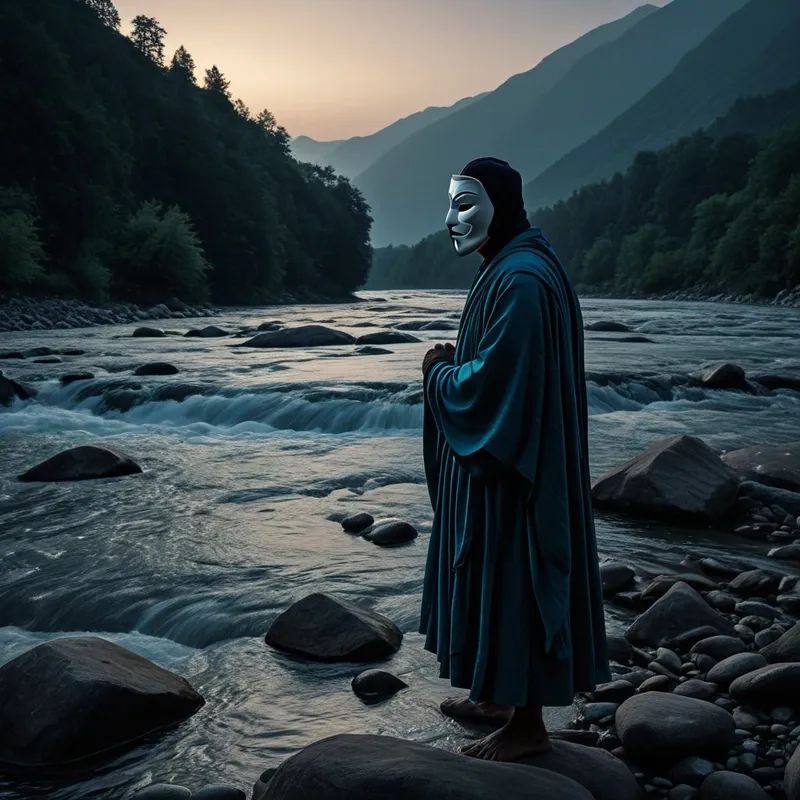
On the fifth day of the fifth lunar month, he walked to the bank of the Miluo River. The air was thick and humid, heavy with the coming summer. He held a great stone to his chest, as if embracing the full weight of his unwavering principle. He looked once more upon the green hills of his beloved, lost land, then stepped into the dark, welcoming waters. The river did not fight him; it opened and closed, a liquid tomb for a spirit too vast for the compromised world.
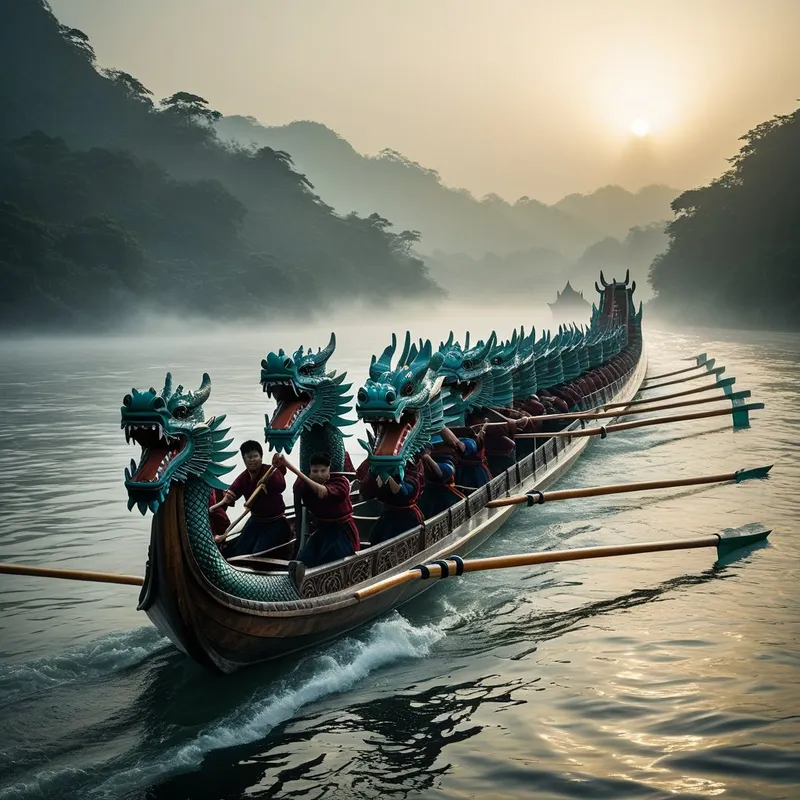
The people of Chu, hearing of this, rushed to their boats. They beat the water with their oars and thundered drums upon the river, not to race for sport, but to scare away the fish and water dragons, to keep them from desecrating the body of their sage. They threw packets of rice—zongzi—into the current, food for Qu Yuan’s journeying spirit, so he would not hunger in the underworld. Their cries were not of celebration, but of a profound, collective lament, a ritual of love cast across the water’s skin to find a sunken soul.
Cultural Origins & Context
The historical Qu Yuan is a figure glimpsed through the mists of the <abbr title=""Records of the Grand Historian,” a monumental history of ancient China”>“Shiji” and the enduring power of his poetic corpus. The festival that grew around his death, however, is a profound example of mythopoesis—the process by which a historical moment is transformed by the collective psyche into a resonant, repeating ritual. The fifth lunar month was already considered an inauspicious, “yang”-poisoned time in ancient China, associated with heat, disease, and malevolent spirits. Practices to ward off evil, like hanging medicinal herbs and calamus, were already in place.
The story of Qu Yuan’s sacrificial drowning grafted itself onto these older, protective customs, giving them a human heart and a heroic narrative. It was passed down not just by historians, but by villagers, fishermen, and rice farmers—the very people who took to the water each year. The festival became a societal vessel for multiple functions: it was a lesson in unwavering loyalty and integrity (a core Confucian virtue), a communal exorcism of midsummer malaise, and a powerful act of ancestor veneration that unified communities in shared, rhythmic labor (the boat racing) and shared sustenance (the making and eating of zongzi).
Symbolic Architecture
At its core, the myth is an alchemy of despair into enduring form. Qu Yuan represents the Righteous Individual whose consciousness becomes unbearable to the compromised state. His drowning is not a defeat, but the ultimate, tragic statement of his ideals—he would rather be consumed by the pure, formless element of water than live in a corrupted world of earth and politics.
The sacrifice is not for a future reward, but to make the invisible principle viscerally, unavoidably real. The body must drown so the idea can float forever.
The river is the great symbol of the unconscious, of the collective soul and the flow of time. Qu Yuan’s descent into it is a return to the source, a merging with the primal waters from which new life and new understanding can eventually emerge. The frantic boat racing that follows is the ego’s desperate, belated attempt to rescue something from those depths—to reclaim the lost soul, or at least protect its sanctity. The drums are the heartbeat of the community, a rhythmic spell against the chaos of loss. The zongzi, with rice wrapped tightly in leaves and bound by string, is a perfect symbol of contained nourishment, of culture (the cooked grain) wrapped in nature (the leaf), offered to feed the spirit that has journeyed beyond the mundane world.

The Dreamer’s Resonance
When this myth surfaces in modern dreams, it rarely appears as a literal dragon boat race. Instead, one may dream of standing at the edge of a vast, dark body of water, feeling a profound, melancholic pull to enter it, often while holding a cherished but heavy object (a book, a piece of art, a failed project). This signals a psychological process of sacrificio—the necessary, painful letting go of an outmoded identity, a cherished ideal, or a life direction that has, like the state of Chu, reached its end.
Alternatively, one might dream of being in a boat, rowing frantically against a current or searching the water for something precious and lost. This somatic experience in the dreamscape reflects the ego’s struggle to integrate a deep, soulful content (the lost Qu Yuan) that has been submerged by life’s circumstances—betrayal, failure, or profound disappointment. The dream is an internal re-enactment of the rescue attempt, urging the dreamer to listen to the drums of their own instinct and pay attention to what they are trying, perhaps clumsily, to feed (the zongzi) in their own psychic ecosystem.

Alchemical Translation
For the modern individual, Qu Yuan’s path models a harrowing but essential stage of individuation. It is the moment when one’s deepest values and authentic self (the “kingdom of Chu” within) are so besieged by external compromise, internal critics, or life’s betrayals that a psychic death feels inevitable. The “drowning” is the conscious surrender of the ego’s position—the job, the relationship, the long-held self-image—that has become a prison.
The ritual is not in the dying, but in the community of soul-parts that mobilizes afterward to honor what was lost.
The alchemy occurs in what happens after the descent. The individual does not stay drowned. The boats that race are the newly mobilized aspects of the psyche—disciplined effort (the rowers), fierce protective instinct (the drumbeat), and nurturing care (the offering of zongzi)—that are activated by the loss. The festival that emerges is the new, integrated psychic structure. The rhythmic, communal labor of dragon boat racing translates to finding one’s own cadence and tribe in recovery. Making zongzi becomes the act of binding one’s scattered energies into a nourishing, portable whole. The myth teaches that our most profound losses, when met with ritual attention and communal self-care (even if that community is within), do not merely end in grief. They are transformed into a powerful, recurring ceremony of remembrance and resilience—a way to navigate the river of life with more power, more syncopation, and a shared meal for the soul that continues its journey.
Associated Symbols
Explore related symbols from the CaleaDream lexicon: