Dragon Myth Meaning & Symbolism
The celestial dragon, sovereign of waters and skies, embodies cosmic order, imperial authority, and the alchemical power of transformation within and without.
The Tale of Dragon
Listen, and let the mists of time part. Before the first emperor, before the first written character, the world was a canvas of chaos and potential. From the primordial breath of Dao, from the dance of Yin and Yang, a presence stirred. It was not born; it coalesced.
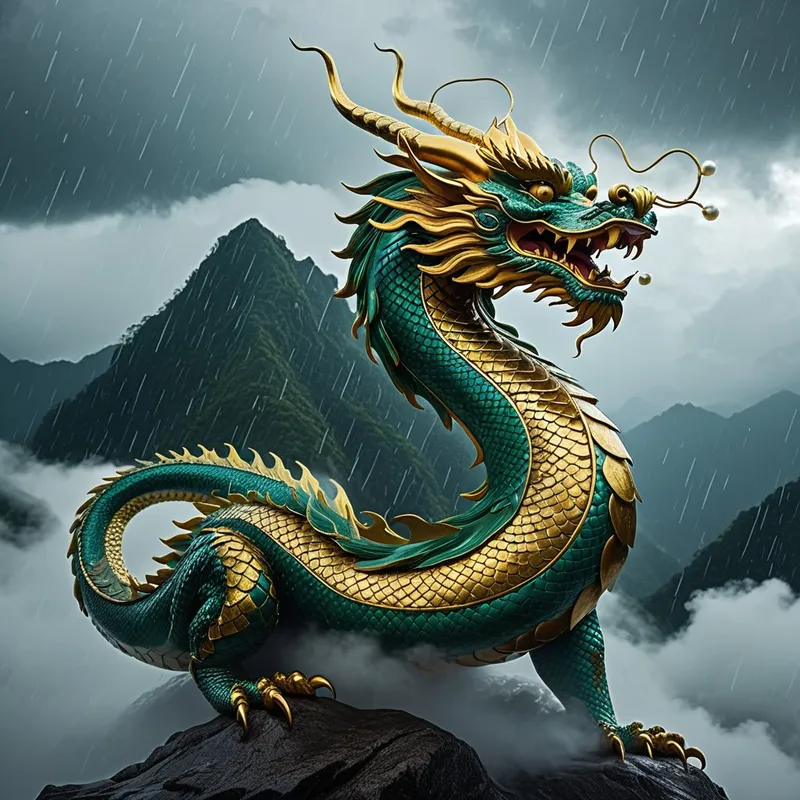
It began in the deep, silent womb of the world—the waters. In the fathomless abyss of the Hundun, a ripple became a current, a current became a coil, a coil became a form. It was sinuous and immense, its body a tapestry of all creatures: the scales of a fish, shimmering like a thousand mirrors; the horns of a stag, branching towards heaven; the claws of an eagle, gripping the fabric of reality; the mane of a lion, flowing like liquid flame. Its eyes were pools of ancient wisdom, holding the light of the sun and the coolness of the moon. This was Long, the Dragon.
It did not crawl; it flowed. Through the subterranean rivers, it shaped the veins of the earth. It rose with the morning mist from sacred lakes, its form half-seen, a promise in the haze. When the seasons stalled and the earth cracked with thirst, the people would gather at the water's edge. They would beat drums of turtle-shell, their voices a desperate whisper on the wind. And then, a rumble, not from the sky but from the deep. The waters would churn, and the Dragon would ascend.
The air grew heavy, charged with the scent of ozone and wet stone. Clouds, dark as ink, would gather at its command, swirling around its celestial form. With a flick of its tail—a crack of thunder—the first fat drops would fall, drumming on parched soil, swelling the rivers, blessing the fields. It was not a beast to be slain, but a sovereign to be petitioned, a vital force of the cosmos made manifest. It ruled not by terror, but by an inherent, majestic authority over the rhythms of life itself—the rains, the floods, the winds, and the hidden energies of the earth. To see it was to witness the universe breathing.
Cultural Origins & Context
The Dragon's myth is not a single story with a beginning and end, but a living, breathing stratum of Chinese consciousness, woven into the fabric of civilization from its Neolithic dawn. Its earliest depictions on jade cong and ding vessels show a stylized, composite creature, likely representing the animating spirit of water, fertility, and the ancestral clan's protective power.
This archetype was systematized and elevated with the rise of imperial authority. The Dragon became the exclusive symbol of the Son of Heaven. His throne was the Dragon Throne, his robes the Dragon Robes, his face the Dragon Face. The myth here served a profound societal function: it visualized the Mandate of Heaven. Just as the Dragon brought harmonious order to the waters and skies, the Emperor’s virtuous rule brought order to the human realm. The myth was passed down not merely by bards, but through state ritual, court iconography, folklore, and the annual Duanwu Festival, ensuring the Dragon remained a constant, palpable presence in both cosmology and daily life.
Symbolic Architecture
The Dragon is the ultimate symbol of synthesized power. It is not a monster of unchecked id, but a conscious, sovereign expression of the world's latent forces.
The Dragon does not hoard power; it is the circuit through which cosmic power flows. Its pearl is the concentrated essence of wisdom, potential, and spiritual attainment.
Psychologically, it represents the fully integrated Self. Its composite nature—part serpent (instinct, the unconscious), part stag (spiritual aspiration), part eagle (vision, sovereignty), part fish (depth, the unknown)—symbolizes the successful unification of our disparate inner parts. It is the ruler archetype in its most profound sense: not a tyrant, but the central, organizing principle of the psyche that brings the inner kingdom into harmonious order. Its domain over water signifies mastery over the emotional and unconscious depths, while its ascent into the clouds represents the ability to translate those depths into creative, life-giving action (rain).
The Dreamer's Resonance
When the Dragon swims into the modern dreamscape, it heralds a profound encounter with one's own latent authority and vital force. To dream of a distant, majestic Dragon in the sky often points to a nascent awareness of a larger, more potent Self calling from the unconscious. There is a longing for a life of greater significance and authentic power.
Conversely, dreaming of a Dragon trapped, wounded, or angry in a confined space (a cave, a pool) signals that this inner sovereign energy is being suppressed, perhaps by a rigid ego-structure ("the emperor" in us that has grown corrupt or weak). The somatic experience might be one of tightness in the chest (constrained power) or a surging, restless energy with no outlet. A dream of becoming the Dragon, or of having its pearl, indicates a critical phase of psychic integration—the ego is aligning with the Self's majestic blueprint.
Alchemical Translation
The myth of the Dragon models the alchemical process of individuation, where base elements of the personality are transmuted into golden consciousness. The journey begins in the prima materia—the chaotic, watery depths of our unexamined instincts and emotions. This is the Dragon's abode.
The first task is not to slay the dragon, but to learn its language—to listen to the rumble in the depths, to respect the power of the flood.
The "rising action" is the arduous work of differentiation and integration. We must fish up our scattered instincts (the scales), acknowledge our spiritual yearnings (the horns), claim our capacity to grasp our destiny (the claws), and own our fierce, protective vitality (the mane). This is the forging of the composite being. The "pearl" it often chases or guards is the philosopher's stone of the psyche—the hard-won, luminous core of individual identity and purpose.
Finally, the Dragon's ascent and command of the rain symbolizes the ultimate alchemical gift: the ability to take the integrated power of the Self and use it to nourish the world. The sovereign individual, like the Dragon, does not exist in isolation. Their realized power becomes a generative force, bringing creativity (rain) to barren projects, emotional depth to relationships, and a sense of harmonious order to their corner of the universe. The myth teaches that true power is synonymous with responsibility to the whole.
Associated Symbols
Explore related symbols from the CaleaDream lexicon: