Dorje Shugden Myth Meaning & Symbolism
A myth of a brilliant, wrathful protector born from betrayal, embodying the fierce intelligence needed to guard the sacred path from corruption.
The Tale of Dorje Shugden
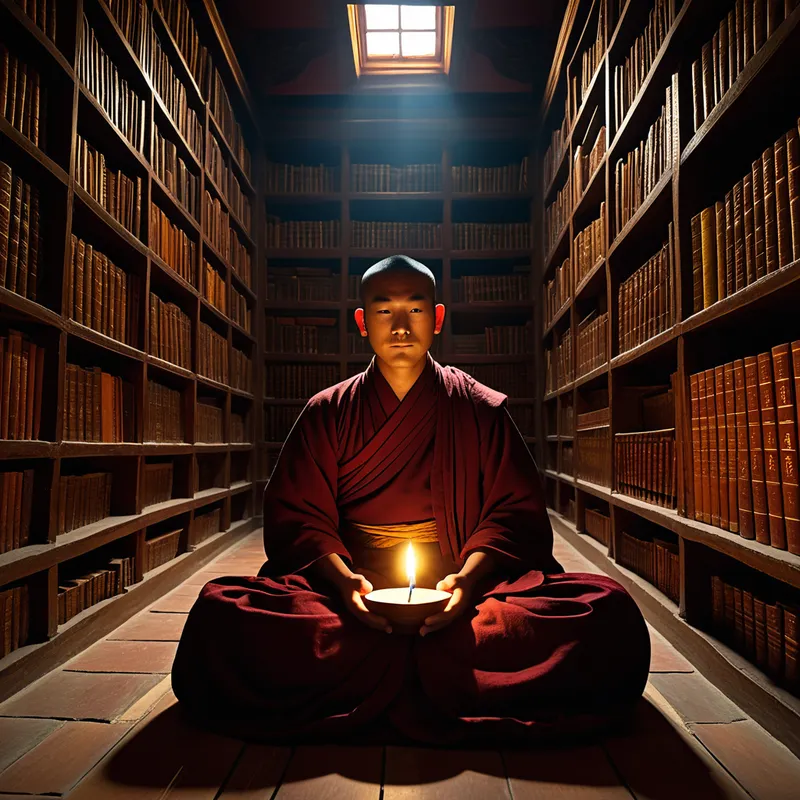
Listen, and hear a tale not of simple light, but of the diamond-hard brilliance that forms in the heart of shadow. In the high, wind-scoured plateaus of Tibet, where the air is thin and the line between worlds grows faint, there lived a being of supreme intellect and purest vow. He was Tulku Drakpa Gyaltsen, a monk whose wisdom shone like a sun in the hallowed halls of Drepung Monastery. His mind was a vast library of sacred texts, his heart a vessel of unwavering devotion. He walked the path with a certainty that drew disciples like moths to a flame.
Yet, in the corridors of power, where spiritual authority meets worldly ambition, a poison took root. Envy, that green-eyed serpent, coiled around the hearts of lesser men. They whispered. They plotted. They could not bear the luminosity of his virtue, for it cast their own compromises into sharp, unflattering relief. Through treachery most foul, a betrayal that stained the sanctity of the sangha itself, the luminous tulku was cast down. His life, a testament to the Dharma, was extinguished not by natural decay, but by the hand of jealousy disguised as piety.
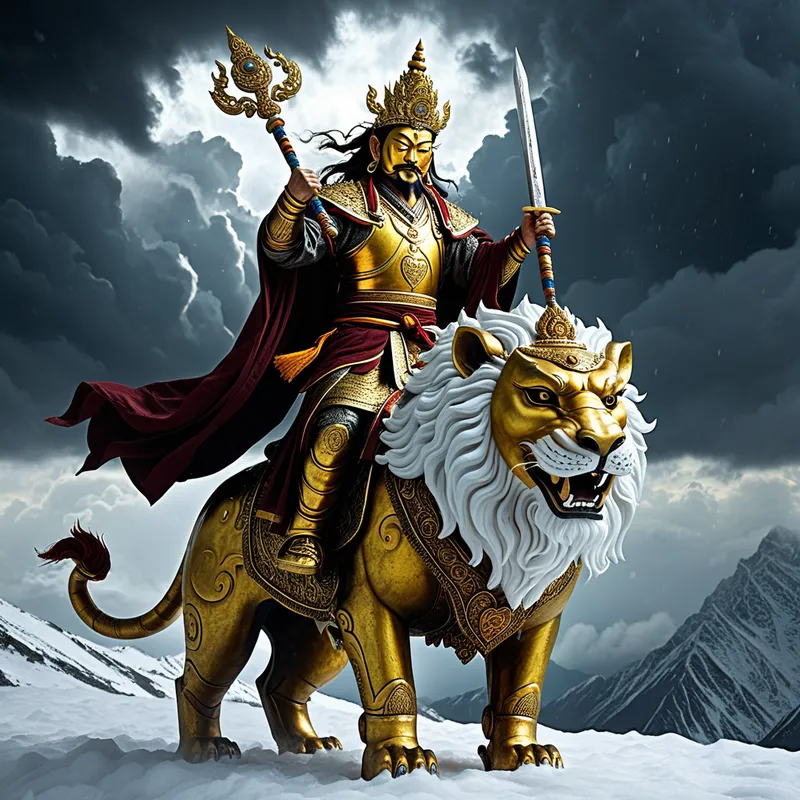
But a vow made with the iron of absolute conviction is not so easily undone. From the searing crucible of that injustice, from the white-hot rage of a promise broken, a new form coalesced. His consciousness did not dissipate into the peaceful dharmakaya. It condensed, transformed, and took on a mantle of terrifying, purposeful wrath. He arose as Dorje Shugden—a protector deity clad not in gentle robes, but in the armor of a warrior-king, riding a snarling snow lion across the psychic skies. His face, once serene, now blazed with the fierce intelligence of a wisdom that has seen the darkest face of betrayal and chosen not to forgive, but to guard. He became the sworn enemy of corruption, the relentless hunter of falsehood within the very walls of the tradition he loved. His is not the anger of blind hatred, but the incandescent, focused fury of a sacred oath turned inside out to protect the path from those who would poison it from within.
Cultural Origins & Context
The narrative of Dorje Shugden emerges from the complex, politically charged atmosphere of 17th-century Tibet, a time of great spiritual ferment and sectarian rivalry. It is not an ancient, primordial myth, but a story born from the historical tensions between the emerging Gelug tradition and the older Nyingma and Kagyu schools. The figure of Tulku Drakpa Gyaltsen is historically attested, and his conflict with the Fifth Dalai Lama's regent is a matter of record.
The myth was propagated and sustained within specific monastic lineages, primarily as a namtar (liberation story) and a source for protector deity practices. Its societal function was multifaceted: for some, it served as a cautionary tale about the perils of monastic politics and the karmic consequences of betrayal. For others, it provided a powerful, embodied symbol of a protector whose very genesis was tied to the integrity of the Gelug doctrinal system. The practice of propitiating Dorje Shugden became a deeply embedded, yet controversial, element of spiritual life for many, a means of invoking fierce, intelligent energy to remove obstacles and guard the purity of practice. The myth, therefore, lives in the tense space between history and devotion, between the documented past and the potent realm of ritual invocation.
Symbolic Architecture
At its core, the myth of Dorje Shugden is a profound allegory of the birth of the Shadow from a wound of betrayal. The brilliant, virtuous tulku represents the conscious ideal—the perfected ego, the persona of flawless scholarship and piety. His violent downfall is the inevitable shattering of that perfection, the traumatic encounter with the unconscious, amoral dynamics of envy and power that exist even in the most sacred of spaces.
The protector is born not from light, but from the fracture of light. He is the crystallized intelligence of a wound that refuses to be merely suffered, but instead transforms into vigilant guardianship.
Dorje Shugden himself symbolizes the useful shadow—the immense psychic energy that is liberated when we consciously integrate the parts of ourselves that have been betrayed, wronged, or cast out. He is not primitive rage, but metabolized rage; anger alchemized into a precise, discerning force. His wrath is not against the external world per se, but specifically against spiritual corruption, hypocrisy, and the inner obstacles that hinder enlightenment. He represents the necessary fierceness required to defend the nascent, fragile Self against the collective pressures, both internal and external, that would dilute or distort it. He is the psychological immune system, born from a prior infection.

The Dreamer's Resonance
When this mythic pattern stirs in the modern dreamer, it often signals a profound process of psychic reorganization centered on betrayal and the reclamation of power. To dream of a fierce, armored guardian, especially one that emerges from a scene of intellectual or spiritual injustice, points to a somatic awakening of the inner protector.
The dreamer may be processing a real or perceived betrayal in a community, workplace, or family—any context where trust in a shared ideal has been violated. Psychologically, this is the Self mobilizing its defenses. The somatic experience can be one of heat, a tightening in the solar plexus, or a feeling of armored solidity. The dream is not advocating for literal vengeance, but indicating that the psyche is forging a new inner authority from the raw material of hurt. It is the Self learning to say, "This boundary was crossed, and I will not allow it to happen again." The dream figure is often terrifying because it carries the charge of our own repressed righteous anger, an energy we have been taught to fear and disown.

Alchemical Translation
The individuation journey modeled here is not a gentle unfolding, but a forceful reclamation. It is the process of transmuting the poison of betrayal into the medicine of fierce self-sovereignty. The first stage is the "fall of the tulku": the disillusionment where our idealized self-image or our idealized view of an authority (spiritual, professional, parental) is shattered. This is a necessary death, painful but initiatory.
The second stage is the crucial, often misunderstood, period of "gestation in the wrath." This is not acting out in bitterness, but consciously holding the searing energy of the injustice without dispersing it. It is allowing the anger to teach us what we truly value and what must be protected.
The alchemical fire is not for warming the hands, but for forging the sword that cleaves truth from falsehood within one's own soul.
The final stage is the "arising of the protector." This is the integration of that focused energy into the personality as a capacity for fierce discernment, clear boundaries, and an unwavering commitment to one's own inner truth. The integrated individual no longer seeks external validation from the corrupt "monastery" but becomes the guardian of their own inner sanctum. They develop a Dorje Shugden-like quality: an intelligent, relentless vigilance against their own inner hypocrisies and self-betrayals, and the courage to stand firm in their own constituted authority. The myth teaches that true spiritual power is not naive innocence, but innocence that has faced the shadow and enlisted its strength in service of the whole.
Associated Symbols
Explore related symbols from the CaleaDream lexicon:
- Vajra — The indestructible diamond scepter, representing the unshakable, wrathful wisdom of Dorje Shugden that cuts through illusion and spiritual corruption.
- Shadow — The core archetype of the myth, representing the disowned rage and power born from betrayal that is reclaimed and transformed into a protective force.
- Betrayal — The catalytic wound that shatters naive idealism and forces the psyche to forge a more complex, resilient form of consciousness and guardianship.
- Warrior — The archetypal energy of Dorje Shugden, embodying focused discipline, fierce protection of boundaries, and the courage to confront inner and outer adversaries.
- Mask — The transformed visage of the deity, symbolizing how a personal wound (the tulku's betrayal) becomes an impersonal, archetypal force of protection.
- Heart — Often depicted as a jeweled heart held by the deity, representing the core vow and essential motivation—twisted by betrayal but ultimately guarding the essence of compassion and truth.
- Order — The deity's primary function: to protect the integrity of a spiritual system (the Dharma) from chaos, corruption, and degeneration, enforcing a sacred structure.
- Rage — The primal, un-metabolized emotion that is the raw material for the deity's creation, which must be alchemized into enlightened, discerning fierceness.
- Temple — The inner sanctum, the system of belief or the personal psyche that requires vigilant protection from both external violation and internal decay.
- Lightning — The sudden, illuminating, and destructive force of the deity's wisdom, which strikes with precision to shatter obstacles and falsehoods.
- Guardian — The essential role of the mythic figure, representing the psyche's capacity to establish and defend the boundaries of the developing Self.