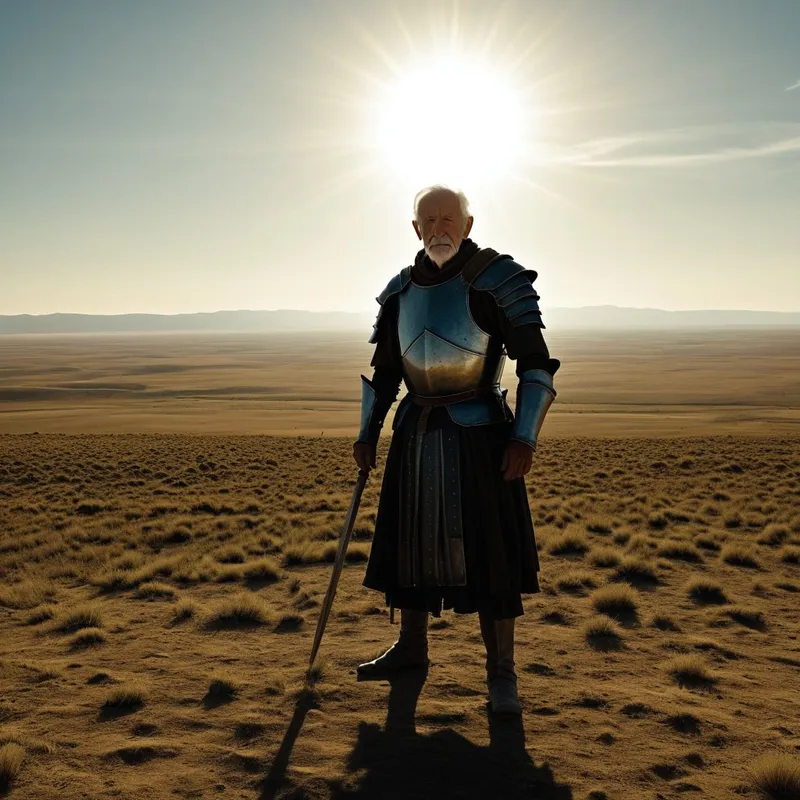
Don Quixote Myth Meaning & Symbolism
An aging man, maddened by tales of chivalry, declares himself a knight and embarks on a quest to restore a lost age of honor, battling windmills and reality itself.
The Tale of Don Quixote
In a place of dust and relentless sun, where the earth cracked and the horizons stretched into forever, there lived a man whose soul had been consumed by fire. His name was Alonso Quijano, but that name was ash. The fire was lit by books—great, leather-bound tomes filled with the deeds of knights-errant, of King Arthur and Amadís de Gaula. In his quiet house, the words did not stay on the page; they rose like ghosts, whispering of honor, enchantment, and impossible love. They hollowed out his mind and filled it with a brighter, fiercer world.
One day, the fire could no longer be contained. He scoured his ancestors’ trunks, piecing together a suit of armor, misshapen and corroded. He took a lean, weary horse and named it Rocinante, a name that held the echo of past grandeur. He declared himself Don Quixote de la Mancha, a knight-errant. Every knight needed a lady to serve, and so he chose Aldonza Lorenzo, a sturdy farm girl, and baptized her in his mind as the beauteous, peerless Dulcinea del Toboso, the sovereign of his thoughts.
And so he rode out. The world, however, refused to play its part. A roadside inn became a magnificent castle; the innkeeper, a castellan. Rough muleteers were insolent knights. Prostitutes were high-born ladies. He demanded the innkeeper dub him a knight, enduring a vigil over his armor in a courtyard, which he defended fiercely from bemused mule drivers. He was beaten, but he was knighted. The fire was now his law.
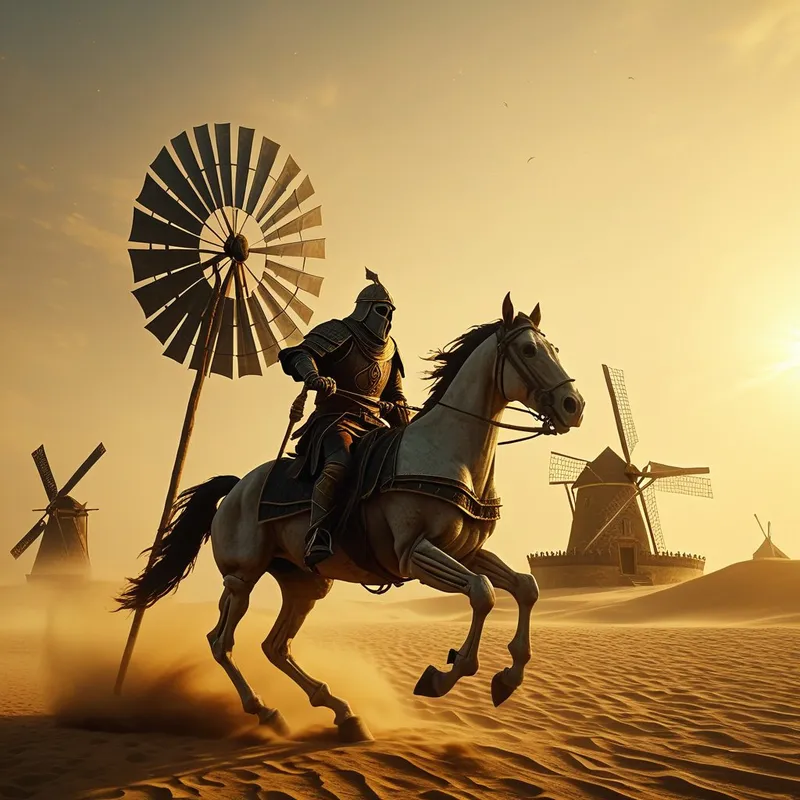
His greatest battle awaited him on the wide plains. Seeing a line of windmills, their sails turning slowly in the wind, he saw monstrous giants with long, wicked arms. “Fly not, cowards and vile creatures!” he cried to Sancho Panza, his newly acquired squire—a short, round peasant lured by promises of an island governorship. “It is a single knight against you!” He couched his lance, spurred Rocinante, and charged. The windmill’s sail caught lance and man, hurling them both, broken, into the dirt. “The sage who is my enemy,” he groaned to a baffled Sancho, “has turned these giants into windmills to rob me of the glory.”
His quest was a tapestry of such misapprehensions. A barber’s brass basin became the legendary Helmet of Mambrino. Flocks of sheep became opposing armies. He freed galley slaves, believing them persecuted gentlemen. He attacked wineskins, thinking them a giant. Through it all, Sancho was his anchor to the earth, a chorus of proverbs and pragmatism, yet slowly, subtly, infected by his master’s dreaming.
The final enchantment was the cruelest. A friendly duke and duchess, for their amusement, wove elaborate deceptions around the knight and squire. They made Sancho governor of a fictional island, a bittersweet parody of his dream come true. They conjured a false enchanted Dulcinea, a coarse peasant girl under a spell. Don Quixote’s heart broke, but his faith did not waver. Defeated at last in a staged duel by a knight of his own invention, he was bound by the rules of chivalry to abandon his quest.
He returned home, the fire extinguished. The enchantment lifted, and Alonso Quijano lay in his bed, the world now flat, common, and unbearably real. On his deathbed, he renounced the books of chivalry and his identity as Don Quixote. He made his will, received last rites, and died quietly. The knight-errant was no more, his final act a surrender to the world he had spent his glorious, mad life defying.
Cultural Origins & Context
The myth was born not in an oral tradition, but from the pen of Miguel de Cervantes Saavedra in the early 17th century, a period of profound transition for Spain. The nation was grappling with the fading glory of its empire, the rigid hierarchies of the Inquisition, and the stark contrast between aristocratic ideals and harsh, everyday reality. Cervantes, a soldier who had been wounded and enslaved, wrote from the margins of this society.
Don Quixote was published in two parts (1605 and 1615). It was an immediate popular sensation, read aloud in public squares and discussed in taverns. Its societal function was complex: it was a hilarious parody of the wildly popular but formulaic chivalric romances of the time, yet it quickly transcended mere satire. It held up a mirror to a nation obsessed with a romanticized past, questioning the very nature of truth, perception, and honor in a changing world. It was passed down not by bards, but by printers and readers, becoming a cornerstone of Western literature precisely because it captured a universal psychic tension.
Symbolic Architecture
At its core, the myth is a profound exploration of the collision between the inner world of the ego and the outer world of collective reality. Don Quixote is not merely a madman; he is the archetypal hero of the psyche, but one whose quest is directed inward. The windmills, the inns, the sheep—these are not what he battles. He battles the literal, the mundane, the disenchanted world.
The true battle is never with the windmill, but with the mind that sees only a windmill where a giant could be.
Sancho Panza represents the embodied, instinctual self—the sensation function grounded in the body and its needs. He is the necessary counterweight to Quixote’s soaring intuition. Their relationship models the necessary, if fraught, dialogue between spirit and matter, ideal and real, madness and sanity. Dulcinea is the ultimate symbol of the anima, the soul-image. She is pure projection, an inner goddess who makes the outer world meaningful and worth fighting for, even if she has no objective existence.
The Dreamer's Resonance
When this myth stirs in modern dreams, it signals a profound rupture between one’s inner narrative and external circumstances. To dream of charging at illusory giants is to experience the somatic shock of commitment meeting emptiness. The body feels the lunge, the impact, the fall. Psychologically, the dreamer is in a state of heroic inflation—a possession by an archetype—where a deeply held ideal, belief, or self-image has become so powerful it distorts perception.
Dreams of being a misunderstood knight, or of having a loyal but doubting companion (a Sancho), point to a psyche attempting to validate a fragile, beautiful, but unsustainable reality. The process is one of painful disillusionment. The dream ego is going through the necessary, often humiliating, deflation of a fantasy that has outlived its usefulness. It is the psyche’s way of staging the collision so that, unlike the original Quixote, the waking self might integrate the message before the final, fatal surrender.
Alchemical Translation
The Quixotic journey is a stark map of psychic alchemy. The base metal of Alonso Quijano—a life grown stale and meaningless—is subjected to the nigredo, the blackening. This is the madness, the dissolution of consensus reality in the fire of chivalric romance. His old identity is burned away.
The knight is the crucible; his madness is the fire that separates the dross of the mundane from the gold of the personal myth.
His adventures are the chaotic albedo and citrinitas, the whitening and yellowing, where opposites clash: idealism vs. realism, spirit vs. matter, madness vs. sanity. Each defeat is a mortificatio, a killing of the literal interpretation, forcing the spirit to refine its aim. Sancho is the essential sol niger, the black sun, whose earthy wisdom slowly infiltrates the knight’s consciousness, just as the knight’s idealism elevates the squire’s.
The ultimate goal of this alchemy is not the conquest of the world, but the individuation achieved through the relationship between these opposites. The tragedy of the myth is that Don Quixote achieves the final stage, the rubedo or reddening—the return to integrated consciousness—only on his deathbed, in the renunciation of his quest. For the modern individual, the alchemical translation is not about abandoning one’s giants, but in learning to see them for what they are: not monsters to be slain, nor mere machinery to be ignored, but powerful, turning forces that can, if engaged with conscious awareness, grind the ego to dust so that the Self might, eventually, be revealed. The quest is not to restore a lost golden age, but to forge the gold of meaning in the furnace of the present, however cracked and sun-bleached it may be.
Associated Symbols
Explore related symbols from the CaleaDream lexicon: