
Dodona Oracle Myth Meaning & Symbolism
At the world's oldest oracle, the voice of Zeus spoke through the rustling leaves of a sacred oak, interpreted by priestesses who listened to the earth.
The Tale of Dodona Oracle
Before the marble halls of Delphi echoed with priestly chants, before the laurel wreath was a symbol of prophecy, there was a sound older than language. It was the sound of wind through leaves in a high, lonely grove in the land of the Thesprotians. This was Dodona.
They say it began with a dove—or was it a priestess?—that flew from the ancient lands of Thebes in Egypt, across the wine-dark sea, to alight upon the branches of a mighty oak. This was no ordinary tree. Its roots drank from the same deep springs as the earth’s own heart. Its trunk was so vast a man could not encircle it with his arms. And in its sighing branches, the god himself made his home.
For this was the oracle of Zeus Naios, Zeus of the flowing streams. He did not speak through the ravings of a priestess, nor the cryptic verses of a medium. His voice was the voice of the world itself. When a seeker came—a king doubting his war, a farmer fearing for his harvest, a mother praying for a child—they would bring their question to the silent grove.
They would stand before the sacred oak, their fate hanging on the breeze. The three priestesses, the Peleiades, would stand barefoot upon the earth, their eyes closed, their heads tilted. They listened. They listened to the rustle and creak, the groan and whisper of the branches as the wind moved through them. They listened to the clanging of bronze lebetes hung from the boughs, their song carried by the same wind. The sound was chaotic, a symphony of nature, yet within it, the trained ear could find a pattern, a meaning, a divine sentence.
One tale tells of a king who sent a delegation, asking if he should build a new city. The oak, through its rustling interpreters, spoke: “Build where you find a man with three eyes.” Despairing of such a riddle, the men wandered until they met a one-eyed man riding a donkey—a beast with two eyes, making three in total. There, they built the city, and it prospered. The oracle spoke not in clear commands, but in the language of the world, a code to be deciphered by the wise and the humble.
The answers were never easy. They demanded listening, not just hearing. They required the seeker to become part of the grove’s ecology, to still their own inner noise to perceive the voice in the wind. To consult Dodona was to confess that the greatest wisdom was not invented by man, but breathed out by the ancient, living earth, and that to understand it, one must first learn to be silent.

Cultural Origins & Context
Dodona’s origins are shrouded in the mists of prehistory, likely dating back to a pre-Greek, Pelasgian earth-cult. Homer references it in the Iliad, where Achilles prays to “Zeus, lord of Dodona, Pelasgian, dwelling afar, who rulest over wintry Dodona.” This establishes its immense antiquity and its connection to a chthonic, localized form of worship predating the Olympian pantheon’s formal hierarchy.
Its societal function was foundational. As perhaps the oldest Hellenic oracle, it served as a direct line to the most primal authority: Zeus himself, in his aspect as a weather and sky god intimately tied to a specific, numinous place. Unlike the later, politically instrumental oracle at Delphi, Dodona retained a raw, rustic character. It was consulted on matters both grand and personal—state treaties, colonial expeditions, agricultural cycles, and private disputes. Its priesthood, initially male Selloi who slept on the ground and never washed their feet (to maintain contact with the chthonic power), later evolved to include the female Peleiades, linking the oracle to symbols of fertility and the soul.
The myth was passed down not as a single, cohesive story, but as a living tradition embedded in ritual practice. Its authority came from its perceived unbroken connection to the primordial. It told the Greeks that wisdom was not a human construct, but an environmental constant—you simply had to know how to listen to the land upon which you walked.
Symbolic Architecture
At its core, Dodona symbolizes the oracle within the natural world. The sacred oak is the axis mundi, the world tree connecting the heavens (Zeus’s domain), the earth (its trunk and roots), and the underworld (the springs beneath it). It is a living antenna for divine will.
The first language of the gods is not words, but the sound of being itself—the wind, the water, the growth of wood. To prophesy is to translate the world.
The wind represents the pneuma, the animating spirit of the universe. It is invisible force made audible through the instrument of the oak. The priestesses are not the source of the message but its interpreters, modeling the human role as a conscious mediator between the raw, unconscious voice of nature (the Self) and the conscious, questioning ego.
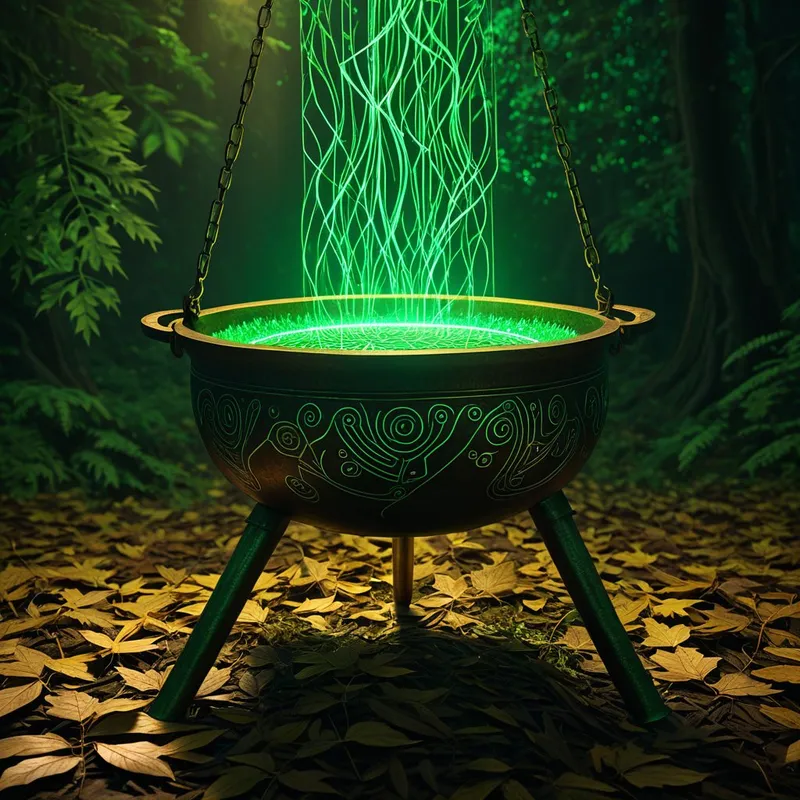
The bronze cauldrons that ring in the wind add a layer of human craft to natural revelation. They symbolize the necessity of culture—ritual, art, technology—to amplify, shape, and contain the primal message, making it resonate more deeply within the human psyche. The oracle’s answers, often riddling, force the seeker out of literal-mindedness and into a symbolic relationship with reality, where a “man with three eyes” is not a monster but a pattern to be recognized.
The Dreamer's Resonance
When this myth pattern stirs in the modern unconscious, it often manifests in dreams where listening becomes paramount. The dreamer may find themselves in a vast, natural space—a forest, a shore, a mountain pass—where a significant message is being conveyed not by a person, but by the environment itself. The rustling of leaves forms words; the pattern of waves spells a name; the call of a bird holds a specific warning.
Somatically, this can correlate with a process of deep inner listening, often emerging during periods of burnout, intellectual over-saturation, or emotional numbness. The psyche is signaling that the answers being sought through analysis, advice, or external validation are not forthcoming because the true guidance lies in re-establishing connection with the instinctual, bodily self. The “oracle” is the dreamer’s own somatic intelligence, their gut feeling, or the quiet, persistent voice of intuition that has been drowned out by the noise of daily life. The dream is an invitation to become one’s own Peleiades, to interpret the subtle signs and sensations arising from within.
Alchemical Translation
The alchemical journey modeled by Dodona is the transmutation of noise into guidance, and confusion into rooted knowing. The modern individual, besieged by data and opinion, is the seeker arriving at the grove with a question. The first, crucial operation is silencing the personal will. This is the negredo, the darkening, where one must cease striving and become still.
The second operation is attunement. Like the priestesses grounding their feet on the earth, one must shift consciousness from the head to the body and the senses, becoming receptive to the “wind”—the subtle movements of the unconscious. This is the albedo, the whitening, a purification of perception.
Individuation is not about finding a voice that is uniquely yours; it is about becoming a clear vessel for the voice that has always been there, whispering through the leaves of your own ancestral tree.
Finally, the third operation is interpretation. The rustling leaves and ringing bronze are the symbolic, often paradoxical, communications of the Self. The ego’s task is not to command but to translate this symbolic language into actionable insight for the personality. This is the rubedo, the reddening, where the raw, divine message is integrated into the fabric of one’s life, resulting in a wisdom that feels both deeply personal and transpersonal. One becomes, in a sense, both the oak and the interpreter, a rooted being through whom the spirit of life can speak its timeless, necessary truths.
Associated Symbols
Explore related symbols from the CaleaDream lexicon: