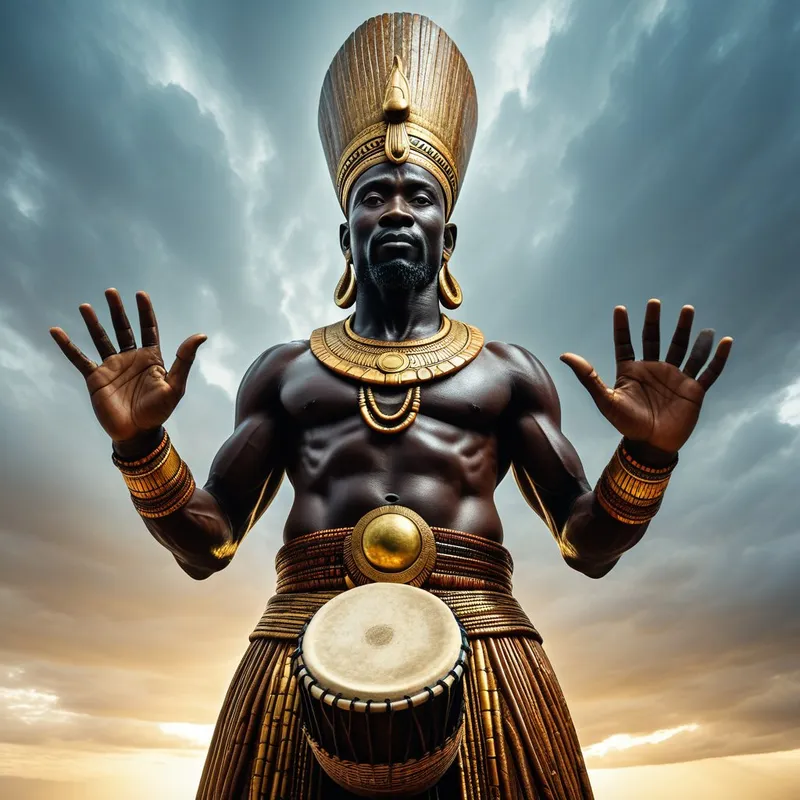
Djembe Myth Meaning & Symbolism
A sacred drum is born from a deity's sacrifice, granting humanity the voice of the cosmos to heal division and summon the community of life.
The Tale of Djembe
Listen. Before the first word was spoken, there was a silence so deep it was a presence. In that silence lived the Numu, the master smiths of the spirit world. They were the keepers of the primal rhythm, the heartbeat of the cosmos itself. But on the earth below, humanity was adrift. Their communities were fractured, their joys solitary, their griefs a private burden. They had fire and tool and tongue, but they lacked the one thing that could weave their separate hearts into a single, living tapestry: a communal voice.
Among the Numu was one whose spirit resonated with a particular sorrow for the human condition. This deity, whose name is whispered only in the space between drumbeats, looked upon the fractured villages and felt a profound dissonance. The cosmic rhythm was whole, but its echo on earth was broken, reflected only in the lonely pounding of mortars and the disconnected tapping of tools.
Moved by a compassion that shook the foundations of the spirit realm, the Numu made a decision that would echo for all time. They descended to the sacred grove of the Saman tree. Placing a hand upon its trunk, they spoke not with sound, but with intent. “For connection, a body must be given. For voice, a skin must be offered. For spirit to travel, a vessel must be hallowed.”
And so, the great sacrifice began. The Numu’s own divine essence flowed into the Saman, and from its living wood, a form was hollowed—a chalice of potential, curved like the womb of the world and the shoulder of the earth. But a drum is mute without its head. From the realms above, a goat, creature of both earth and agility, was summoned. Its hide, stretched across the wooden chalice, became the waiting membrane between silence and speech.
The final act was one of terrifying generosity. The Numu did not merely craft the drum; they became it. With a final pulse of their celestial being, they transferred the knowledge of the three sacred spirits of the drum into its very form. The bass, the deep call of the earth, was placed in the center. The tone, the clear speech of the community, was set around the edge. The slap, the sharp crack of alertness and truth, was imbued in the skilled hand itself.
The first sound was not a note, but a presence. When the first human hand, guided by ancestral memory, struck the head, the air did not just vibrate—it parted. The deep Dun spoke to the bones of the listeners, rooting them. The clear Ton spoke to their minds, clarifying thought. The sharp Pa spoke to their spirits, awakening them. Villagers emerged from their isolation. Strangers turned toward the common pulse. Grief was poured into the rhythm and came out shared, diluted by the community. Joy was offered and was multiplied. The Djembe had been born, not built, and in its voice, humanity found its chorus.
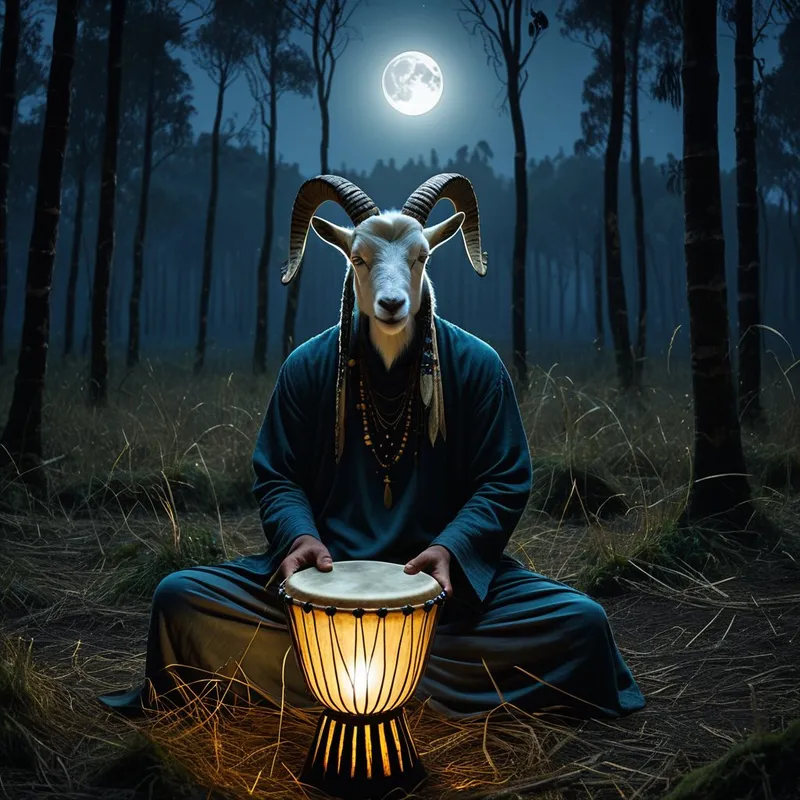
Cultural Origins & Context
This foundational narrative originates from the Mande peoples, specifically linked to the Numu caste, who are considered the sacred smiths and original carvers of the drum. The myth was not written but lived, passed down through the oral tradition of griots—the historian-poet-musicians who are the memory of West African societies. It was told not as mere folklore, but as a charter myth, explaining the sacred origin of an object central to social, spiritual, and political life.
The Djembe’s function was, and is, profoundly societal. It is the engine of ceremony—from births and marriages to rites of passage and funerals. It calls councils to order and villagers to dance. It is the primary tool for communication with the ancestral world, its rhythms serving as a linguistic bridge to the spirits. The myth therefore served to sanctify the drum, elevating it from an instrument to a living entity, a direct descendant of divine sacrifice, whose use required respect, skill, and a understanding of its profound responsibility. To play the Djembe was to step into a mythic role, to become the temporary vessel for that unifying, divine voice.
Symbolic Architecture
At its core, the myth of the Djembe is a profound map of integration. The drum itself is a perfect symbolic vessel: the wooden body (Gbedi) represents the container of the individual soul and the community, carved from the World Tree that connects heaven, earth, and underworld. The skin head (Kesebe) represents the sensitive membrane of consciousness, the interface where the outer world (the strike) meets the inner resonance (the sound).
The sacrifice of the Numu is the archetypal act of creation: something of the infinite must be limited, must take a form, to make the ineffable communicable.
The three spirits of the sound—Bass, Tone, Slap—symbolize the triune nature of a complete psyche and a healthy society. The Bass is the unconscious, the foundational pulse of instinct and earth. The Tone is the conscious mind, the voice of clear expression and order. The Slap is the transcendent function, the disruptive, awakening spark of insight that cuts through illusion. A master drummer weaves these three into conversation, modeling the internal dialogue necessary for wholeness. The myth teaches that true voice is not a solo note, but a complex, integrated rhythm born from sacrifice and directed toward connection.
The Dreamer's Resonance
When the Djembe appears in a modern dream, it often signals a crucial moment in the dreamer’s relationship with their own voice and their place in the communal fabric. To dream of finding a Djembe suggests the emergence of a new capacity for self-expression or a calling to bridge divides. To dream of a Djembe that is broken or mute speaks to a profound feeling of disconnection, a sacrifice of one’s authentic voice to please others or maintain a false peace.
Dreaming of playing the Djembe, especially if one feels the vibrations in their body, points to an active somatic process. The dream-ego is practicing the integration of its own “three spirits”—perhaps trying to connect deep, ignored instincts (Bass) with rational thoughts (Tone) through a courageous act of truth-telling (Slap). The rhythm played in the dream is key: a frantic, chaotic rhythm may indicate internal conflict, while a steady, compelling pulse suggests the dreamer is successfully “calling their soul to order” and, by extension, attracting their true community.
Alchemical Translation
The myth of the Djembe provides a potent model for the alchemical process of individuation—the Jungian journey toward psychic wholeness. It begins with the recognitio, the painful awareness of our inner “fractured villages”—the disparate, conflicting parts of ourselves living in isolation. This is the human condition the Numu saw.
The sacrifice is the central, non-negotiable stage. For the modern individual, this is not a literal death, but the sacrifice of a lesser state of being. It is the willingness to hollow out the ego (the Saman of the personality) to create a vessel. It is the offering up of our defensive “hides”—our personas and protective layers—to be stretched taut, made vulnerable, into a receptive membrane. We must give up the comfort of silent isolation to gain a voice.
The drum is not played upon; it is played through. Individuation is not about constructing a new self, but about becoming a clear vessel through which the Self can sound.
The final transmutation is the integration of the “three spirits” into a coherent voice. This is the masterful play of the individuated psyche: allowing the deep, often dark, truths of the unconscious (Bass) to rise; articulating them with clarity and purpose (Tone); and having the courage to let that truth strike with disruptive, awakening force (Slap) where needed in one’s life. The goal, as in the myth, is not solo virtuosity, but the creation of a resonant life that, by its very rhythm, calls forth authentic connection, heals inner division, and contributes its unique pulse to the great, communal music of existence. We are invited to become, each of us, a living Djembe.
Associated Symbols
Explore related symbols from the CaleaDream lexicon: