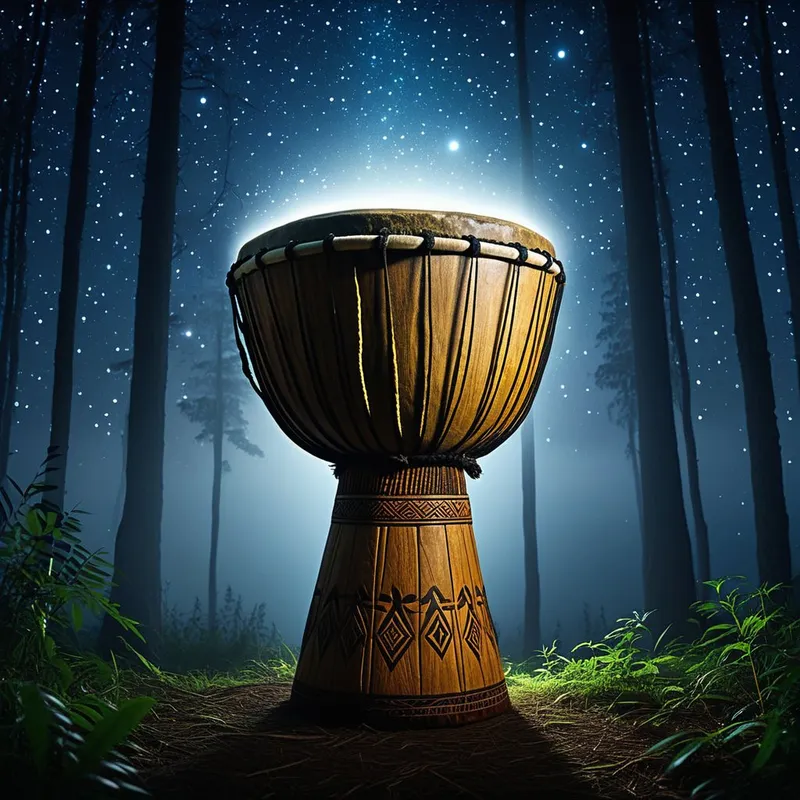
Djembe Drum Myth Meaning & Symbolism
A sacred drum is born from a tree and a hunter's sacrifice, channeling the voices of ancestors and the rhythms of the cosmos to unite the people.
The Tale of Djembe Drum
Listen. Before the villages were many, when the world was closer to the sky, there was a silence. It was not a peaceful quiet, but a great emptiness between the people. They moved, they spoke, but their spirits did not touch. Their joys were solitary, their griefs were lonely echoes. The ancestors watched from the realm of Nyama, their voices muffled by the veil between worlds.
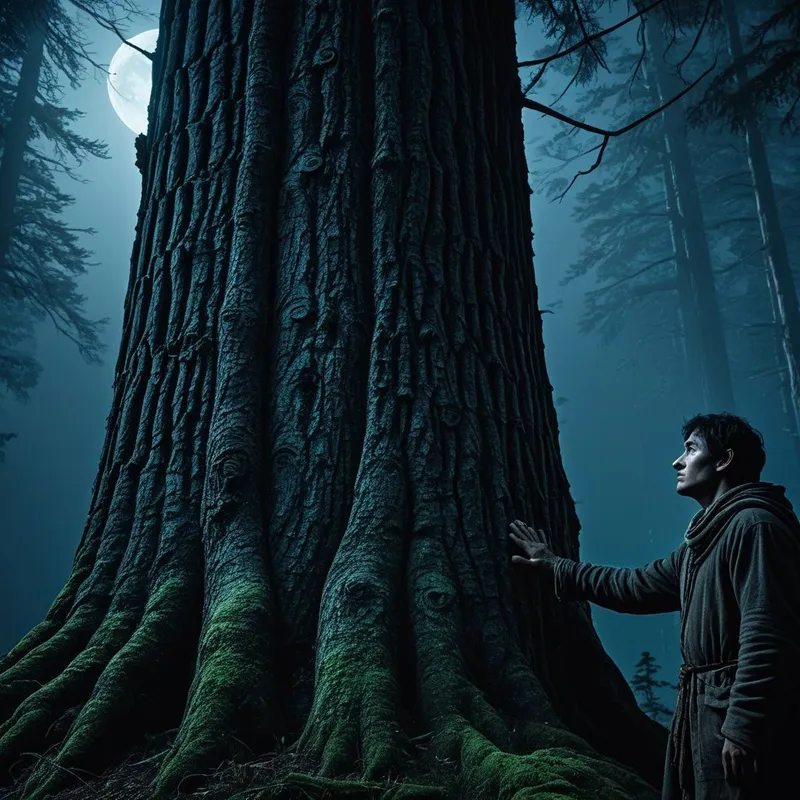
In a time of great disconnection, a hunter named Sundiata walked deep into the heart of the oldest forest. He was not hunting game, but seeking a cure for the silence in his people's souls. For three days and three nights, he walked, until he came upon the Bao-Bab, the tree of life and wisdom. Its trunk was vast as a hill, its branches holding up the sky.
Sundiata laid his weapons down and spoke to the tree. "Great Elder, my people are fragments. We have no center, no shared heartbeat. How can we become one?"
The Bao-Bab did not speak with words, but with a feeling that vibrated in Sundiata's bones. He understood. A sacred exchange was required. To create a vessel for unity, a sacrifice of solitude was needed. The tree would give of its body—the trunk that had witnessed centuries—but it required a spirit to bridge the worlds, to bind the voice of the wood to the pulse of the community.
Without hesitation, Sundiata offered his own life's rhythm. He pressed his palm against the rough bark and vowed, "Take my heartbeat. Let it be the first note. Let my breath become the sustain, and my spirit the bridge between the living and the ancestors."
A profound stillness fell. Then, a crack like thunder, not from the sky, but from within the tree. The great Bao-Bab split, not in death, but in transformation. From its heartwood, a shape was revealed: a goblet of solid wood, curved and perfect. At that same moment, Sundiata’s physical form faded, not into nothingness, but into essence. His skin became the tight, resonant head of the drum, stretched across the wooden chalice. His heartbeat became the deep, central tone—the Dun. His breath became the sharp, slapping accent—the Pa. His spirit became the ringing, open note—the Tak.
The first Djembe fell to the forest floor, not with a thud, but with a low, warm Dun that rolled through the trees like a wave. The animals fell silent. The wind held its breath. Then, from the drum, a rhythm began of its own accord—a complex, living pattern of Dun, Pa, and Tak. It was the sound of a heart, a conversation, a community. It was Sundiata’s sacrifice, now a gift.
The rhythm traveled. It reached the scattered people. Without understanding why, they were drawn to the sound. They gathered around the drum. Hands, moved by a memory deeper than thought, reached out and played. They found they could speak through it—joy, sorrow, warning, celebration. The ancestors, hearing the clear call of the drum, finally found their voice too, their wisdom riding the rhythms into the hearts of the living. The silence was broken forever, not by noise, but by a shared, sacred pulse.
Cultural Origins & Context
The myth of the Djembe’s origin is woven into the cultural fabric of the Mande world, primarily in the regions that are now Mali, Guinea, Senegal, and Ivory Coast. It is a foundational narrative belonging to the Jeli (Griots), the oral historians and musicians. For them, the Djembe is not merely an instrument; it is a living archive and a sacred tool of social cohesion.
The story was never meant to be a literal historical account, but a metaphorical truth told under the baobab tree during initiations, festivals, and community gatherings. Its function was multifaceted: to explain the profound spiritual and social role of music, to encode the values of sacrifice and community over the individual, and to sanctify the instrument itself. By linking the drum to a heroic sacrifice and the world tree, the myth grants the Djembe its authority. It legitimizes the power of the drummer, who is seen as a mediator channeling Nyama from the ancestors and the natural world into the communal body. The myth ensures that every time the drum is played, the story of Sundiata and the Bao-Bab is implicitly remembered, re-enacting the original moment of connection.
Symbolic Architecture
At its core, the myth presents a powerful blueprint for the creation of meaning and community from the raw materials of individual existence and the natural world.
The Bao-Bab represents the cosmic axis, the timeless, enduring structure of the world and the collective unconscious. It is the raw, unformed potential of nature and tradition. Sundiata, the hunter, symbolizes the conscious ego or the individual soul, which recognizes a lack—the "silence" of disconnection. His journey is one of seeking, not for food, but for psychic wholeness.
The sacrifice is not a destruction, but a sublime exchange: the individual ego surrenders its isolated form to become the animating principle of a collective vessel.
The drum that is born is the conjunctio, the sacred marriage. It is the vessel (the wood) animated by the spirit (the sacrifice). Psychologically, it represents the birth of the Self—a structure that can hold and harmonize the individual within the collective. The three fundamental tones—Dun (bass), Pa (slap), and Tak (tone)—mirror a trinitarian principle found worldwide: body, mind, and spirit; or in Jungian terms, the grounding of the unconscious (Dun), the sharp clarity of consciousness (Pa), and the transcendent, ringing connection between them (Tak).
The Dreamer's Resonance
When this myth pattern stirs in the modern psyche, it often manifests in dreams of searching for a lost sound, a silent crowd, or a transformative object that requires a part of oneself to activate it. One might dream of a magnificent but mute instrument, or of being in a group where everyone speaks but no one understands.
Somatically, this process feels like a deep, rhythmic tug in the chest or solar plexus—a longing for resonance. Psychologically, the dreamer is confronting the "great silence" of their own life: a feeling of existential isolation, a lack of authentic connection to their community, ancestry, or inner world. The dream-ego, like Sundiata, is being called to make a journey into the forest of the unconscious (the Bao-Bab) to find what is missing. The critical turn is the realization that the cure is not found, but co-created through a willing offering of one's own isolated "beat"—one's rigid identity, protected wounds, or solitary pride—to a larger, unifying structure.
Alchemical Translation
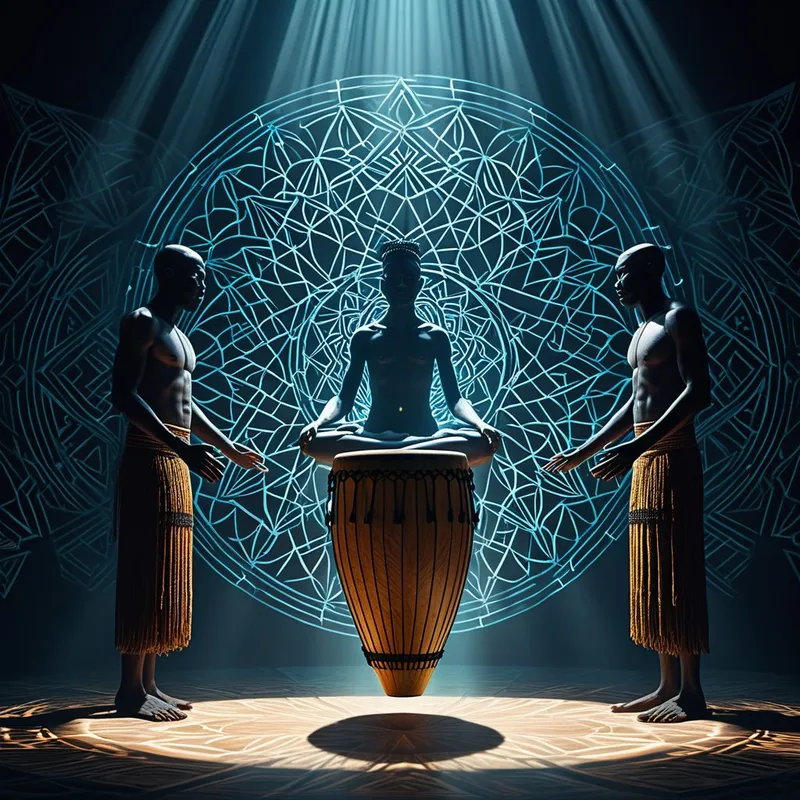
The myth of the Djembe is a perfect allegory for the alchemical process of individuation—the Jungian path to psychological wholeness. It maps the transformation from individuation-as-separation to individuation-as-integration.
The initial state is the nigredo, the blackening: the "silence" and disconnection of the fragmented people (the fragmented psyche). Sundiata's quest is the albedo, the whitening: the conscious recognition of this state and the search for a unifying principle. The encounter with the Bao-Bab is the confrontation with the Self as an archetypal, pre-existing structure (the cosmic tree).
The moment of sacrifice is the rubedo, the reddening: the fiery, passionate surrender of the ego's sovereignty. The ego does not die; it is transmuted from the subject of experience into the medium of experience.
The birth of the drum is the citrinitas, the yellowing or illumination: the emergence of the new, functional center of the personality. The finished product—the drum being played by the community—represents the ongoing, lived reality of individuation. The Self (the drum) is not a static achievement but a dynamic instrument. It must be "played"—engaged with through the rhythms of daily life, relationship, and creative expression. The unified sounds it produces are the harmonious functioning of a psyche where the personal and the collective, the human and the ancestral, the individual note and the communal rhythm, are no longer in conflict, but in creative, vital conversation. The modern individual's "alchemical work" is to find the unique shape of their own "drum" and have the courage to offer their heartbeat to it, thus turning personal solitude into universal music.
Associated Symbols
Explore related symbols from the CaleaDream lexicon: