Djanggawul Creation Myth Myth Meaning & Symbolism
Ancestral beings journey from the east, creating the land and its sacred laws through ritual and the power of their generative bodies, establishing the foundation of life.
The Tale of Djanggawul Creation Myth
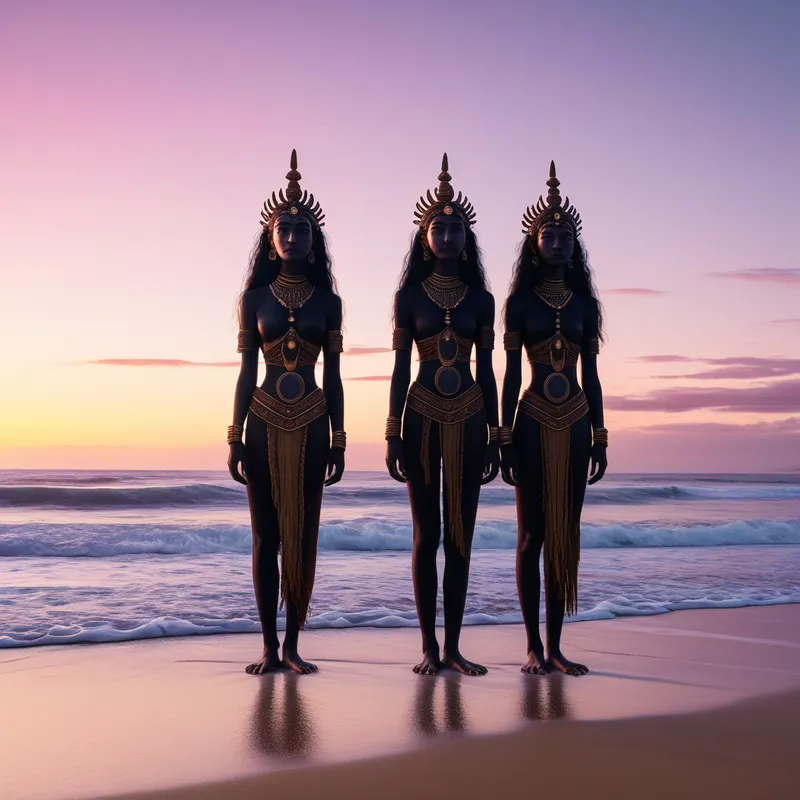
From the eternal east, from the island of Bralgu, they came. The sea, a sheet of beaten silver under a sky not yet fully awake, parted before their purpose. First, the two Sisters, Miralal and Miralal, their bodies tall and strong, the very essence of the earth made flesh. With them came their Brother, Djanggawul, a figure of profound potency. They did not walk upon the water; they emerged from it, as the land itself yearns to emerge from the dreaming sea.
In their hands, they carried the sacred rangga, long poles humming with the song of creation. These were no mere sticks, but the bones of the world-to-be, vessels of all life and law. The Sisters’ bodies, too, were sacred vessels. From their wombs, which had never known a mortal father, the first children of the land were born. They planted them gently on the soft, wet sand, and the children grew instantly, becoming the first people of the clans.
Their journey was the world’s becoming. Where the tip of a rangga touched the barren ground, a spring bubbled forth, cool and clear. Where it dragged, a river carved its course, singing to the stones. The Sisters danced, and with each stamp of their feet, a mountain rose; with each sweep of their arms, a valley deepened. They sang the names of the places—the waterholes, the trees, the animals—and so they were. All was wet, fertile, and pulsing with potential.
But the world was too open, too raw. The sacred rangga stood exposed, their power naked to the sky. The Brother, Djanggawul, watched. A tension grew, a silent understanding of imbalance. Then came the Wawalag Sisters, or in some tellings, the cunning men of the Dua moiety. They saw the unguarded power, the flow of life that came so freely from the feminine.
In an act that would echo through all time, they broke the sacred rangga. They cut them down to size, hiding the longest, most potent sections. They instituted the first Kunapipi rituals, taking the overt, generative power of the Sisters into the hidden, ceremonial space of the men’s sacred ground. The world changed. The direct flow was ritualized. The Sisters’ creative act was complete, but its manifestation was now governed by law, by ceremony, by the balance of revealed and concealed.
The Djanggawul did not rage. They saw the new pattern settle upon the land they had birthed. Their work was done. They turned, and slowly, with the dignity of tides, they retreated back into the mythic east, into Bralgu. They left behind a world alive, a people, and the sacred, complicated law that would hold it all together—a law born from their bodies and sealed by their seeming diminishment.

Cultural Origins & Context
This myth belongs to the Yolngu people of north-eastern Arnhem Land. It is not a story of the distant past but a narrative of the Dreamtime—the Alcheringa—a time that is both past and eternally present, underpinning all reality. The myth was and is transmitted through elaborate song cycles, dances, and sacred ceremonies, particularly those associated with the Kunapipi cult. It is not merely told; it is performed, its power re-activated with each ritual.
Elders, the custodians of deep law, hold the knowledge. The myth functions as a social charter: it explains the origins of the landscape, the clans, the sacred objects (rangga), and the division of ritual responsibilities between men and women. It establishes the template for life itself—fertility, social order, and the sacred interdependence of the genders, even within a framework of ritual separation. To know the Djanggawul songline is to know the law of the land and one’s place within it.
Symbolic Architecture
At its heart, this is a myth of primordial, feminine creativity. The Djanggawul Sisters are the Mother in her most direct, unmediated form. They do not think the world into being; they birth it, physically and continuously. The rangga are profound phallic symbols, yet they are wielded by the feminine—a union of opposites where the generative principle is holistic.
The sacred is not merely spiritual; it is somatic. Creation flows from the body, and law is inscribed upon it.
The “breaking” of the rangga is not a theft, but a necessary differentiation. It represents the movement from undifferentiated, unconscious creativity to structured, conscious culture. The raw, limitless power of the Mother must be shaped by the principle of limit (the Brother, the ritual men) to create a sustainable world. It is the birth of the ego from the unconscious, the establishment of form from formlessness. The wound of separation is the price of individuated existence.
The Dreamer's Resonance
When this myth stirs in the modern Dream, it often manifests as dreams of overwhelming fertility or creative potency that feels unmanageable. Dreaming of gushing springs, of landscapes forming from one’s body, or of possessing a powerful object one doesn’t know how to “use.” Conversely, it may appear as dreams of having one’s creative power “broken” or taken by another—a boss, a partner, an internal critic.
Somatically, this can feel like a surge of energy with no outlet, or a deep grief for a lost, primal connection to one’s own generative core. The psyche is working through the fundamental human tension between the desire for unbounded expression (the Sisters’ journey) and the need for structure, containment, and meaning (the ritual law). The dreamer is at the threshold between their inner, creative Bralgu and the need to manifest that creativity in the “real world.”
Alchemical Translation
The individuation process modeled here is not a heroic conquest, but a sacred division and integration. The initial stage is the acknowledgment of one’s own primordial creative force—the Djanggawul Sisters within. This is the prima materia, the raw, often chaotic urge to bring something new into being.
The alchemical “breaking” is the conscious ego’s necessary intervention. It is the difficult, often painful work of giving form to that force: drafting the novel, starting the business, committing to the relationship. It is limiting the infinite possibilities to a single, manifested reality. This feels like a loss, a diminishment of the original, glorious vision.
The ritual that follows the breaking is the disciplined practice, the craft, the daily labor. It is making the sacred rangga of one’s vision into a tool for the community of the self.
The final stage is the return to Bralgu—not as a defeat, but as a completion. The creative act is released into the world, governed by its own internal laws. The creator withdraws, having established a new order within the self. The individual no is the unbounded creative flow; they are the ritual ground where that flow is channeled into a life of meaning and law. They hold both the Sister’s power and the Brother’s structure in sacred, internal balance.
Associated Symbols
Explore related symbols from the CaleaDream lexicon:
- Mother — The Djanggawul Sisters embody the ultimate creative Mother archetype, from whose body the world and its people are directly born, representing unmediated generative power.
- Water — The element from which the ancestors emerge and which they create from the rangga, symbolizing the primordial, fluid state of potential and the source of all life.
- Ritual — The establishment of the Kunapipi ceremonies after the breaking of the rangga represents the transformation of raw creative power into structured, meaningful cultural practice.
- Journey — The myth is fundamentally a songline, a creative journey across the landscape that literally forms the world, mapping the path from potential to manifestation.
- Earth — The land itself is the direct creation and embodiment of the ancestors, not a separate entity but their continued physical presence, formed from their actions and essence.
- Sacrifice — The "breaking" of the rangga and the Sisters' acceptance of ritual law is a sacred sacrifice of undifferentiated power for the sake of a structured, sustainable world.
- Origin — This is a pure origin myth, detailing the very first acts that brought the tangible world, its laws, and its people into being from the Dreamtime.
- Fertility — The core theme of the myth, expressed through the Sisters' bodies, the flowing water, and the sprouting vegetation, representing prolific, life-giving energy.
- Dream — The entire narrative occurs within and explains the nature of the Dreamtime, the eternal, foundational reality that underlies the visible world.
- Mythic Hero — The Djanggawul beings are not heroes in a classical sense, but mythic progenitors whose heroic act is the foundational, self-giving work of creation itself.