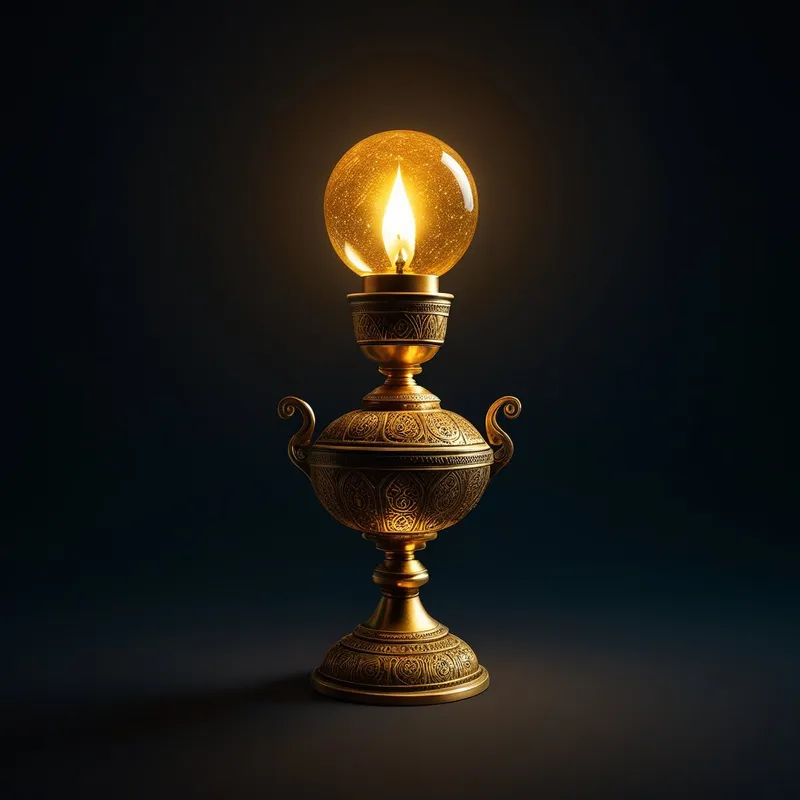
Diya Myth Meaning & Symbolism
The myth of the first lamp, born from divine sacrifice to hold back primordial darkness, symbolizing the eternal flame of consciousness within the human soul.
The Tale of Diya
Before the first dawn, there was only the great, yawning Nāśa. It was a darkness not of night, but of absence—a silence so profound it pressed upon the soul of the cosmos itself. In this void, the first stirrings of awareness coalesced, a longing for form, for distinction, for a witness. From this longing, the divine mind conceived a thought: a point of reference against the boundless dark.
But a thought alone could not hold. It needed a vessel, a crucible to give it permanence. And so, the Viśvákarma turned his gaze inward. He did not reach for star-stuff or mountain stone. He reached into the very essence of his own being, into the fertile clay of divine substance. With a tenderness that held the weight of all creation, he pressed his thumb into this sacred earth. The impression he made was not grand or towering; it was small, humble—a shallow bowl with a pinched spout.
Yet, this act was an offering of self. Into this bowl of his own essence, he poured the nectar of his attention, the clarified butter of his consciousness. But still, the darkness clung, a living thing that swallowed purity whole. A spark was needed, a catalyst to transmute potential into presence.
It was then that Lakshmi, she who resides in all that is auspicious and nourishing, approached. She saw the vessel of clay and the offering of ghee, poised on the brink of meaning. Without a word, she breathed upon it. Not with air, but with anugraha—the breath of grace. And where her breath touched the ghee, a flame was born.
It was a tiny thing, that first flame. A trembling, golden tongue no larger than a sesame seed. But as it rose, a miracle unfolded. The Nāśa, which had known no boundary, recoiled. It did not vanish, but it halted, held at bay by a sphere of gentle, unwavering light. The flame did not attack the darkness; it simply asserted, “Here, I am.” And in that assertion, space was created. The world was not built by the light, but the light made the world possible to see. The diya, the first lamp, now sat at the center of a tiny, sacred universe of its own making, a promise whispered against the infinite night: consciousness can hold a space for being.
Cultural Origins & Context
The diya is not the subject of a single, codified epic like the Mahābhārata. Its myth is woven into the very fabric of daily and ritual life in Sanātana Dharma. Its story is told not by bards in courts, but by grandmothers lighting evening lamps, by priests in temple pūjā, and by the collective memory of festivals like Dīpāvali.
This is a living, applied myth. Its primary function is not merely explanatory but profoundly participatory. The lighting of a diya is a re-enactment of the primordial act. Every individual who prepares the clay, pours the oil, and lights the wick steps into the role of Viśvákarma and Lakshmi. The myth is passed down through the somatic ritual itself—the feel of the clay, the scent of the oil, the warmth of the flame. It serves as a societal anchor, marking time (sunset), sanctifying space (homes, temples), and affirming a core ontological truth: that order (Dharma) is not a given, but is consciously maintained through small, repeated acts of devotion and awareness against the ever-present background of potential chaos (Adharma).
Symbolic Architecture
The diya is a complete symbolic universe in miniature. Its architecture maps the journey of consciousness from inert potential to active, sustaining presence.
The clay bowl represents the physical body and the material world (Prakṛti)—malleable, humble, and born of the earth. It is the necessary vessel, the container without which the sacred cannot be held in this realm. The oil or ghee symbolizes the fuel of life—our desires, efforts, mental and emotional energy (Prāṇa). In its raw state, this fuel is inert, even heavy. The cotton wick is the focused mind, the disciplined intellect (Buddhi), the channel that draws up the raw fuel of experience.
The flame is not the fuel, nor the wick, nor the vessel. It is the transcendent principle that emerges from their sacred alignment—the witness, the Ātman, consciousness itself.
The darkness it holds back is not evil, but the undifferentiated, unconscious state—the Nāśa, the potential for both chaos and creation that exists before the light of awareness is brought to bear. The diya’s light does not eradicate this darkness; it relates to it. It creates a sacred boundary, a limina, where knowing can occur.
The Dreamer's Resonance
To dream of lighting a diya, especially with difficulty—a wick that will not catch, oil that spills, a fragile clay lamp—often signals a profound somatic and psychological process: the struggle to establish or maintain conscious awareness in the face of an inner “darkness.” This darkness may manifest as depression, confusion, grief, or a period of profound transition where old identities have dissolved and a new one has not yet formed.
The dreamer is in the role of the divine artisan, attempting to shape a vessel (a new sense of self) from the clay of their current experience. The act of lighting the flame is the ego’s attempt to summon the Self, to ignite the pilot light of meaning. If the flame is strong and steady, it indicates a successful inner alignment, a moment of clarity or peace achieved amidst inner turmoil. If it flickers or dies, the dream points to a “fuel” problem—perhaps burnout, depleted emotional resources, or a mind (the wick) that is too saturated with worry to draw up the nourishing insights from the unconscious. The dream is a direct message from the psyche about the integrity of its own inner altar.
Alchemical Translation
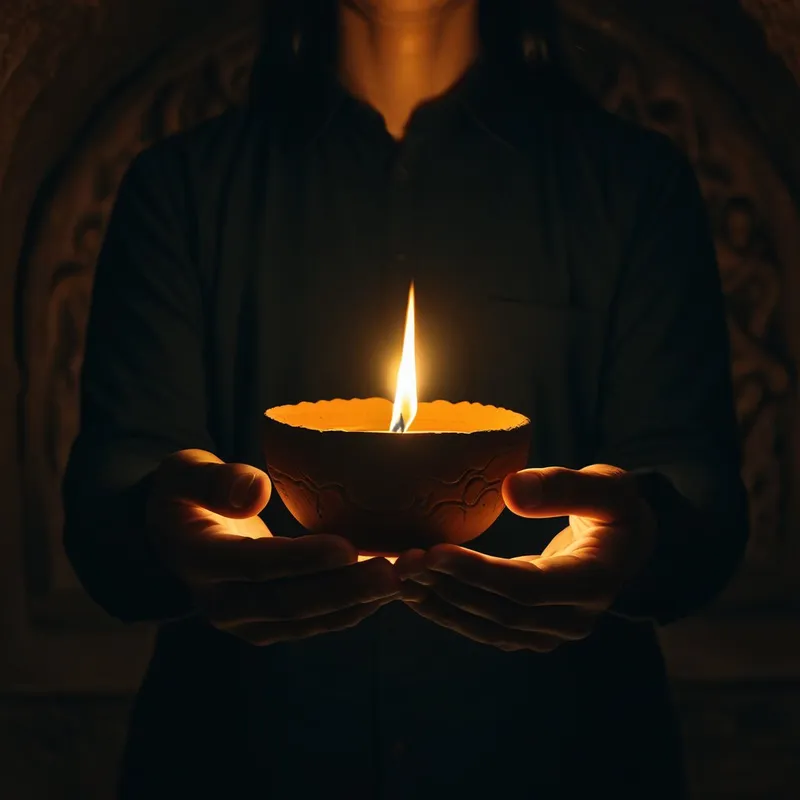
The myth of Diya models the alchemical process of psychic transmutation—individuation—with elegant precision. The modern individual begins in a state of Nāśa: the unconscious, undifferentiated mass of potentials, complexes, and inherited patterns. This is the raw clay.
The first step is Vessel-Making—the often-painful work of building an ego structure strong enough to contain the inner work. This is the thumbprint of Viśvákarma, the discipline of crafting a life and a mind capable of holding sacred inquiry. Next is the offering of Prāṇa—pouring one’s life energy, time, and attention into this vessel. This is the sacrifice, the investment of self.
The alchemical fire is ignited not by willpower alone, but by the breath of grace—the unexpected insight, the moment of synchronicity, the acceptance that comes from beyond the ego. This is Lakshmi’s touch.
The resulting flame is the conscious connection to the Self. It does not burn away all darkness (the shadow, the unknown); instead, it allows us to sit in relationship with it. It creates a bounded, sacred space within the psyche where we can see, know, and integrate. The lamp must be tended—the wick trimmed of distractions, the oil replenished through self-care and reflection. This is the ongoing ritual of individuation: not a single victory, but the daily, humble re-assertion of “I am here, I am aware,” thereby continuously creating a livable, meaningful inner world against the vast and beautiful mystery of all we do not yet know.
Associated Symbols
Explore related symbols from the CaleaDream lexicon: