Dioscuri Myth Meaning & Symbolism
The myth of twin brothers, one mortal, one divine, whose bond transcends death, creating a constellation of light and shadow in the human soul.
The Tale of Dioscuri
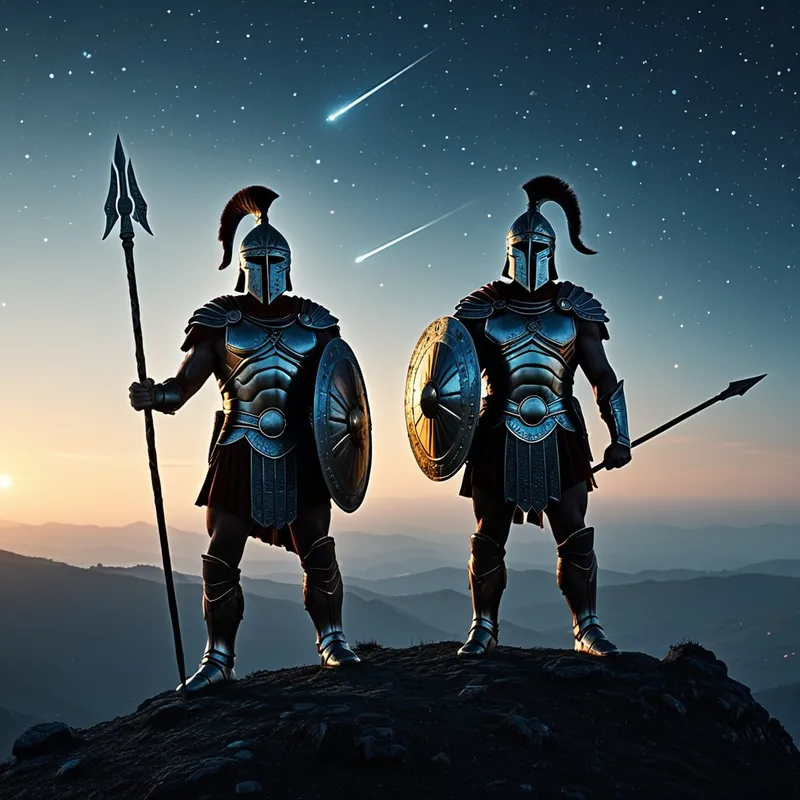
Hear now the tale of the twin lights, the sons of thunder and swan, born of a single egg cracked open beneath the Spartan sun. From it emerged Castor and Polydeuces, whom the Romans would call Pollux. They were two bodies sharing one breath, one spirit split between earth and sky. Castor’s hands could gentle the wildest stallion, his voice a whisper to the wind in the mane. Pollux’s fists were like falling stars, his strength a gift from his father, the Cloud-Gatherer.
They sailed with Jason on the Argo, their presence a steady beacon amidst the clashing rocks and the sirens’ call. Where Castor calmed the seas with a glance, Pollux shattered opponents with a blow. They were the balance of the ship, the human and the divine holding the world in tension.
But the thread spun by the Moirai is finite for mortal men. A feud with their cousins, the twins Idas and Lynceus, over stolen cattle, erupted into a storm of violence. In the dusty heat of the conflict, fate’s cruel edge fell. Idas, with a fury gifted by Ares, drove his spear deep. It found not the star-born Pollux, but the earth-bound Castor. The horseman fell, his life bleeding into the Spartan soil he loved.
Then arose a sound not of this world—the cry of an immortal facing a loss it was never meant to bear. Pollux knelt in the dust, cradling his brother’s still form. The sky darkened in sympathy. Looking up to the peak of Olympus, Pollux made not a demand, but a plea born of perfect love. “Father,” his voice echoed with a grief that shook the heavens, “I will not dwell in your golden halls without him. Let me share my gift, or let me follow him into the dark.”
In the throne room of the gods, a silence fell. Zeus, the wielder of lightning, was moved by a mortal dilemma. Here was a love that challenged the very order of things. The solution was not a resurrection, but a transformation. He offered a choice that was both a blessing and a burden: the twins would never be wholly together, nor ever wholly apart. One day they would walk the sunlit fields of Elysium; the next, they would dwell in the misty gloom of Hades. Eternal alternation, a celestial heartbeat.
And so, to guide lost sailors and remind humanity of the price of such devotion, Zeus placed their images among the fixed stars. There they shine, the Gemini, two points of light forever chasing one another across the vault of night, a promise written in fire that not even death can untie a true bond.
Cultural Origins & Context
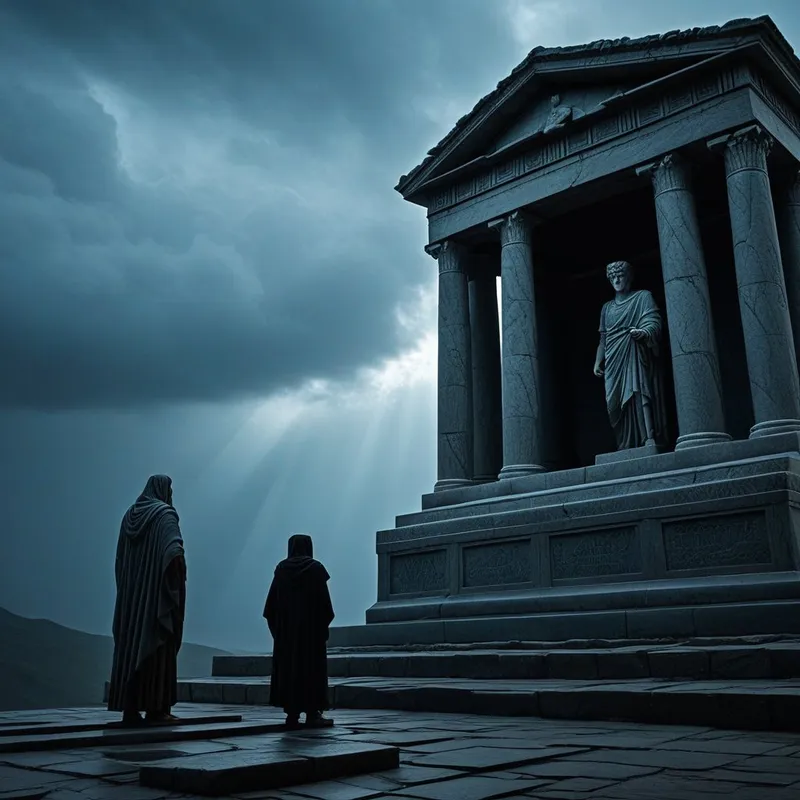
The Dioscuri were not mere characters in a tale; they were living presences in the daily and spiritual life of the ancient Greeks, particularly the Spartans, who claimed them as their divine patrons. Their cult was one of heroes, figures who existed in the liminal space between human and god. This placed them uniquely as accessible intercessors—powerful, yet born of human drama.
Their stories were woven into the fabric of Greek epic poetry, most notably in the Cypria and referenced by poets like Pindar. They were the archetypal brothers, the ideal comrades-in-arms, embodying the Spartan virtues of military excellence, loyalty (philia), and absolute brotherhood. Temples, known as Anakeion, housed their statues—two youthful, identical horsemen, often crowned with the distinctive egg-shaped cap, the pilos.
Their societal function was multifaceted. For sailors, they were the St. Elmo’s fire, the glowing plasma on ship masts that signaled divine protection in a storm. For soldiers, they were the embodiment of tactical duality—the cavalryman and the boxer, strategy and brute force. For the common person, they represented the hope that the bonds we forge in life might somehow transcend its ultimate boundary. They were a myth that answered a deep, human need: the reconciliation of our mortal fragility with our longing for eternal connection.
Symbolic Architecture
At its heart, the myth of the Dioscuri is a profound exploration of duality and its transcendence. They are not opposites, but complements. Castor represents the mortal, earthly, and tangible—the realm of the body, skill, and temporal life. Pollux represents the immortal, celestial, and intangible—the realm of the spirit, divine gift, and eternity.
The greatest alchemy is not turning lead to gold, but forging a single soul from the twin ores of mortal experience and immortal yearning.
Their shared egg symbolizes the primordial unity from which all opposites emerge. Their alternating fate in Hades and Elysium is the ultimate symbol of integrated wholeness. They do not conquer duality by eliminating one side, but by embracing the rhythm of both. One cannot exist without the other’s context; the joy of Elysium is defined by the sojourn in Hades, and vice versa. Psychologically, they represent the conscious and the unconscious, the ego and the Self, the personal identity and the transpersonal spirit. The conflict that leads to Castor’s death is the inevitable crisis that occurs when this inner partnership is challenged by the external world (the cousins, representing shadow or adversarial forces). The resolution is not a victory of one over the other, but a sacred pact that honors both.
The Dreamer's Resonance
When the pattern of the Dioscuri stirs in the modern dreamer, it signals a profound somatic and psychological process: the confrontation with an inner duality that demands integration. This is not a simple choice between two options, but a deep reckoning with a fundamental split in one’s nature.
You may dream of a twin, a double, or a mirror image that is both you and not-you. You may dream of alternating states—finding yourself in a radiant palace one moment and a labyrinthine basement the next. There is often a somatic sensation of being pulled in two directions, or of a vital connection (like the luminous thread in the dream image) tethering you to something you fear to lose or are compelled to join. This is the psyche working on the problem of sacrifice. Which part of yourself must “die” (the mortal Castor) so that a new, more complete arrangement can be born? The grief in the dream is real; it is the ego mourning its exclusive claim to the throne of consciousness. The dream prompts the Pollux-question: What gift of spirit (immortality) am I willing to share, or what darkness am I willing to enter, to keep my whole self intact?

Alchemical Translation
The alchemical journey modeled by the Dioscuri is the nigredo of separation followed by the albedo of a transcendent solution. For the modern individual pursuing individuation, the myth maps a critical transition.
First, we identify with one twin—often the skilled, competent, mortal Castor (the adapted ego). We build our lives on this identity. Then, crisis (the fatal spear) strikes. This is the death of an old way of being, the shattering of a self-concept that can no longer hold our totality. The immortal twin, Pollux (the symbolic Self, the connection to the transpersonal), is revealed in this despair. The pivotal moment is Pollux’s refusal of a one-sided paradise.
Individuation is the immortal’s choice to dwell also in the mortal’s realm, forging a consciousness that can hold both heaven and hell within its compass.
This is the alchemical translation: we are asked to make the sacred pact. We must agree to let our consciousness alternate. We must spend time in the “Hades” of our unconscious—our wounds, complexes, and shadows—not to live there permanently, but to retrieve the brother/sister aspect of ourselves trapped within. Then, we can return to the “Elysium” of conscious achievement and relationship, enriched and more complete. The resulting symbol is the constellation Gemini—a pattern made of two points, perceived as a unified figure of light. The integrated Self is not a bland unity, but a dynamic, living constellation where our inner opposites are held in eternal, creative tension, guiding us through the dark nights of the soul as once they guided sailors through stormy seas.
Associated Symbols
Explore related symbols from the CaleaDream lexicon: