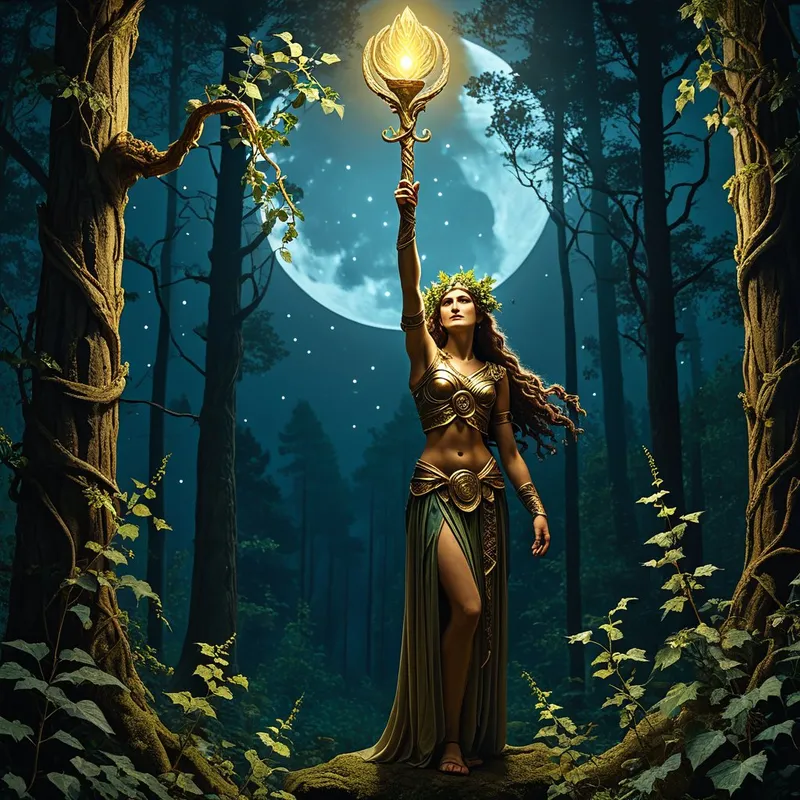
Dionysus's Thyrsus Myth Meaning & Symbolism
The story of the thyrsus, a fennel staff crowned with ivy and pine cone, embodies the god's power to shatter rigid order and unleash primal, transformative ecstasy.
The Tale of Dionysus's Thyrsus
Hear now the tale not of a sword or a shield, but of a staff—a weapon of another kind. In the time when the world was younger and the boundaries between beast and god were thin, the son of Zeus and the mortal Semele walked the earth. He was Dionysus, twice-born, and the air around him hummed with a potent, unsettling magic. The world of men was one of strict order, of measured cups and walled cities, but Dionysus carried the scent of the untamed mountain, the fermenting grape, and the dark, rich soil.
His journey was not a conquest of armies, but a seduction of the soul. Where he walked, the rigid minds of kings and commoners alike began to crack. Women, tired of the loom and the hearth, heard his wild, piping music in the wind and felt a longing they could not name. They left their homes, their names, becoming the Maenads, the "raving ones." But they did not go unarmed. The god provided their tool, their scepter, their proof of divine sanction.
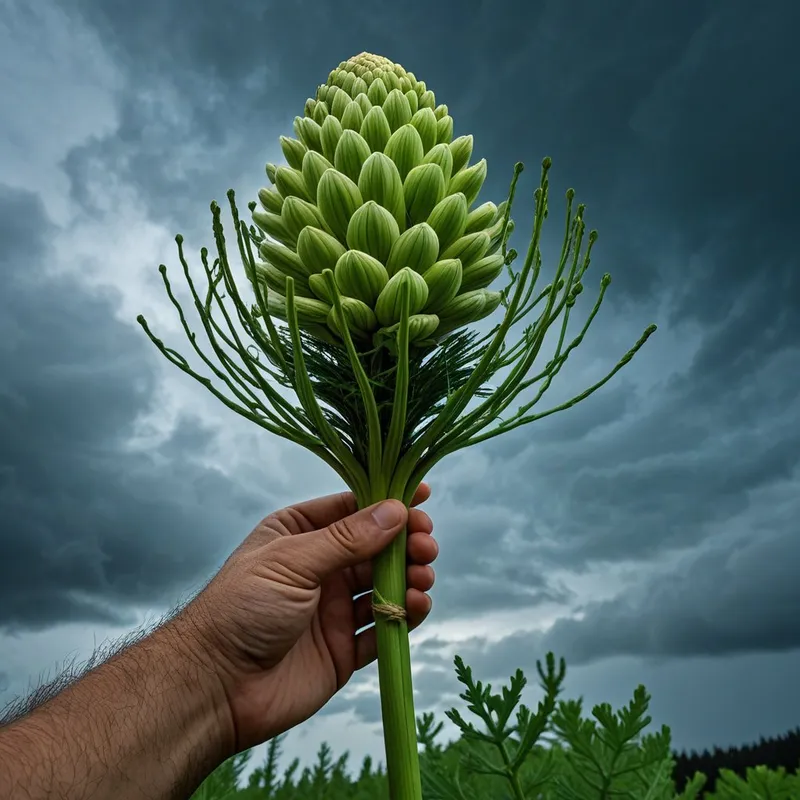
It began with a humble stalk—the giant fennel, narthex, that grows wild on the sun-baked hills. Its stem is hollow, light yet strong. This was the foundation. Into this hollow shaft, the god breathed the spirit of the inextinguishable, the evergreen. Ivy, the plant that binds and consumes, yet remains vital through the dead of winter, coiled itself around the fennel, a living, gripping testament to relentless life.
But the crown, the terrifying and glorious secret, was the pine cone. Plucked from the high, silent pines that touch the realm of the gods, it was fixed upon the tip. This was no mere decoration. In its tight, geometric spiral of scales, it held the promise of a thousand forests, the latent, explosive potential of life itself. Resin, the blood of the tree, sacred and flammable, oozed from its core. This was the Thyrsus.
In the hands of the Maenads, the thyrsus was a paradox. It was a walking staff for their frenzied dances up the mountain paths. It was a weapon that could strike the earth and bring forth streams of wine or milk from solid rock, a magic wand of divine abundance. And when the frenzy peaked, when the civilized self was utterly dissolved in the sparagmos—the sacred, tearing apart—the thyrsus could become a fearsome club. With it, they could rend flesh as easily as they summoned spring water, for the god’s gift encompasses both creation and destruction, the nourishing vine and the devastating blast.
The most profound test came in the land of Thrace, ruled by the arrogant King Lycurgus. He denied the god, imprisoning the Maenads, mocking the thyrsus as a fool’s stick. In his hubris, he believed stone walls and cold steel could contain the force of life. Dionysus, in response, did not summon an army. He simply allowed his presence to expand. Madness, of the divine sort, infected Lycurgus. In a hallucinatory fit, the king mistook his own son for a thick, creeping vine—a manifestation of the very god he scorned. Seizing an axe, Lycurgus struck, committing a horrific filicide. The land itself turned against him; the vineyards withered. The thyrsus had not been wielded in battle, yet its principle—the undeniable, chaotic truth of nature—had destroyed a king more completely than any sword. Order, when it denies the fundamental wildness of being, turns in on itself and devours its own.
Cultural Origins & Context
The myth of the thyrsus is not from a single epic poem but is woven through the fabric of Greek cult practice, theater, and art. It is primarily the artifact of the Mysteries and the popular, decentralized worship of Dionysus. Unlike the state-sanctioned, temple-based worship of Athena or Apollo, the cult of Dionysus was often subversive, practiced in the wilds, by women, foreigners, and the common folk. The thyrsus was their standard.
It was carried in the thiasus, the ecstatic procession, and was central to the City Dionysia festival in Athens, the birthplace of tragedy and comedy. Playwrights like Euripides, in The Bacchae, placed the thyrsus in the hands of the chorus, making it a visible, potent symbol of the forces the tragic hero foolishly attempts to suppress. The myth was passed down not just by bards, but by the participants themselves, in a felt, somatic experience of carrying the staff, dancing with it, and understanding its dual nature through ritual action. Its societal function was profound: it was a sanctioned, temporary release valve for the repressed instincts, emotions, and chaos that the polished, rational, masculine civic order of the polis necessarily excluded. It reminded society that civilization is built upon, and must periodically acknowledge, the raw, creative/destructive soil from which it grows.
Symbolic Architecture
The thyrsus is a perfect symbolic equation of Dionysian power. Each component is an essential operand in a formula of psychic transformation.
The fennel stalk (narthex) represents the hollow vessel, the human self stripped of pretension. It is light, implying mobility and lack of burden, and hollow, suggesting a channel, a readiness to be filled by a force greater than the individual ego. It is the necessary humility before the divine.
The ivy represents binding, connection, and eternal return. It clings, signifying the grip of instinct and the unconscious, which cannot be shaken off. As an evergreen, it symbolizes the aspect of the psyche that never dies, the persistent, often hidden life of the soul that continues beneath the frosts of trauma or repression.
The pine cone is the secret heart of the mystery. In its perfect Fibonacci spiral, it is nature’s own diagram of explosive, generative growth. It is the pineal gland of the earth, the latent fire, the concentrated potential waiting for the spark.
The pine cone is the secret heart of the mystery. In its perfect Fibonacci spiral, it is nature’s own diagram of explosive, generative growth. It is the pineal gland of the earth, the latent fire, the concentrated potential waiting for the spark. Psychologically, it is the seed of divine madness (enthousiasmos—"the god within"), the point where order becomes so complex and dense that it tips into ecstatic chaos and new creation. The resin is the intoxicating, sticky, transformative sap of this process—painful, binding, and illuminating.
Together, they form a map of initiation: the hollow ego (fennel) is gripped by the relentless life of the unconscious (ivy) and is crowned, or penetrated, by the illuminating/ devastating spark of transpersonal awareness (pine cone). The thyrsus says: true power comes not from solidity, but from becoming a conduit.
The Dreamer's Resonance
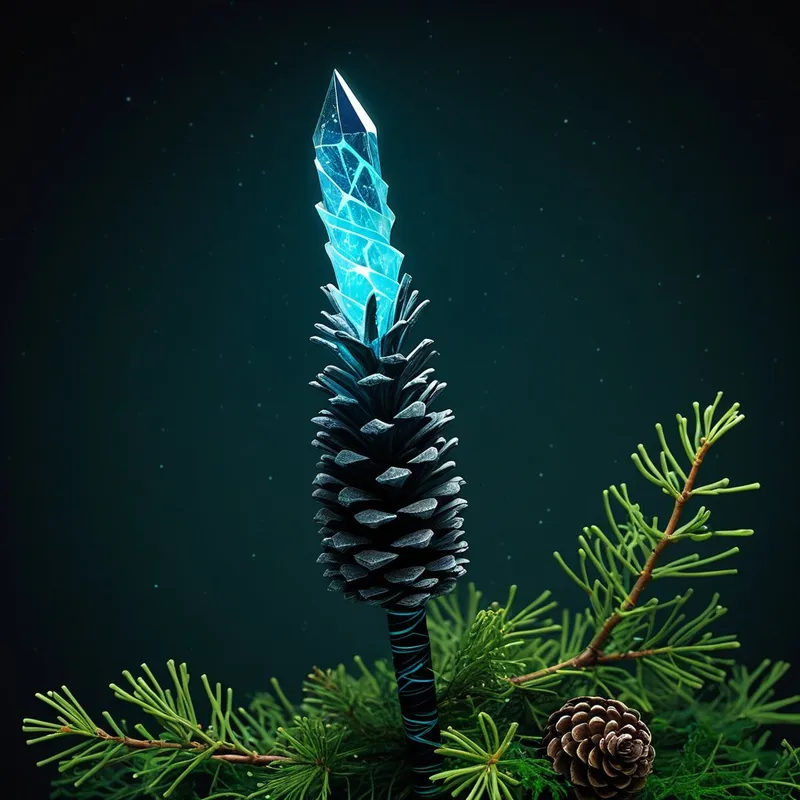
When the thyrsus appears in a modern dream, it rarely manifests as a literal mythological staff. Its pattern emerges more subtly. One might dream of a key that is also a growing plant; a pen that drips honey and blood; a tool at work that suddenly blossoms with impossible flowers; or a rigid, dead tree that is found to be hollow, with a vibrant, pulsating light inside.
Somatically, the dreamer may be experiencing a profound tension between a life that feels too structured, dry, and "hollow" (the fennel) and a rising, almost viscous pressure of unmet instinct or emotion (the ivy's grip). The pine-cone moment is the crisis point—a sudden, irrational insight, a burst of creative mania, a devastating loss, or a spiritual awakening that feels both terrifying and electrifying. The psyche is performing its own sparagmos, tearing apart an old, outworn identity structure (the "King Lycurgus" of the personality) that has refused to acknowledge a deeper, wilder truth. The dream is an announcement: the controlled environment is being invaded by the vineyard. The process is underway, and the dreamer is both the Maenad wielding the staff and the king who fears it.

Alchemical Translation
The alchemical journey mirrored in the thyrsus myth is the solve et coagula—dissolve and coagulate—applied to the psyche. The rigid, leaden ego (the isolated, rational self) must first be solved. This is the hollowing of the fennel, the dissolution performed by the intoxicating wine of Dionysus. It is a necessary breakdown, a loss of one's former solidity and certainty.
The ivy represents the coagula in its binding, formative stage. After dissolution, the unconscious contents surge forth, clinging and connecting in new, often chaotic patterns. This is the period of feeling gripped by moods, compulsions, or inspirations one doesn't fully understand.
The ultimate goal is not to become permanently ecstatic or mad, but to integrate that catalytic, pine-cone energy into the structure of a more complete self—a self that acknowledges its own hollows, its binding vines, and its crown of latent, divine fire.
The pine cone is the Philosopher's Stone of this process. It is the coniunctio oppositorum—the conjunction of opposites—made manifest. It is order (geometric pattern) containing chaos (explosive life); it is wood (earth) containing fire (resin); it is a weapon that brings forth nourishment. For the modern individual seeking individuation, the "thyrsus moment" is when the dissolved and re-coagulating elements of the psyche are suddenly catalyzed by a transcendent insight. This insight feels alien and god-given (the "pine cone" descending from the high, symbolic mountain). It irrevocably changes everything, providing a new, central organizing principle that is not rigid like the old ego, but generative and alive.
The triumph is not in wielding the thyrsus to destroy external enemies, but in allowing it to be planted within one's own psychic landscape. To become thyrsus-bearing is to accept one's role as a vessel for forces both creative and destructive, to make one's own hollow core a channel for a life that is more than personal. The ultimate goal is not to become permanently ecstatic or mad, but to integrate that catalytic, pine-cone energy into the structure of a more complete self—a self that acknowledges its own hollows, its binding vines, and its crown of latent, divine fire.
Associated Symbols
Explore related symbols from the CaleaDream lexicon: