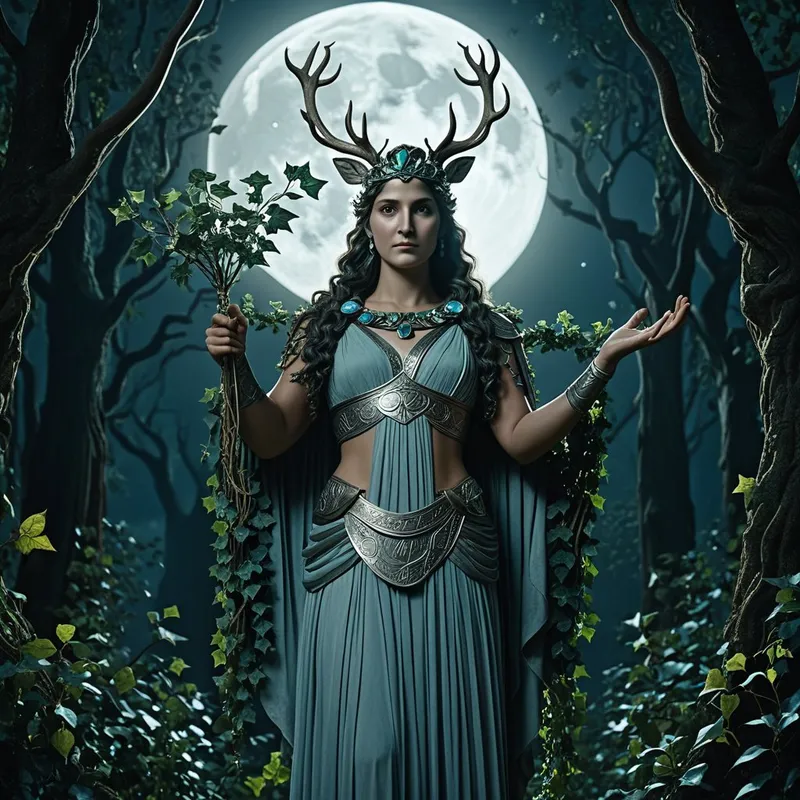
Dionysus & Artemis Myth Meaning & Symbolism
A mythic encounter between the god of ecstatic liberation and the goddess of untamed nature, revealing the tension between wild abandon and sacred order.
The Tale of Dionysus & Artemis
Listen, and hear a tale not of war, but of a quieter, deeper conflict. It unfolds not on the plains of Troy, but in the secret heart of the world, where the mountains breathe and the oldest trees remember.
The forest of Mount Cithaeron was a realm of perfect, silent order. Every leaf knew its place, every stream its course. This was the sacred domain of Artemis. Here, she moved, a silver shadow among the pines, her footsteps silent on the moss, her breath the cool night wind. Her nymphs, reflections of her own fierce purity, danced in glades untouched by mortal hand. The law was simple: the wild was to be honored, not possessed; followed, not broken.
But a new sound began to stir at the forest’s edge. It was the sound of breaking—not of branches, but of boundaries. It was the thrum of drums cut from taut hide, the sharp cry of the aulos, and a laughter that was both joyous and terrifying. This was the procession of Dionysus. He came not as a conqueror with a sword, but as a liberator with a vine-wrapped staff, the thyrsus. His followers, the Maenads, swirled in a frenzy, their hair wild with ivy, their eyes seeing a world unseen. They did not walk the paths; they were the path, a river of raw life flooding into the structured groves.
Artemis, from her high crag, watched. The scent of crushed grapes and sweat clashed with the clean scent of pine and cold stone. The disciplined silence of the hunt was shattered by shrieks of ecstasy. This was not merely noise; it was an ontology of chaos, a challenge to her very essence. Her hand tightened on her bow.
The clash was inevitable, yet it came not as a battle, but as a transgression. A sacred stag, one under Artemis’s protection, startled by the cacophony, bolted through the Maenadic throng. In the swirling madness, a thyrsus fell, not in malice, but in the indiscriminate whirl of the dance, and the creature was struck. It fled, wounded, to the purest spring in Artemis’s deepest grove, its lifeblood dripping into the sacred waters.
There, at the violated spring, the two deities met. Dionysus arrived, his expression not of triumph, but of a deep, unsettling calm, his eyes holding the chaos of the stars being born. Artemis stood before him, a statue of frozen fury, the moon’s light a cold armor on her skin. No words passed between them that mortals could record. It was a confrontation of atmospheres: the structured, sacred wild against the formless, ecstatic wild. The forest itself held its breath.
And then… a resolution woven not from victory, but from recognition. The stag’s blood in the spring did not poison it; instead, the waters seemed to shimmer with a new, ambiguous potency. Artemis did not loose her arrow. Dionysus did not advance his revel. A tense, profound accord was struck, a boundary drawn not as a wall, but as a threshold. The deep woods would remain a place of solitary pursuit and lunar clarity. The slopes and villages would pulse with the god’s liberating frenzy. They became opposites in a necessary balance, two truths of the same untamable world, forever separate, forever entwined.

Cultural Origins & Context
This myth exists in the fragments and echoes of the ancient world, not in a single, canonical text like Homer’s epics. It is found in the scholia (ancient commentaries) on the plays of Euripides, particularly The Bacchae, and in the later compilations of mythographers. This suggests it was a regional tale, perhaps central to the cult practices in Boeotia, where the mountain of Cithaeron was a major site for both the mysteries of Dionysus and the wilderness rites of Artemis.
The storytellers here were likely the priests and initiates themselves, using the narrative to map the spiritual geography of their land. Its societal function was profound: it served as a theodicy, a justification of the gods’ ways. It explained why the worship of these two powerful, seemingly antithetical deities could coexist within the same culture. The myth provided a sacred rationale for zoning the human and natural landscape, delineating where the ecstatic, communal rites of the vineyard were appropriate, and where the austere, individual devotion to the untamed forest must be preserved. It was a story that managed cosmic conflict not through annihilation, but through divine diplomacy, modeling a necessary cultural compromise.
Symbolic Architecture
At its core, this myth is a profound exploration of duality within the realm of the instinctual and untamed. Artemis and Dionysus are not civilization versus nature; they are two contrasting, irreconcilable, yet equally vital modes of nature.
Artemis symbolizes the wild as order. Her wilderness is one of precise laws, clear boundaries, and fierce autonomy. She represents the psyche’s need for containment, purity, and focused purpose. She is the instinct towards individuation through separation, the clarity of the hunter’s eye, the cold, illuminating light of the moon that reveals forms and distinctions. Her sacred space is the temenos, the consecrated precinct where the profane is excluded.
Dionysus, in contrast, symbolizes the wild as chaos. His domain is the dissolution of boundaries—between man and god, human and animal, self and other. He represents the psyche’s need for de-individuation, for merging, for the ecstatic loss of self in the greater current of life. He is the instinct that breaks down rigid structures, liberates repressed energies, and connects us to the chthonic, emotional, and somatic depths. His sacred space is the orgia, the rite of passionate union.
Their conflict, therefore, is the eternal tension within the human soul between structure and flow, between the ego’s need for defined identity (Artemis) and the unconscious’s pressure to overwhelm and renew that identity (Dionysus). The wounded stag is the symbolic casualty of this clash—the natural self, the instinctive life, caught and injured when these two colossal forces meet without integration.
The Dreamer’s Resonance
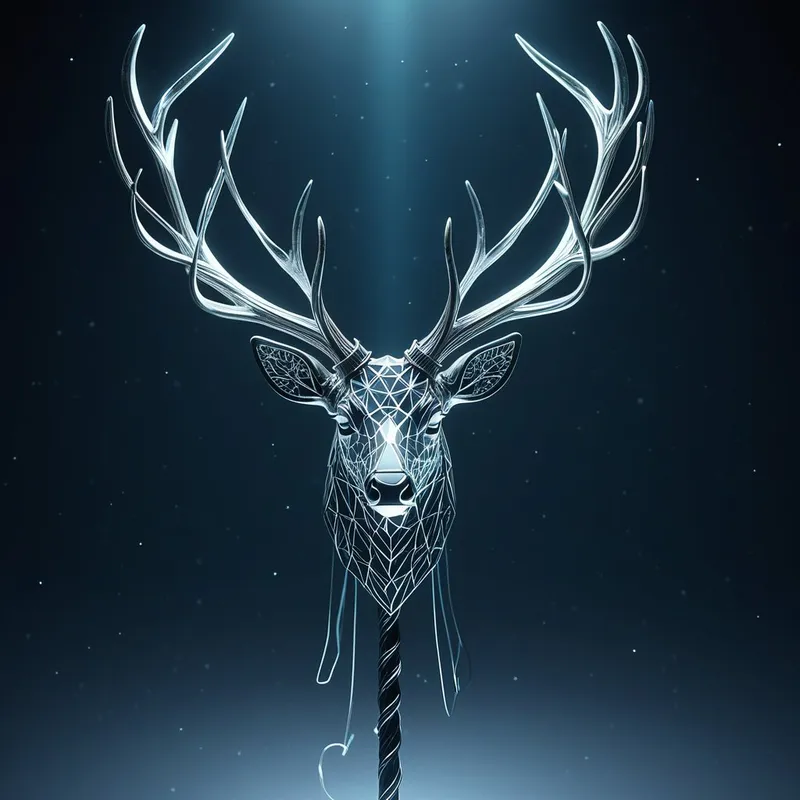
When this mythic pattern stirs in the modern dreamscape, it signals a critical juncture in one’s relationship with instinct and order. To dream of a frenzied, irresistible celebration invading a serene, familiar forest (or home, or mind) speaks to the Dionysian impulse breaking through an overly Artemisian psyche. The dreamer may be experiencing a somatic uprising—anxiety, unexplained passions, or a health crisis—that challenges a life lived with too much control, austerity, or isolation. The body and the unconscious are staging a revel, demanding acknowledgment.
Conversely, dreaming of a stern, armed figure confronting a chaotic, joyful mob points to the Artemisian principle rising in defense. This often occurs when the dreamer feels their core identity, values, or sacred personal space is being threatened by external pressures or by their own unregulated emotions. There is a somatic feeling of being “violated” or “polluted,” a need to retreat, purify, and re-establish boundaries. The dream is the psyche’s attempt to broker a truce between the need for ecstatic connection and the need for inviolate selfhood.
Alchemical Translation
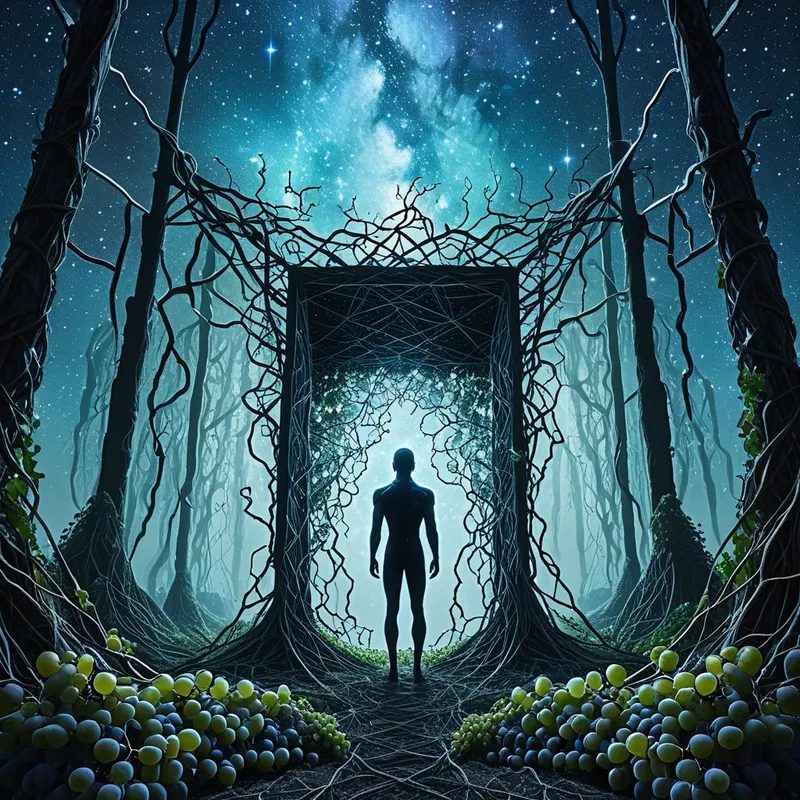
The individuation process, the alchemy of the soul, requires both these gods. One cannot integrate the shadow (the unconscious) through Artemisian distance and analysis alone, nor through Dionysian immersion and identification alone. The myth models the necessary, painful stage of confrontatio.
The initial clash is unavoidable. The conscious attitude (Artemis) must face the erupting contents of the unconscious (Dionysus). This is often experienced as a life crisis, a “wounding of the stag”—a damage to one’s previous, perhaps too-rigid, sense of self and natural order.
The alchemical work lies in the silent accord that follows the confrontation. It is the creation of an inner liminal space, symbolized by the shimmering, blood-touched spring. This is the vas, the sacred vessel where opposites can interact without destroying each other.
The modern individual must become the landscape where both deities have jurisdiction. One learns to cultivate Artemisian spaces within: times of solitude, disciplined practice, and clear intention. Equally, one must consciously and respectfully admit the Dionysian: through creative abandon, communal celebration, and the honest expression of emotion. The goal is not a fusion into a bland middle, but a conscious recognition and rotation between these poles. One honors the sacred spring by not polluting it with frenzy, and honors the frenzy by not constraining it within sterile bounds. In doing so, the individual moves from being a passive site of conflict to becoming the active, conscious steward of their own complete, and wonderfully contradictory, nature.
Associated Symbols
Explore related symbols from the CaleaDream lexicon: