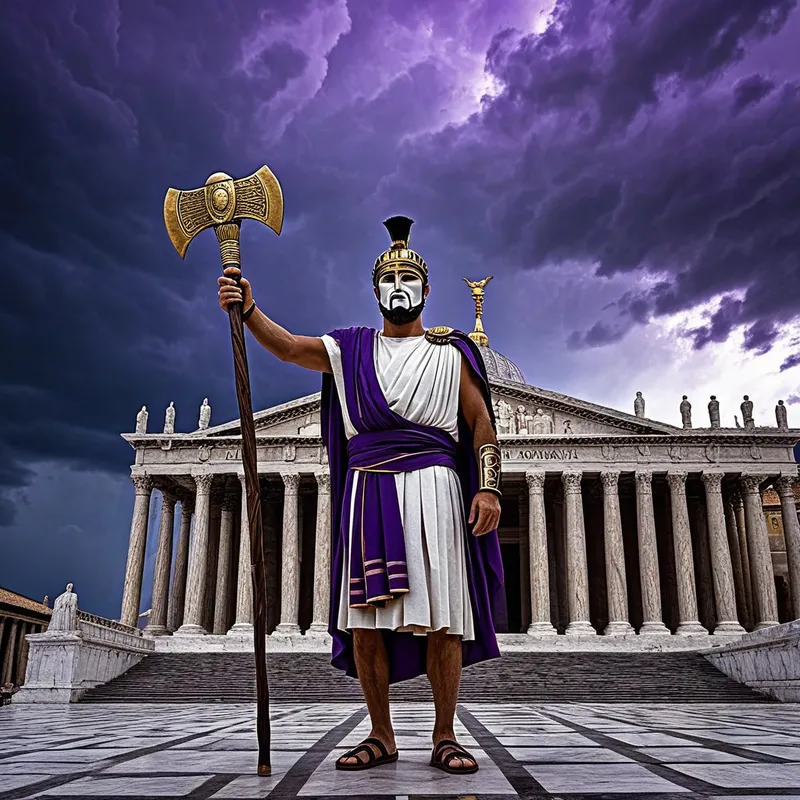
Dictator Myth Meaning & Symbolism
A sacred office of absolute power, granted in crisis and relinquished when the work is done, embodying the paradox of necessary tyranny and sacred surrender.
The Tale of Dictator
Hear now, and listen well. The city trembles. Not from earthquake, but from a terror that walks on two legs. The Aequi are at the gates, their war-horns a blight upon the wind. The Consuls are deadlocked, the Senate a cacophony of fear. The sacred order of Res Publica itself groans under the strain, cracking like winter ice.
In this hour of utter fracture, the old men, the Senators with eyes like flint, do not reach for a sword. They reach for a law older than the city’s walls. They send the lictors, their faces grim, through the choked streets to find a single man. Not a king—the ghosts of kings still haunt the Septimontium—but a Dictator.
They find him. Perhaps it is Lucius Quinctius Cincinnatus, his hands calloused from the plough, the smell of turned earth still upon him. The lictors approach, bearing the awful symbols: the fasces, the rods and the axe, now unbound for him alone. The message is simple, terrifying: “The Senate and the People of Rome command you to come.”
He does not hesitate. He wipes the soil from his hands, a gesture of profound farewell. He kisses his wife, his gaze holding a sorrow she cannot name. He follows the lictors to the city, where the Senate, in solemn silence, invests him with imperium maius—the greater command. The power of life and death. The authority to muster legions, to spend the treasury, to break any law to save the law itself. For six months, he is the embodied will of Rome. He is the single eye in the storm, the unblinking focus of a people’s fate.
He marches. He fights. The battle is a blur of mud, iron, and screaming. He is not a god, but for those six months, his word is divine. He wins. The enemy is broken, the city saved. The crisis passes like a fever.
And then… he does the unthinkable. He lays down the fasces. He surrenders the absolute power that could make him a god-king. He returns to the Senate, gives his report, and without ceremony, walks out of the gates. He goes back to his small farm, to his waiting plough. He picks up the handles, his fingers finding their familiar grooves in the wood, and he pushes the blade back into the same earth he left. The office of Dictator dissolves like mist in morning sun, leaving only the restored Republic, breathing again.

Cultural Origins & Context
This is not a myth of the distant, god-haunted past, but a foundational political and ethical legend of the Roman Republic. The figure of the Dictator was a constitutional office, an emergency mechanism written into the very fabric of the mos maiorum. It was invoked only in times of tumultus—extreme military peril or civil collapse—when the slow, deliberative machinery of the consuls and Senate was a fatal luxury.
The tales of early Dictators like Cincinnatus were not mere stories; they were civic parables, repeated by senators to their sons, by historians like Livy to their audiences. They served a critical societal function: to illustrate the ideal of absolute power wielded not for personal gain, but as a sacred, temporary trust. It was a cultural bulwark against tyranny, a living reminder that authority’s highest purpose was its own surrender for the good of the whole. The myth was the psychic container for Rome’s deepest anxiety and its highest aspiration: the fear of chaos and the dream of perfect, self-limiting order.
Symbolic Architecture
The myth of the Dictator is a masterclass in the symbolism of concentrated consciousness. The Dictator is not a person, but an office, an archetypal role that a mortal steps into. He represents the ego forced to become absolute, to integrate the shadow of its own potential tyranny for a higher purpose.
The fasces is the ultimate symbol of bound power: individually, the rods are weak; bound together, they are unbreakable. The axe within is the lethal potential that must be contained, yet ever-present.
The call from the plough is the call of the Self, the greater totality of the psyche, to the conscious ego. It says: your personal life, your comfort, your individual journey must be suspended. A greater pattern—the survival of the psychic whole—demands you now become its sole, unwavering agent. The six-month term is the symbol of necessary limitation; even absolute power must have an expiration, lest it fossilize and become a demonic complex. The return to the plough is the most profound symbol of all: the reintegration of the transcendent ego back into the humble, cyclical, nourishing life of the earth. It is the completion of the circuit. Power is not kept; it is a loan from the soul, to be repaid in full.
The Dreamer's Resonance
When this myth stirs in the modern dreamer, it rarely appears in togas and senates. It manifests as dreams of being suddenly, overwhelmingly promoted to a position of terrifying responsibility with no training. Dreams of being handed the "keys to the kingdom" at work, in a family crisis, or in a social group. The somatic feeling is one of immense weight—a crushing pressure on the shoulders, a feeling of being watched by countless eyes.
Psychologically, this is the psyche’s declaration of a state of emergency. A complex has run rampant (the invading "Aequi" of anxiety, addiction, or conflict), and the usual diplomatic councils of the mind (rationalization, compromise, avoidance) have failed. The dreaming culture.") ego is being nominated as Dictator. This is a call to conscious, perhaps even authoritarian, action within one’s own psyche. It is permission to make ruthless decisions for the sake of inner stability: to cut off toxic influences, to enforce personal boundaries, to focus all energy on a single, healing goal. The anxiety in the dream is the fear of this power—the fear that if you take it, you will become a tyrant and never give it up.
Alchemical Translation
The alchemical journey of the Dictator myth is the opus of Solve et Coagula—dissolve and coagulate—applied to the structure of the self. The ordinary, dispersed state of consciousness (the Republic) is dissolved by crisis. In the alchemical vessel of extreme pressure, all elements are broken down. From this chaos, the alchemist must coax a "single thing," the unum necessarium: the focused will of the Dictator.
This is the creation of the Philosopher’s Stone of the personality: a consciousness capable of absolute integrity and purpose, but only for a defined, transformative period.
The triumph is not in the battle, but in the surrender. The final, crucial stage of the work is the rubedo, the reddening, where the achieved stone must be returned to the earth to give it life. The Dictator who clings to his fasces turns the gold back to lead; he becomes a stagnant, inflated complex, a Julius Caesar betraying the archetype. The one who returns to his plough performs the ultimate alchemy: he transmutes raw power into grounded wisdom. He demonstrates that the highest strength is the strength to limit oneself, that true authority serves a order greater than itself. For the modern individual, this myth maps the path through necessary ego-inflation—the "I must take complete control"—back to a humble, renewed participation in the simple, sacred rhythms of being. The power was never yours to keep; it was yours to wield, so that you could learn to lay it down.
Associated Symbols
Explore related symbols from the CaleaDream lexicon: