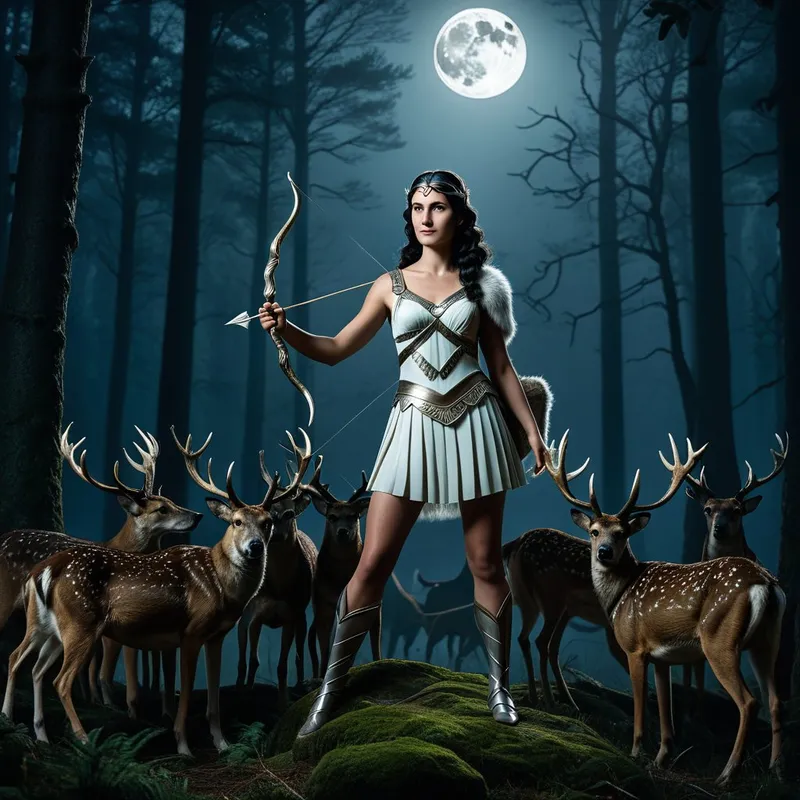
Diana/Artemis Myth Meaning & Symbolism
The story of the goddess who rules the untamed woods and silver moon, protector of thresholds and the fierce, autonomous self.
The Tale of Diana/Artemis
Hear now the tale that whispers on the wind through the deepest groves, where the oak’s roots drink from secret springs. It is not a story of palaces, but of the spaces between—the shadowed glade, the silvered path on dark water, the silent flight of the owl. This is the domain of Diana, she who was called Artemis by those across the sea.
Before the first stone of Rome was laid, she claimed her sovereignty. A child of Jupiter and Latona, she emerged from the womb first and, with a divine infant’s ancient knowledge, became midwife to her own twin brother, Apollo. But while he sought the lyre and the sun-chariot, she turned her face from the polished halls of Olympus. She went to her father, amidst the cosmic forge of creation, and made her demands not as a plea, but as a declaration: a bow and arrows as fine as her brother’s; the freedom to roam the untamed mountains and forests; a short tunic for the chase; sixty Oceanids as her choir; and twenty river nymphs as her handmaidens. And above all, she asked for eternal virginity—not a lack, but a potent, self-contained wholeness. Jupiter, amused and awed, granted it all.
Thus, she became the lady of the wild things. Her footsteps were silent on the pine needles, her form glimpsed only as a flash of movement between the trees. Her arrows flew true, bringing swift death to prey and swift justice to those who violated her sacred spaces. Her nymphs danced in moonlit rings, and the very air of her groves hummed with a sacred, dangerous purity. She was the protector of young women, of childbirth, and of all creatures in the vulnerable, liminal state of becoming.
But the world of men, with its hunger and its carelessness, ever seeks to penetrate such sanctuaries. The most telling clash came not with a monster, but with a mortal gaze. The hunter Actaeon, wandering far with his hounds, stumbled upon a hidden vale where a crystal pool lay like a jewel in the rock. There, in the dappled light, Diana and her nymphs bathed, their laughter the only sound. Actaeon froze, a trespasser in a vision not meant for him. The goddess sensed his presence—not with shame, but with a volcanic rage at the violation of her boundary. Before he could utter a word or flee, she flicked water from her hand. “Go now,” she whispered, her voice the crack of ice, “and tell, if you can, of what you have seen.”
The water struck him, and a searing transformation began. Antlers burst from his brow, his neck elongated, his hands became hooves. He was a stag, his own human mind trapped within the beast’s form. Terror seized him, and he fled crashing through the very woods he once hunted. His own hounds, catching the scent of prey, gave chase with joyous, familiar barks. He tried to cry out “It is I, your master!” but only a stag’s bleat emerged. They closed in, their teeth finding the flesh they had so often been praised for bringing down. The last thing Actaeon knew was the hot breath of his most loyal companions, and the distant, cold gaze of the goddess from a rocky outcrop, her bow untouched. The sanctum had been defended. The law of the wild had been upheld.

Cultural Origins & Context
The figure of Diana entered the Roman religious landscape not as a foreign import, but as a deeply indigenous spirit of the wild, later syncretized with the Greek Artemis. She was originally a goddess of the wooded countryside, a protector of the margins and the pomerium between civilization and wilderness. Her most ancient and revered sanctuary was at Lake Nemi, the Speculum Dianae (Diana’s Mirror). Here, in the nemus (sacred grove), a unique and savage rite held sway: the priesthood was held by a runaway slave who became Rex Nemorensis (the King of the Grove) by plucking a golden bough from a sacred tree and then slaying his predecessor in single combat. This ritual, echoing Diana’s domain over life, death, and sovereignty, points to her role as a goddess of terrifying, cyclical power beyond the ordered Roman state religion.
Her myths were not codified in a single text like the Bible, but lived in the oral traditions, the rituals at her groves, and later in the poetic works of authors like Ovid. Her primary societal function was as a liminal deity. She presided over the transitions of women (puberty, childbirth), the success of the hunt (a vital food source), and the health of the wild spaces upon which rural life depended. She represented a necessary, untamed force that Rome needed to acknowledge and propitiate, a reminder that human order was a clearing in a much older, much wilder forest.
Symbolic Architecture
Diana/Artemis is not merely a goddess of nature, but the archetypal embodiment of autonomous, self-defined feminine power. Her virginity is the ultimate symbol of this.
It is not an absence of experience, but a presence of self-containment. It represents a psyche that is whole unto itself, not defined by relationship to another, but in sacred relationship to its own purpose and domain.
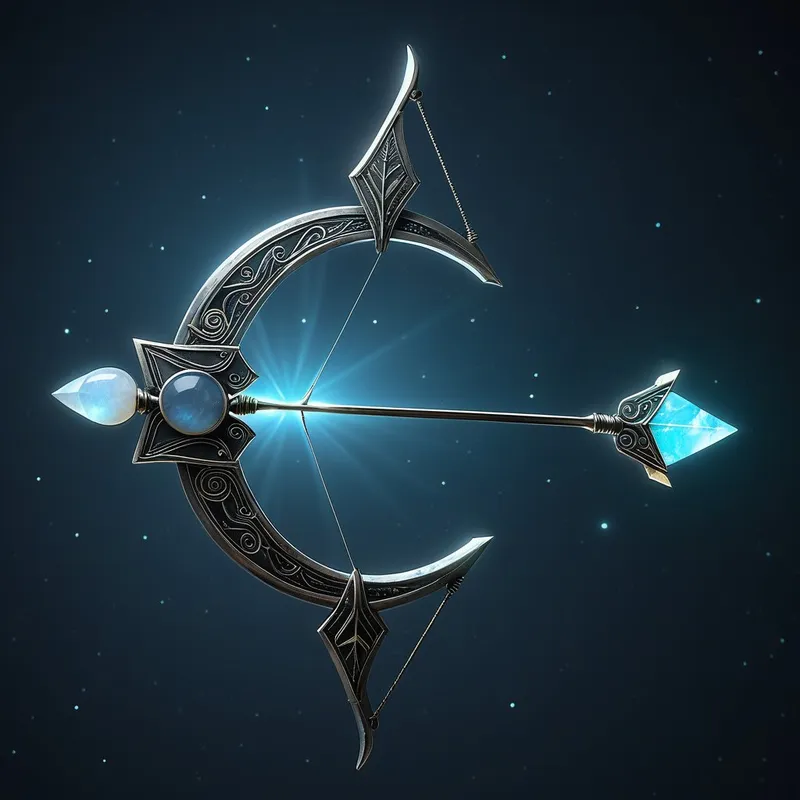
The bow and arrow symbolize focused intention, discernment, and the ability to act decisively from a center of calm precision. She does not fight with a sword (a weapon of chaotic clash) but with a projectile that strikes from a distance, representing clarity of vision and the enforcement of boundaries. The crescent moon diadem connects her to the cyclical, intuitive, and reflective powers of the unconscious, the light that governs the dark.
The myth of Actaeon is a masterful depiction of psychological law. The sacred grove and pool represent the inviolable core of the self, the inner sanctum of soul and spirit. Actaeon represents the unprepared, voyeuristic consciousness that stumbles into this depth without reverence or invitation—the ego seeking to possess or witness what it does not understand. The transformation into a stag and death by his own hounds is the inevitable consequence: the dissolution of the conscious personality (Actaeon) when it is overwhelmed by its own instinctual, unconscious forces (the hounds) it can no longer control or even recognize as part of itself.
The Dreamer's Resonance
When the pattern of Diana/Artemis stirs in modern dreams, it signals a profound process of boundary-setting and reclamation of autonomy. Dreaming of a dense, moonlit forest often accompanies a felt need for psychological space and a return to one’s own natural rhythm, away from the demands of collective or relational life. A dream of being a skilled hunter or archer can point to the development of sharp discernment—the ability to identify and “target” what one truly needs or what is toxic in one’s environment.
The most potent resonance comes with dreams of being seen or seeing. To dream of bathing in a secluded, beautiful place and suddenly feeling observed speaks to a violation of personal privacy or the exposure of a vulnerable, intimate part of the self. Conversely, to dream in the role of Diana, feeling a righteous, cold fury at an intrusion, marks the awakening of the inner protector. This is not petty anger, but the somatic and psychic activation of a deep, archetypal defense mechanism for the soul’s sovereignty. The dreamer may awaken with a visceral sense of clarity about a relationship or situation that requires a firm, non-negotiable boundary.

Alchemical Translation
The alchemical journey modeled by Diana is one of separatio and individuatio—the conscious separation from external definitions to achieve self-definition. In the psychic opus, she represents the stage where the individual must retreat to their own “sacred grove” to differentiate from the collective, from familial expectations, or from anima/animus projections.
The process is not about becoming isolated, but about becoming intact. It is the forging of the silver bow of will from the ore of one’s own unique nature.
The confrontation with the “Actaeon” within—the part of ourselves that seeks to spy on, judge, or violate our own depths out of curiosity or fear—is essential. This might manifest as self-sabotage, critical inner voices, or the temptation to betray one’s values for external approval. The goddess’s transformative rage, when internalized, becomes the potent energy of self-containment. It turns the trespassing energy back upon itself, forcing a metamorphosis. The ego (Actaeon) must be dissolved and reconstituted in service to the greater Self (the sanctum).
Ultimately, the alchemy of Diana is the achievement of a conscious virginity of spirit. It is to stand, like the moon, complete in one’s own cyclical light, governing the wilderness of one’s interior with compassion for its creatures and fierce protection of its mysteries. She offers not a path of relationship to the other, but the prior and necessary path of sacred relationship to the self, from which all other true relationships can then flow.
Associated Symbols
Explore related symbols from the CaleaDream lexicon: