
Dian Cécht Myth Meaning & Symbolism
The myth of the divine physician Dian Cécht, whose healing prowess is shadowed by jealousy, leading to a fateful act against his own kin.
The Tale of Dian Cécht
Hear now the tale of the Silver Arm, a story not of glorious battle, but of the deeper war waged in the heart of the healer.
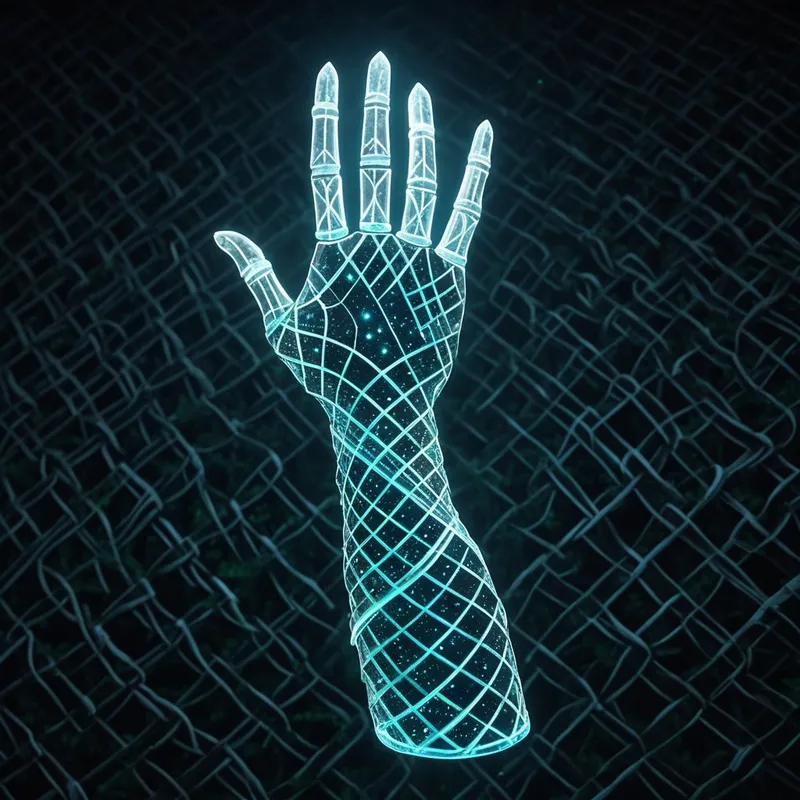
In the time of the Tuatha Dé Danann, when the world was raw with magic, there lived Dian Cécht, the master of leechcraft. His hands knew the song of sinew and bone; his breath could cool fever, his voice could knit flesh. He was the pillar of the people, the one who stood between life and the cold embrace of the Sídhe. When the great king Nuada lost his arm in the First Battle of Mag Tuired, it was Dian Cécht who acted. Not with pity, but with swift, cunning artistry. He fashioned an arm of silver, perfect and mobile, a wonder that allowed Nuada to rule again. The people marveled. The healer’s fame was sealed in mithril.
But the seeds of shadow are often sown in the soil of great skill. Dian Cécht had children: his daughter, Airmed, who collected the whispers of herbs, and his son, Miach, in whose quiet eyes the deeper mysteries of life shimmered.
When Nuada’s silver limb, for all its craft, was seen as a blemish barring him from kingship, the call for healing came again. Dian Cécht approached with his proven arts. But Miach stepped forward. He did not speak of replacement, but of regeneration. He placed his hands upon the king’s shoulder, and sang a chant so potent it was a genesis in reverse: flesh to flesh, bone to bone, sinew to sinew. In three days and three nights, a new arm of warm, living flesh grew from the king’s stump. The court gasped. It was not a marvel of craft, but a miracle of life itself.
A cold fire ignited in Dian Cécht’s breast. The praise that once was his now flowed to his son. The healer, the caregiver, felt the venom of obsolescence. In the green cloak of jealousy, he confronted Miach. Words turned to blows. With a physician’s cruel precision, but a wounded father’s rage, Dian Cécht struck his son upon the head. Once, twice, thrice. With the fourth blow, he broke the skull, and the light in Miach’s eyes—the light that understood the song of cellular rebirth—guttered and died.
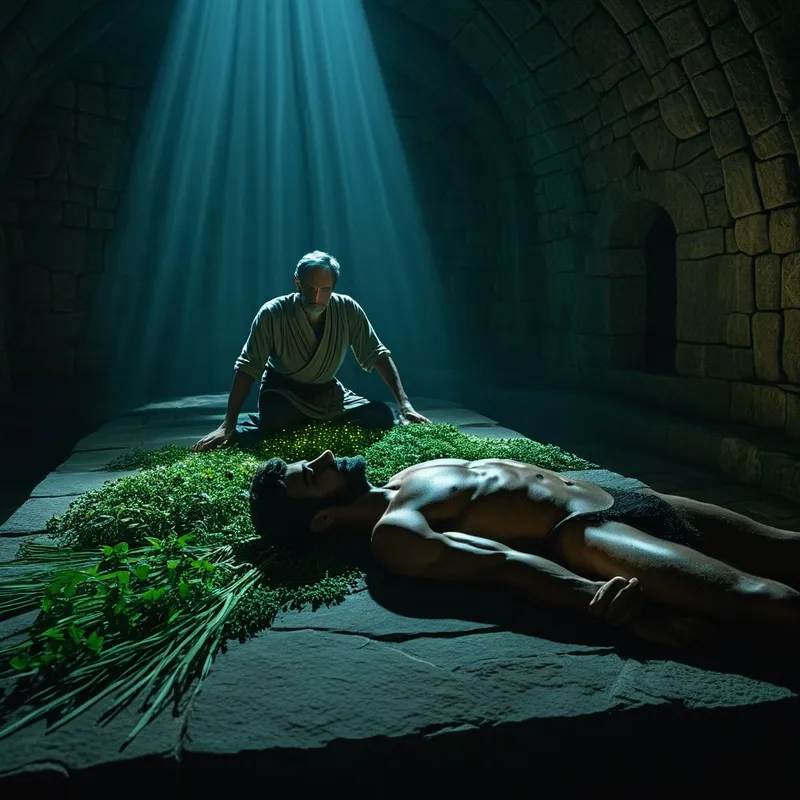
Upon Miach’s grave, from the richness of his sacrificed wisdom, 365 herbs sprang forth, one for every joint and sinew of the human body. Airmed, in her grief, spread her cloak and began to gather them, to order their secrets. Seeing this, Dian Cécht came one last time. He scattered the herbs to the four winds, so that no mortal or god would ever again possess the complete knowledge his son had embodied. The ultimate healing was lost, fragmented, scattered like seeds on the wind, and the healer was left alone with his silver art and his leaden heart.
Cultural Origins & Context
This poignant myth comes to us from the medieval Irish text, the Lebor Gabála Érenn, and is elaborated in the Cycle of the Kings. It is a story preserved by Christian scribes, yet its bones are older, echoing a pre-Christian fili’s tale. In a society where skill (dán) defined one’s place, the myth explores the terrifying vulnerability of that identity. Dian Cécht is not a remote Olympian; he is a professional, a craftsman-god whose worth is his utility. The story served as a profound commentary on the hierarchies of skill, the tension between innovation and tradition, and the sacred, almost dangerous power of the healer’s art. It warned of the poison that can fester when the caregiver’s identity becomes more important than the care itself.
Symbolic Architecture
At its core, the myth presents healing not as a purely benevolent force, but as a complex archetypal power shadowed by its own paradoxes. Dian Cécht represents the technē of healing—the brilliant, external fix. The silver arm is a symbol of prosthetic genius, the ego’s attempt to restore wholeness through artifice and control. It is functional, but it lacks soul.
Miach represents the physis of healing—the internal, unconscious, life-giving force of nature itself. His is the archetype of the Wounded Healer in its purest form, where the remedy emerges organically from the site of the wound.
The fatal conflict, therefore, is between the conscious skill of the ego (Dian Cécht) and the unconscious, transformative wisdom of the Self (Miach). The father’s jealousy is the ego’s violent rejection of a deeper, more authentic power that threatens to render its careful constructions obsolete. The scattering of the herbs is the ultimate tragedy: the fragmentation of wholeness. It symbolizes how total, holistic knowledge—of ourselves, of healing—is lost to consciousness, scattered into the collective unconscious (the four winds). We are left to gather fragments, to piece together understanding from the dispersed clues left in dreams, symptoms, and intuitions.
The Dreamer's Resonance
When this myth stirs in the modern psyche, it often manifests in dreams of conflicted healing or creative sabotage. You may dream of a brilliant doctor who secretly resents their patient’s recovery, or of a mentor figure who destroys your project. Somaticly, this can coincide with a period where a long-held identity—the “fixer,” the “strong one,” the “expert”—is being challenged by the emergence of a more authentic, perhaps vulnerable, way of being.
The dreamer is experiencing the “Miach moment”: a nascent, organic healing or new skill is rising from within, threatening the old, silver-arm structures of the personality. The jealous, critical inner voice (the Dian Cécht complex) attacks this new growth. To dream this is to feel the painful but necessary death of an outdated self-image that was built on competence alone, making way for a wholeness that includes vulnerability and innate, un-engineered wisdom.

Alchemical Translation
The alchemical journey modeled here is the transmutation of the Caregiver archetype from its shadow to its enlightened state. The base metal is Dian Cécht’s initial condition: healing as a source of pride, identity, and power. The nigredo, the blackening, is the eruption of jealous rage—the realization that one’s cherished skill is not the source of life, but only its steward.
The killing of Miach is the necessary, if brutal, mortificatio—the death of the illusion that we are the sole authors of our healing or our gifts. We must witness the murder of the idea that our crafted persona is our true self.
The 365 herbs sprouting from the grave represent the albedo, the whitening: the revelation that true, holistic knowledge is born from the corpse of the old ego. It is not invented, but discovered, growing from the fertile ground of our wounds and failures. The final stage, the rubedo or reddening, is not achieved in the myth, but is implied in the task it leaves us: the lifelong work of individuation. We are Airmed, gathering the scattered herbs. Our work is to recollect the fragments of our lost wholeness—through therapy, art, relationship, and introspection—slowly reassembling the cloak of complete knowing. We integrate the silver arm’s skill with the memory of the living flesh, becoming healers of ourselves not through perfect technique alone, but through humble, ongoing re-membering.
Associated Symbols
Explore related symbols from the CaleaDream lexicon: