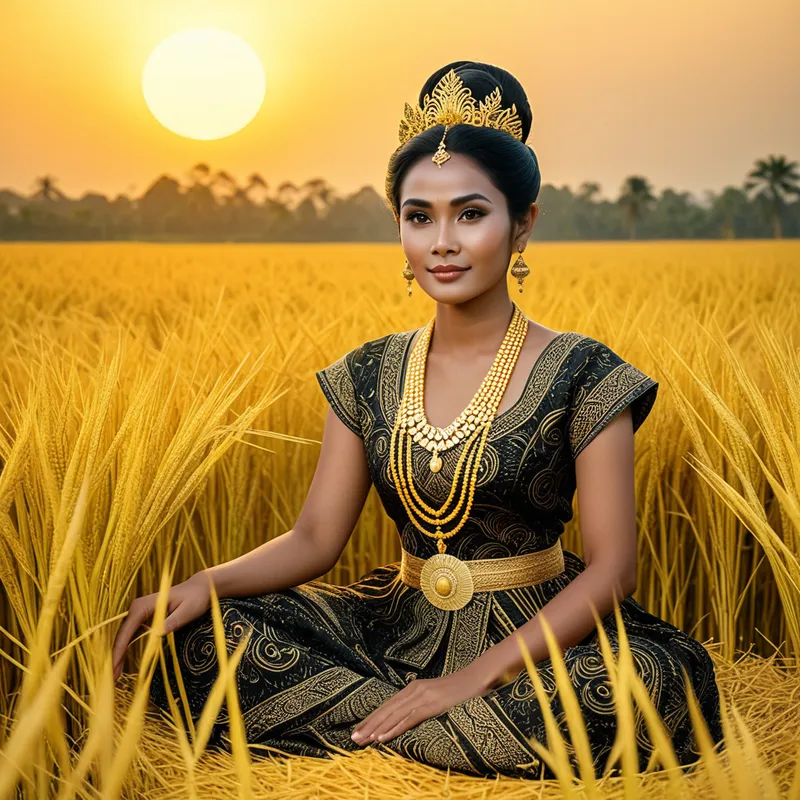
Dewi Sri Myth Meaning & Symbolism
The myth of Dewi Sri tells of a goddess born from divine union, murdered by jealousy, and transformed into life-giving rice, embodying sacred sacrifice and fertility.
The Tale of Dewi Sri
Listen. In the time before time, when the world was still soft and the gods walked close to the earth, there was a longing in the heart of Batara Guru. His kingdom in the heavens, Suralaya, was perfect, yet it lacked a certain essence—a warmth, a tenderness that only a consort could bring. From the depths of his divine solitude, he summoned his most powerful essence and cast it into the great void. From this act of profound desire, a being of impossible beauty and grace was formed: a goddess named Dewi Uma.
She was his perfect match, and for a time, Suralaya was a paradise of union. But the gaze of a god is a consuming fire. In a moment of possessive passion, Batara Guru’s gaze fell upon Dewi Uma with such intensity that she could not bear its weight. Shamed and transformed, she fled from the heavens, descending to the mortal realm where she took a new name and a new form: Dewi Durga, a terrifying specter dwelling in the graveyards and wild places.
Yet, the story does not end in wrath. From this fractured union, a new hope was born. Batara Guru, in his remorse and longing, sent a messenger, the god Batara Narada, to seek her. Their reconciliation was not a return to the old, but a transformation into something new and fertile. From their renewed, sacred union, two children were born: a son, Batara Brama, and a daughter of such radiant benevolence that the very air softened around her. She was named Dewi Sri.
But a shadow grew alongside this light. Batara Brama, the brother, was consumed by a dark, possessive love for his sister. When his desires were refused, jealousy curdled into murderous intent. In a act of terrible betrayal, he took the life of the gentle Dewi Sri. The world held its breath. The gods wept. Her body was buried in the dark, forgiving earth, a sacred sacrifice.
Then, a miracle. From the place where her body lay, the earth did not yield decay, but life. Lush, green shoots pierced the soil, reaching for the sun. They grew tall and heavy with grain—the first rice. From her flesh came sustenance; from her sacrifice, the survival of a people. Batara Brama, in a final twist of fate and perhaps penance, was transformed into a creature of utility and burden—the first kerbau. And so, life emerged from death, order from chaos, and nourishment from sacrifice. The goddess became the grain, and the grain became the goddess, in an eternal, sacred cycle.

Cultural Origins & Context
The myth of Dewi Sri is not merely a story; it is the living, breathing soul of agrarian life across Java, Bali, and other islands of the archipelago. Its origins are ancient, predating the major world religions that later arrived on the islands, rooted in the indigenous Kejawen and Hindu-Balinese traditions. She is the preeminent danhyang of the rice field.
The myth was, and in many places still is, passed down not through written texts first, but through oral tradition—by village elders, by dalangs during wayang kulit performances, and woven into the rituals of the agricultural calendar. Her story is recited at key moments: before planting, to bless the seeds; during the growth of the crop, to ensure protection; and most importantly, during harvest, to thank her for her gift. Small shrines (pelinggih) dedicated to Dewi Sri are common in rice fields, and the first cut of rice is treated with the reverence due to the goddess herself, often fashioned into a ritual effigy called the mbok Sri.
Societally, the myth functions as a sacred contract and a cosmological map. It explains the origin of humanity’s staple food, sanctifies the hard labor of farming, and encodes essential values of respect for nature, the necessity of sacrifice, and the profound interdependence of life and death. It places human existence within a divine cycle, where eating is a holy communion with the goddess.
Symbolic Architecture
At its heart, the myth of Dewi Sri is a profound allegory of the alchemy of life itself. It maps the transformation of raw, chaotic potential into nurtured, sustaining order.
The most sacred sustenance is born not from simple growth, but from a willing descent into the dark earth—a sacrifice that transmutes the individual body into a collective body.
Dewi Sri represents the archetypal principle of the Life-Giving Mother, but with a crucial, somber dimension: she is the Sacrificed Mother. Her death is not a tragedy in the mundane sense, but a necessary cosmological event. The brother, Batara Brama, symbolizes the shadow side of desire—possessiveness, jealousy, and unchecked impulse that leads to destruction. Yet, this very destruction becomes the catalyst for a greater creation. He is transformed into the kerbau, the beast of burden that tills the soil, representing the channeling of raw, destructive power into disciplined, productive labor.
The rice plant, emerging from her body, is the ultimate symbol of this transmutation. It represents the idea that true abundance, true nourishment, requires a dissolution of the isolated self. The grain must "die" as a seed to become a plant, and the plant must be "killed" at harvest to become food. Dewi Sri’s myth sanctifies this entire cycle, making it a divine rather than merely a biological process.
The Dreamer's Resonance
When this myth stirs in the modern psyche, it often surfaces in dreams of profound nurturing shadowed by loss, or in images of fertile growth emerging from places of decay. To dream of a nurturing feminine figure who then vanishes or transforms into a landscape (a field, a garden) speaks directly to the Dewi Sri pattern.
The dreamer undergoing this process is often at a point of psychic sacrifice. It may feel like a part of them—a cherished identity, a long-held ambition, a comfortable relationship—must "die" or be surrendered. This is not a violent death, but one of willing offering, though it may be precipitated by a "betrayal" (a job loss, a failed project, a rejection) that feels like Batara Brama’s blow. The somatic sensation can be one of deep heaviness, of being buried or planted. The psychological process is the incubation within the dark earth of the unconscious.
The dream asks: What are you being called to offer up for a greater yield? What personal desire must be composted to feed a more communal, nourishing outcome? The emergence of green shoots in a dream, especially from a wound or a grave, is a powerful sign that this alchemical process is underway, promising that sustenance will come from the surrender.
Alchemical Translation
For the modern individual navigating the path of individuation, Dewi Sri’s myth models the stage where one moves beyond egoic possession to become a source of nourishment for one’s own world. The "Batara Guru" phase is the initial, often possessive, identification with a spiritual ideal or a perfect self-image. The "Dewi Durga" phase is the inevitable shadow eruption—the repressed, wild, and "ugly" aspects that force us out of the celestial fantasy and into the gritty reality of our own psychological underworld.
Individuation is not about remaining a pristine seed, but about consenting to be broken open by life, so that what grows feeds more than just the self.
The reconciliation is the acceptance of this shadow (Durga) as part of the whole self. From this integrated union, the "Dewi Sri" potential is born: a capacity for gentle, abundant creativity. But the final, crucial alchemical act is the sacrifice. The ego (the isolated, beautiful "goddess-self") must be offered up. The brother-shadow (Brama), representing our latent, destructive potentials like rage or envy, must be confronted and its energy harnessed—transmuted into the disciplined "kerbau" that plows the field of daily life.
The resulting "rice" is the tangible fruit of the individuated personality: creative works, deep relationships, mindful leadership, or simple, sustained presence that genuinely nourishes the community around us. One no longer just consumes life; one becomes sustenance. The cycle is complete when we understand that we are both the sacrificer and the sacrificed, the eater and the eaten, participating consciously in the eternal dance of decay and rebirth.
Associated Symbols
Explore related symbols from the CaleaDream lexicon:
- Earth — The womb and the tomb, the receptive element that receives the sacrifice of Dewi Sri and transforms it into sustaining life, representing the unconscious and the body.
- Seed — The encapsulated potential for life, synonymous with Dewi Sri herself before her transformation, representing the dormant Self awaiting the sacrifice necessary for its manifestation.
- Sacrifice — The core action of the myth; the voluntary or forced offering of the individual form for the creation of a greater, nourishing whole.
- Death — Not an end, but the essential transformative phase in the cycle, the dissolution of form that makes new growth and nourishment possible.
- Rebirth — The emergence of the rice from the goddess's body, symbolizing the new life, structure, and sustenance that is born only through a prior dissolution.
- Mother — Dewi Sri as the archetypal nurturing and life-giving principle, who provides not from endless reserve but from her own embodied transformation.
- Goddess — The divine feminine personified as a force of fertility, sovereignty, and cyclical transformation within the natural and human world.
- Grain — The tangible result of the alchemical process; the concentrated essence of life and nourishment born from sacrifice, representing the fruit of psychological work.
- Harvest — The culmination of the cycle, the gathering of the nourishing yield that is treated with ritual reverence, symbolizing reaping the benefits of a completed transformation.
- Water — The essential companion to the earth and the rice, representing the flow of emotion, intuition, and life force that irrigates the process of growth after the sacrifice.