
Dew as Elixir Myth Meaning & Symbolism
A universal myth of a celestial elixir, born from the union of heaven and earth, that grants renewal, wisdom, and the bittersweet gift of mortality.
The Tale of Dew as Elixir
Listen, and let the veil between worlds grow thin. Before the first name was spoken, when the sky was a breath away from the earth, there existed a longing. The heavens, vast and cold with eternal fire, gazed upon the clay of the world, heavy with sleep and potential. From this silent gaze, a sigh was born—a condensation of celestial desire upon the terrestrial brow. This was the first dew.
But it was fleeting, vanishing with the sun’s first glance. The world remained locked in cycles of thirst. Then came Aurora, she who walks the razor’s edge between night and day. She witnessed the suffering—the cracked earth, the parched throat of life, the weary soul of mortality that knew only decay. Her heart, a vessel of compassion, stirred with a divine unrest.
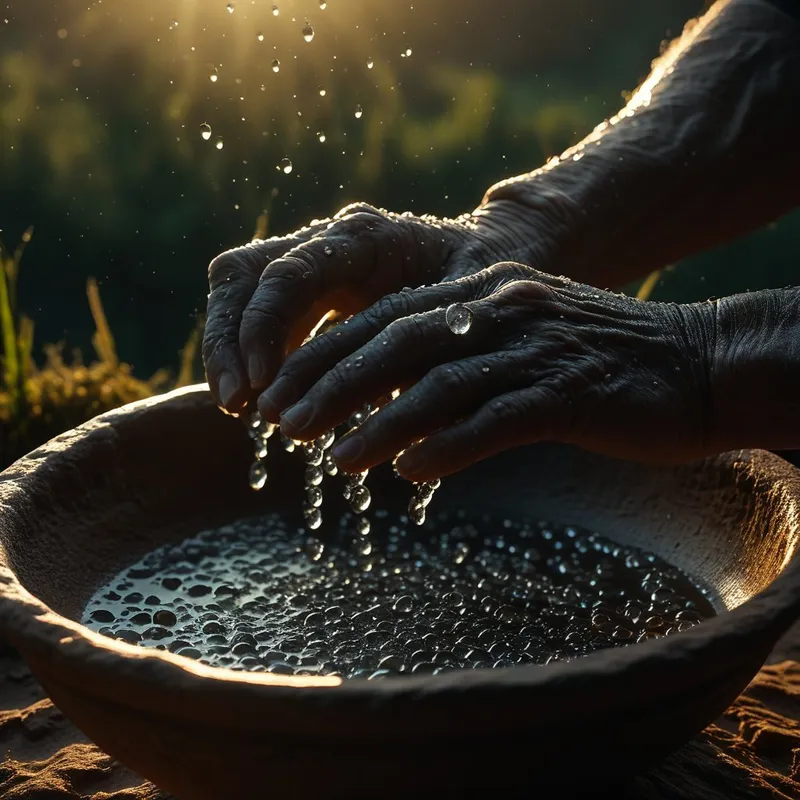
She journeyed to the highest peak, where the cloak of night is worn thin. There, she called not to the blazing sun, nor to the distant, cold moon, but to the space between them—to the quiet moment of their exchange. She stretched out her hands, palms open like lotus blossoms, and began to sing. Her song was not of power, but of plea; not of creation, but of reception. She sang of the earth’s thirst, of the soul’s dryness, of the silent cry for something that could bridge the eternal and the ephemeral.
The cosmos listened. The Nocturnal Spirit softened its dark mantle. The Zephyr held its breath. In that suspended silence, a miracle of condensation occurred. It was not rain, which falls with force and purpose. It was gentler. A million points of starlight, softened by the breath of the earth, gathered on every blade of grass, every leaf, every stone. They coalesced into droplets of liquid silver, each one holding a miniature reflection of the fading stars.
Aurora gathered this essence not in a golden cup, but in a vessel woven from twilight and spider-silk, a bowl that could hold contradiction. This was the Elixir. It did not blaze with light but shone with a soft, internal luminescence. To drink it was not to gain immortal flesh, but to feel the profound truth of the moment—the exquisite joy of existence and the piercing beauty of its end, intertwined like vines. It granted not escape from the cycle, but a deep, resonant harmony with it. The one who drank understood the language of growth and decay, seeing in the wilting rose the same sacred pattern as in the blooming one. The elixir was the consciousness of the threshold itself, the taste of the kiss between darkness and light.
Cultural Origins & Context
The myth of dew as a sacred, life-giving substance is perhaps one of humanity’s most widespread and fundamental narratives. It does not belong to a single culture but emerges polyphonically from agricultural, pastoral, and early mystical societies across continents—from the Vedic references to Soma sometimes linked to dawn dew, to Chinese alchemical traditions seeking the "drinkable jade" of morning condensation, to European folk beliefs in "May dew" for beauty and health, and to countless indigenous rites collecting dawn moisture for ritual purification.
This universality points to a shared somatic experience. Before irrigation, the appearance of dew on a parched landscape was a daily, silent salvation. It required no storm, no divine intervention of obvious drama—it was a gentle, almost secret gift. As such, its mythologization was often intimate, passed down not in grand epics but in household wisdom, folk songs, and the practical magic of healers and midwives. Its tellers were the elders who rose before dawn, the shepherds on the hillsides, the guardians of herbal lore. The myth functioned as an explanation for a daily mystery and as a ritual technology: by framing dew as elixir, its collection became a sacred act, aligning human effort with a cosmic benevolence that operated on a scale of delicate grace rather than overwhelming power.
Symbolic Architecture
At its core, the myth is a profound allegory for the birth of consciousness at the intersection of opposites. Dew is the child of the marriage between Sky (Heaven) and Earth. It is spirit made tangible, eternity condensed into a transient moment. It is not the pure, untouchable fire of the sun, nor the solid, inert clay of the ground. It is the third thing, the tertium non datur, born from their relationship.
The elixir is never found in pure light or pure darkness, but in the liminal tear where they weep for one another.
The figure of Aurora, the gatherer, represents the awakened human soul or the mediating principle—the ego that can stand at the dawn and consciously receive this gift. She does not create the dew; she attends to it. Her vessel, woven of twilight, symbolizes the psyche itself, which must be supple and receptive to hold paradoxical truths. The elixir’s effect—granting not immortality but profound understanding—reveals the myth’s deepest wisdom: the true prize is not escape from the human condition, but a radical, compassionate intimacy with it. The "magic" is in the perception, in tasting the eternal within the fleeting.

The Dreamer's Resonance
When this myth stirs in the modern unconscious, it often manifests in dreams of collecting: gathering pearls from grass, trying to hold moonlight in cupped hands, or finding rooms filled with beaded condensation that must be saved before it evaporates. The somatic feeling is one of urgent, delicate care mixed with poignant sadness. The dreamer is typically in a psychological state of aridity—emotional burnout, creative drought, spiritual numbness—yet is sensing the first hint of potential relief, not as a dramatic rescue, but as a subtle, inward condensation.
The process at work is the nascent formation of a new psychic attitude. The ego (the dreamer) is learning to be a vessel, not a fortress. The conflict is between the desire to possess the elixir (to bottle the insight, keep the feeling) and the nature of the elixir itself, which is impermanent. These dreams guide the individual toward valuing the process of receiving—the quiet predawn vigil of the soul—over the desperate clutching for a permanent cure. They mark the beginning of hydration from a source that is internal yet cosmic, suggesting the psyche is beginning to produce its own nourishing "dew" from the union of conscious and unconscious elements.

Alchemical Translation
For the modern individual on the path of individuation, the myth of the Dew as Elixir models the alchemical stage of Ablutio or Solution. It is not the fiery Nigredo, but the gentle, cooling dissolution that follows. The "base matter" of the psyche—our rigid identifications, our parched certainties—is not smashed, but is gently moistened and made pliable by a reconciling substance.
The struggle is to abandon the heroic quest for a grandiose, permanent transformation (the philosopher’s stone that grants immortality) and instead embrace the daily, humble practice of collecting the "dew." Psychologically, this means valuing small moments of insight, fleeting feelings of unity, brief glimpses of meaning that arise spontaneously from the union of our spiritual aspirations (heaven) and our embodied, earthly reality. It is the practice of mindfulness and active imagination—gathering the condensations of the unconscious as they appear on the surfaces of daily life.
The transmutation occurs in realizing that the vessel and the elixir are one; the self that attends with compassion becomes the nourishing substance.
The triumph is the development of a liminal consciousness. One learns to dwell not in day or night, but in the dawn, capable of holding the tension of opposites without rushing to resolution. The individual becomes like Aurora, a mediator within their own psyche, capable of receiving grace in its most subtle forms and understanding that the essence of life is found not in defying impermanence, but in drinking deeply of its bittersweet, sacred taste. The elixir is the integrated Self, tasted drop by precious drop.
Associated Symbols
Explore related symbols from the CaleaDream lexicon: