Demeter's Sickle Myth Meaning & Symbolism
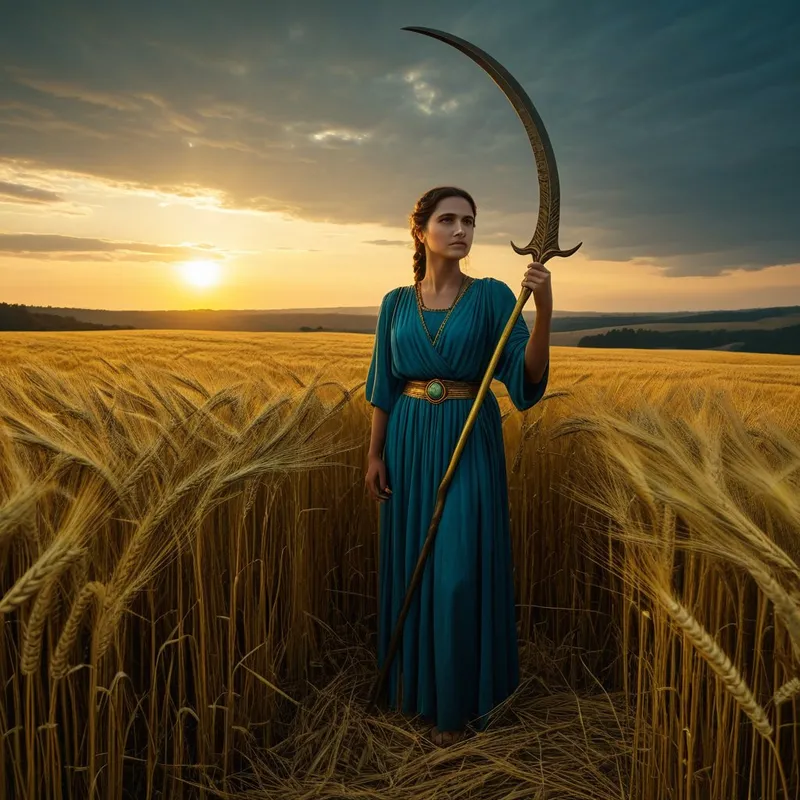
The sickle Demeter gave to her son Ploutos to sever the first stalk of grain, a primal act of harvest that binds life, death, and sacred nourishment.
The Tale of Demeter's Sickle
Hear now the story not of loss, but of the first cut—the cut that makes the feast possible. In the time before time was measured in seasons, the world was a garden of eternal, untamed abundance. Demeter walked the fields, her footsteps causing the wild grasses to swell with life. But it was a life without end, and therefore, without purpose. The green stalks grew tall, fell, and rotted where they lay, a continuous, unchanging blanket over the earth. There was no hunger, but there was also no bread.
Her heart, vast as the plains, held a love not just for the growing, but for the nourishing. She saw the mortals below, children of the clay, and her love for them was a quiet, persistent ache. They gathered berries and nuts, but their bellies were never full, their spirits never lifted by the sacred alchemy of grain. She took a mortal lover, the hero Iasion, in a thrice-plowed field—a union of goddess and mortal, of divine intention and human labor. From this sacred furrow, a son was born: Ploutos, Wealth.
But Ploutos was born blind. He could not see where the wealth of the earth lay. Demeter, the mother, wept. Her tears were not of sorrow alone, but of fierce determination. She would not give her son a world of passive, rotting green. She would give him, and all humanity, a tool.
From the heart of a fallen star, she forged a blade. Not a sword for war, but a crescent of bronze, curved like the new moon, honed to a whisper. This was her sickle. She took her blind son by the hand and led him into the whispering sea of grain. She placed the cool, heavy handle in his grasp and wrapped her own divine fingers over his.
“Now,” her voice was the rustle of a million stalks, “you must learn the sacred severance.”
She guided his hand, and the sickle sang its first song—a soft, decisive hush as it passed through the stem of a single, golden stalk of wheat. The stalk fell into the crook of his arm. In that moment, with the scent of cut sap rising like incense, Ploutos’s blindness was lifted. He saw not just the fallen stalk, but the cycle it represented: the life, the cut, the nourishment to come. He saw the wealth of the earth, made accessible by this deliberate, loving act of separation. Demeter had taught him, and through him, all of humanity, the first sacrament: to harvest is to transform the eternal into the sustaining.
Cultural Origins & Context
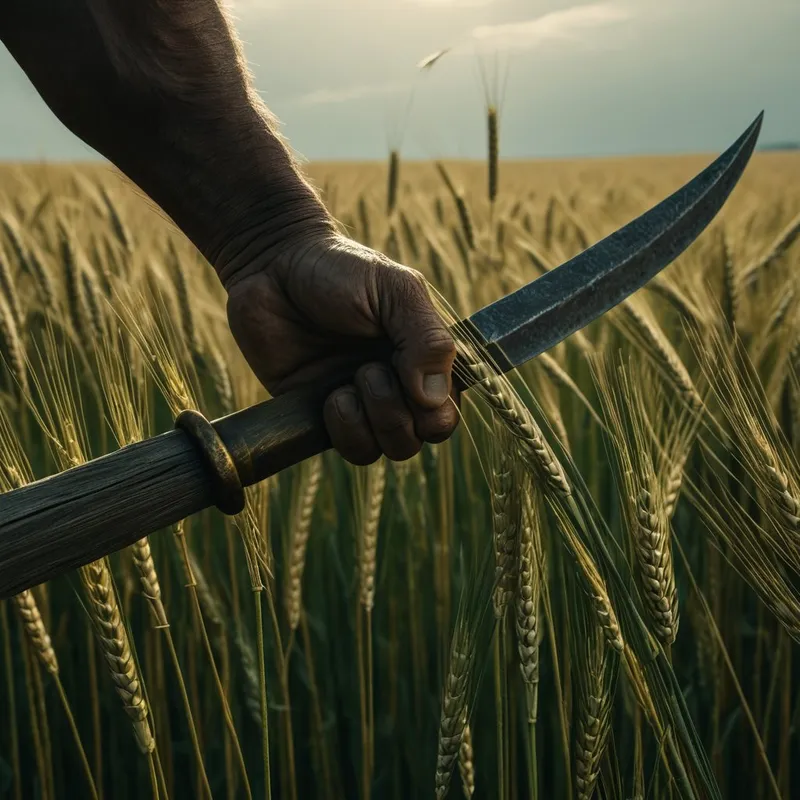
This myth, though less dramatized than the saga of Persephone, is woven into the very fabric of The Eleusinian Mysteries. It is a hieros logos—a sacred story—that underpinned the most profound spiritual experience available to an ancient Greek. The myth was likely recited or enacted during the initiations at Eleusis, where the central revelation was tied to grain, death, and rebirth.
Its societal function was foundational. It provided a divine etiology for agriculture itself, moving humanity from a state of foraging to one of cultivation. The sickle was not just a tool; it was a sacred technology gifted by the gods. The myth sanctified the act of harvesting, transforming it from a mere chore of survival into a religious duty, a participation in a divine order established by the Mother herself. It explained why wealth (Ploutos) comes from the earth and is accessed through labor guided by divine wisdom (Demeter). The storytellers here were the priests and priestesses of Demeter, guardians of the agrarian cycle and the mysteries of life concealed within death.
Symbolic Architecture
The sickle is the archetypal symbol of necessary severance. Its curved blade mirrors the crescent moon, a celestial body of cycles, and the cutting edge of conscious decision.
The first cut is an act of love so deep it must include death. Demeter does not withhold the blade to protect the stalk; she wields it to feed the world.
Demeter represents the Magna Mater in her aspect as the transformer, not just the nurturer. To only nurture is to let life stagnate in perpetual, undifferentiated growth. True nourishment requires the courage to cut, to separate the ripe from the root, to initiate an ending so a new process (threshing, milling, baking) can begin. Ploutos’s blindness signifies humanity’s initial ignorance of how to access the latent wealth (Ploutos) around them. His healing through the act of harvesting symbolizes the dawning of conscious participation in natural cycles—the moment instinct becomes ritual, and ritual becomes culture.
The stalk of wheat itself is a profound symbol: a life that must be cut down at its peak to become the staff of life (bread). It is a perfect metaphor for the sacrifice inherent in all creation and sustenance.
The Dreamer's Resonance
When this myth stirs in the modern unconscious, it rarely appears as a classical scene. Instead, one might dream of a overgrown, suffocating garden they feel compelled to prune, but are paralyzed by guilt at cutting a single stem. Or they may dream of a crucial, glowing connection—to a job, an identity, a relationship—that they know must be severed, and they search in vain for a tool sharp enough, or a hand steady enough, to do it.
The somatic experience is often a tightness in the hands and solar plexus—the will center. It is the feeling of holding a necessary power (the sickle) but being unable to swing it. This dream pattern signals a psychological process of discernment and sacrificial action. The dreamer is at a point of maturation where a state of prolonged, undifferentiated growth (a career plateau, a comfort zone, an old self-concept) has become stagnant and is now inhibiting further development. The psyche is presenting the image of the sickle, the tool of Demeter, indicating that the time for nurturing this particular growth is over; the time for a loving, deliberate cut has come, to make way for a new form of nourishment.
Alchemical Translation
In the alchemy of individuation, Demeter’s Sickle represents the opus of separatio. This is not a violent act of repression or rejection, but a conscious, guided differentiation.
Individuation is not merely about becoming whole; it is about becoming distinct. The sickle does not destroy the wheat; it liberates its essence for its higher purpose.
The modern individual swims in a sea of undifferentiated potentials, obligations, and identities. The initial, blind state of Ploutos is our own—we sense wealth (potential, purpose) but cannot see how to access it. The Demeter within—our own nurturing, deeper Self—must forge the tool of discernment. This is our conscious judgment, our values, our hard-won wisdom. The act of guiding our own hand to make the cut is the heart of the process. We must sever what is ripe from what merely persists. This could be cutting away a redundant habit to feed a new skill, ending a draining commitment to nourish a core relationship, or harvesting the lessons from a past experience and letting the empty husk fall away.
The healing of blindness that follows is the reward: a new clarity of vision. We see the cycle, not just the loss. We understand that this severance was not an end, but the vital first step in transmuting raw, growing life (our potential) into sustainable, soul-nourishing bread (our actualized purpose). We become, like Ploutos, stewards of our own inner wealth, learning that true abundance flows from the courage to enact loving, necessary endings.
Associated Symbols
Explore related symbols from the CaleaDream lexicon: