Demeter's Sanctuary Myth Meaning & Symbolism
A grieving goddess finds sanctuary in a mortal home, teaching that profound loss can be the crucible for sacred wisdom and cyclical renewal.
The Tale of Demeter's Sanctuary
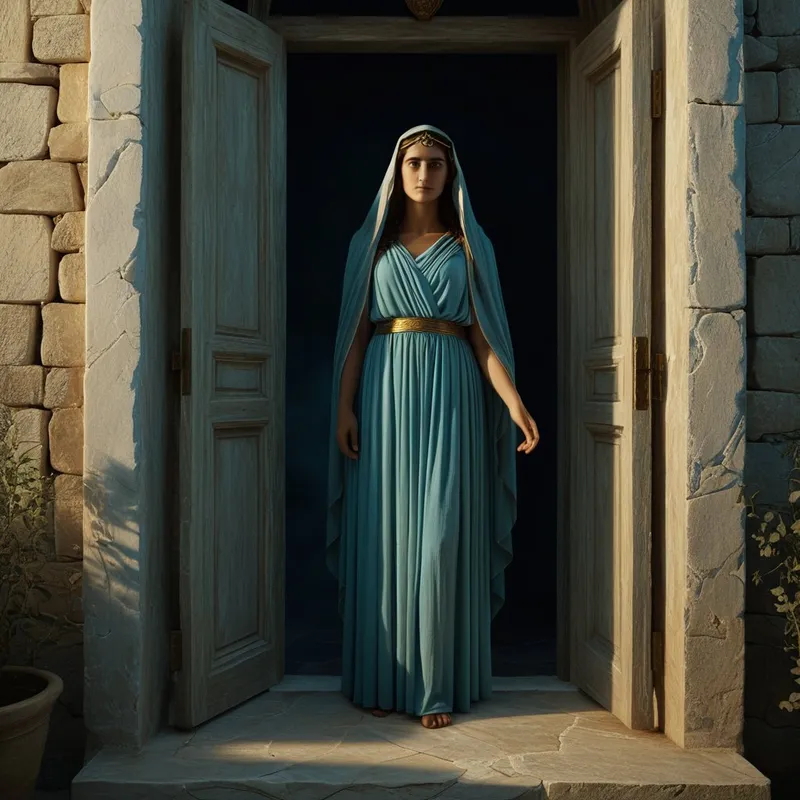
The world was a husk. The sky, once a vibrant dome, was now a sheet of beaten lead. The earth, which had sung with the green chorus of life, fell silent and hard as bone. This was the work of Demeter, the Mother of Grain. Her daughter, the radiant Persephone, had been torn from a sun-drenched meadow, stolen away to the sunless realms below by Hades. In her fathomless grief, Demeter cast off her divinity. She wrapped herself in the cloak of an old mortal woman, a wanderer with eyes like dry wells, and let her feet carry her where they would, which was nowhere and everywhere.
Her wandering brought her to Eleusis. Parched and weary to her immortal soul, she came to a well where the daughters of the king, Keleos, drew water. They did not see a goddess. They saw a grieving grandmother, her dignity clinging to her like tattered silk. With a kindness that was a balm on the raw wound of the cosmos, they offered her water and invited her to their father's house.
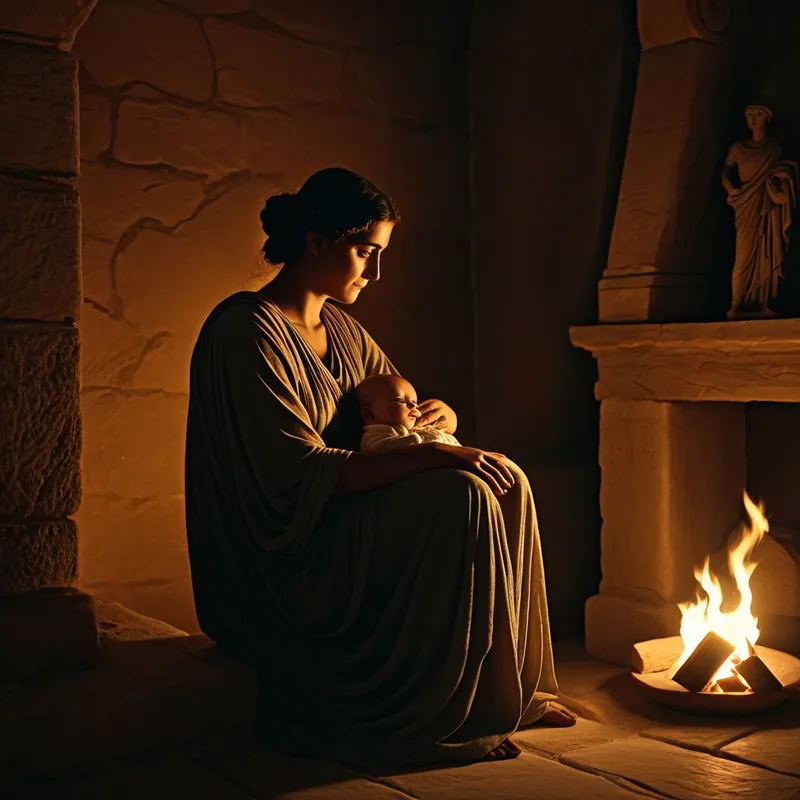
She crossed the threshold not as a deity to be worshipped, but as a broken soul to be sheltered. Queen Metaneira welcomed her, offering food and drink, which the goddess refused, for her fast was a monument to her loss. Yet, she accepted a seat by the hearth, the heart of the home. Seeing the queen's newborn son, Demophoön, a spark flickered in Demeter's void. She offered to nurse and nurture the child.
This was no ordinary nursing. Each night, in secret, Demeter would anoint the infant with ambrosia, the food of the gods, and place him in the very heart of the household fire, burning away his mortal coil to grant him immortality. In that humble hearth, the sanctuary of the home became an alchemical furnace. The goddess, in her profound isolation, began the slow, secret work of creation anew, transferring her thwarted maternal love onto this mortal child. The fire that warmed the house became a chrysalis.
But mortal sight is fragile. One night, Queen Metaneira witnessed the unthinkable: her child nestled in the flames. She screamed in terror, shattering the sacred rite. In that moment of interrupted magic, Demeter’s sorrow transformed into a terrible, unveiled majesty. She cast the child from the fire—now denied godhood but forever blessed—and revealed her true, awe-inspiring form. Light filled the room, and the scent of a thousand harvests overwhelmed the air.
Her voice was the rustle of a dying field and the promise of the first seed. She declared her identity and her grief. Yet, from the ashes of this failed apotheosis, a sacred compact was born. Because she had been offered sanctuary in pure hospitality—xenia—her wrath was tempered into instruction. She commanded the Eleusinians to build her a temple there, upon that very spot. And so they did. In that sanctuary born of shared grief and broken hospitality, Demeter would later teach the Eleusinian princes her most sacred rites, the Mysteries, before her daughter was partially restored to her. The sanctuary was not a palace, but a testament: that even a goddess, in her darkest hour, needed a hearth to sit by, and that the offering of such a hearth could alter the fate of the world.
Cultural Origins & Context
This episode is a pivotal fragment of the Homeric Hymn to Demeter, a poem composed likely in the 7th century BCE. Unlike the epic tales of heroes, this hymn was central to a living, breathing religious practice: the Eleusinian Mysteries. For nearly two thousand years, initiates from across the Greek world would pilgrimage to Eleusis to undergo secret rites that promised solace and a blessed afterlife.
The myth of Demeter's sanctuary was not merely a story told; it was the foundational charter for the Mysteries themselves. It explained why the most profound religious site for many Greeks was at Eleusis, of all places—not on lofty Olympus, but in a mortal king's home. It sacralized the principle of xenia, showing that the correct treatment of a stranger (who could be a god in disguise) was the bedrock of divine favor and cultural continuity. The story was performed, recited, and embedded in the ritual landscape, teaching that the divine touches the human world not only in grand theophanies but in moments of vulnerable, shared humanity.
Symbolic Architecture
At its core, the sanctuary myth is about the psychology of profound, world-stopping grief. Demeter’s wandering represents the dissociative state of deep loss, where the self is stripped of its identity and purpose. The earth’s barrenness is not a punishment, but an accurate external portrait of internal reality: when the core of one’s life is abducted, the inner world freezes.
The true sanctuary is not a place that keeps grief out, but a container strong enough to hold it while transformation occurs within.
The hearth of Keleos’s home symbolizes this container. It is the stable, warm center of human community and care. Demeter’s attempt to immortalize Demophoön in the fire is a desperate, beautiful act of psychic alchemy. It is the grieving soul’s attempt to transmute its overflowing,无处可去的 love into a new creation, to find something eternal in the face of devastating impermanence. The interruption by Metaneira is crucial. It represents the inevitable collision between the raw, transformative process of the unconscious (Demeter’s secret rite) and the conscious mind’s terror (Metaneira’s scream). Perfection—the granting of full immortality—is shattered, but a blessed, human wholeness remains.

The Dreamer's Resonance
When this mythic pattern stirs in the modern dreamer, it often manifests as dreams of finding unexpected refuge in a humble, familiar, yet profoundly different place—a childhood home that feels sacred, a stranger’s kitchen that offers immense peace. One may dream of tending a fire that contains something precious and vulnerable, or of a luminous, authoritative figure (often an older woman) appearing in a domestic setting, offering a silent, weighty gift.
Somatically, this can correlate with a feeling of deep exhaustion giving way to a grounded, hearth-like warmth in the chest or belly—a sign of the psyche beginning to accept nurture and create an inner sanctuary. The dream process signifies a movement from raw, wandering grief towards its containment. The psyche is seeking, or has found, the internal equivalent of Eleusis: a psychic structure sturdy enough to host the devastating "guest" of loss, so it can begin its slow, alchemical work instead of laying waste to the entire inner landscape.

Alchemical Translation
The individuation process modeled here is the alchemy of loss into wisdom. Demeter’s journey is the archetypal roadmap for transforming a catastrophic personal winter into the soil for new growth.
The first stage is the descent and the disguise: the conscious ego, identified with its role (Mother, Creator, Provider), is shattered. One must become the "wanderer," acknowledging the loss of the previous self. The second stage is the acceptance of sanctuary: this is the hard, humble work of therapy, community, or spiritual practice—allowing oneself to be nurtured, to sit by the hearth of basic human support without insisting on one’s former grandeur.
The fire that was meant to immortalize the child is the same fire that, when interrupted, forges the sacred temple. Our interrupted perfections become our most authentic sanctuaries.
The third, crucial stage is the interrupted immortalization. In our lives, this is the failure of the "magic bullet"—the fantasy that our grief can be perfectly transcended or that we can resurrect the lost relationship in a new, immortal form (in another person, a perfect career, a pristine ideology). Metaneira’s scream is the reality principle. The child is saved, but made mortal. The alchemical outcome is not a rejection of the mortal, human world, but its profound blessing. The final stage is the foundation of the temple: from the failed attempt to escape mortality comes the establishment of a permanent inner sacred space—a hard-won wisdom, a compassionate perspective, or a dedication to service that becomes one’s Eleusinian Mystery. The psyche learns that the sanctuary built from the ashes of loss is more durable and sacred than any palace built before the fall.
Associated Symbols
Explore related symbols from the CaleaDream lexicon: